
Georgia tax help for individuals and businesses
A personal return, a business filing and a tax notice need different kinds of help. Begin with the taxpayer, year and work still outstanding. Then separate the federal assignment from Georgia and any other-state responsibilities before choosing basic assistance, a preparer or a specialist.
| Your immediate task | Relevant section |
|---|---|
| Personal or family filing | Individual preparation: years, records and state connections |
| Business returns and owner information | Business preparation: classification, books and handoffs |
| A future personal or business decision | Planning: the change, assumptions and agreed analysis |
| A letter requiring attention | Notice help: the actual issuer, action and date |
Individual tax preparation
Give the preparer the years involved, where you lived and worked, and the income and household changes for each year. Include business-owner information and self-employment records where relevant. Separate a missing return from a correction to one already filed, and identify payments or corrected forms the preparer needs to reconcile.
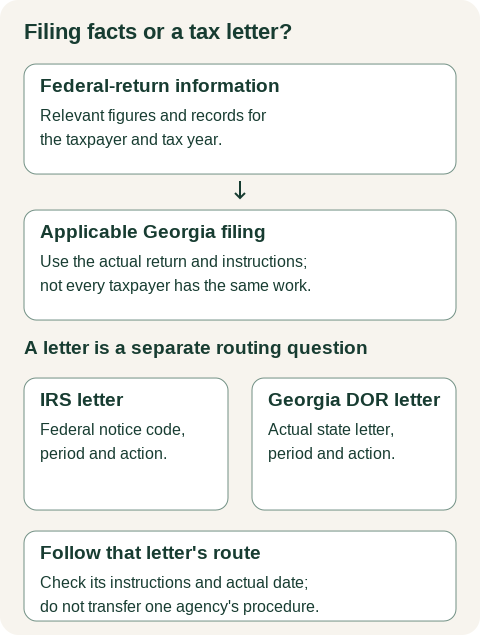
Georgia DOR's individual-filing guidance explains that federal-return information is needed to complete the Georgia return. Confirm that your quote covers the federal, Georgia and any other-state work that actually applies. A federal preparation price or Georgia address does not define that whole assignment. Use the forms and instructions for the relevant tax year rather than assuming the newest calendar year is the return you need.
The Department's tax-help page links to VITA/TCE and software options. Check current opening arrangements, eligibility, supported returns and any state-filing charges. A free federal option does not automatically include every state return or complex issue. The IRS's VITA/TCE guidance provides the national program and locator information; individual sites have their own supported work and arrangements.
For paid preparation, confirm the person's experience with your returns, how review happens and what support remains after filing. Agree who submits each return, checks acceptance or rejection, resolves corrections and supplies copies and payment instructions. The personal preparation guide provides the general completion process.
Business tax preparation
List the business entities, actual tax classifications, owners, reporting periods and connections with Georgia or other states. Give the professional prior returns and relevant elections. A legal name or LLC label alone does not identify every return or account the engagement should cover.
Georgia DOR's forms index separates individual, corporate, sales/use and withholding categories. Those categories are not a checklist of obligations for every business. Have the professional identify the actual taxpayer and applicable forms, with the right year's instructions.
For partnerships, DOR describes Form 700 filing conditions involving a required federal Form 1065 and specified Georgia property, business, income or domiciled-member connections. It also distinguishes an information return from an election to pay tax at entity level. An LLC treated as a partnership for federal income-tax purposes can fall within that guidance; the actual classification and facts matter.
Before preparation begins, assign books and cleanup, missing documents, the preparer and reviewer, and the information sent to each owner or personal preparer. Keep separate taxpayer payment records. Confirm who authorizes and submits each return, checks its filing status and closes any rejected or incomplete item. The business preparation guide develops the general workflow; the Atlanta guide includes the distinct entity-and-owner payment questions that can arise in planning.
Personal planning and business decisions
For a household, explain the decision ahead: retirement, a change in work, several income sources or another event that needs a projection. Ask what assumptions and years the comparison uses and who reviews it when the facts change. The retirement planning guide gives a framework for comparing tax and cash outcomes without prescribing a particular account decision.
Business planning may instead involve ownership, compensation, a transaction or an entity election. Describe that work separately from annual preparation. The Georgia location guides below develop specific business decisions; their scope does not imply every household needs a larger owner-planning engagement.
IRS and Georgia notice help
Identify the actual agency, taxpayer, tax period, letter heading or reference, requested action and response date. Keep the complete letter with the relevant return, payment and filing evidence. A return-preparation assignment does not automatically include representation or the work needed for every later notice.
For an IRS letter, use the federal notice guide. For Georgia DOR correspondence, the Department's Did you get a letter? page routes readers by the actual letter, including return changes, verification and assessments. Follow the applicable letter's instructions and date; a federal CP-code response method is not a substitute for a Georgia procedure.
Georgia Tax Clinic describes nonprofit assistance with IRS and state tax problems for low-income people and families, with its own service scope and acceptance process. Check eligibility and whether it handles the actual problem. Dispute representation and basic return preparation are different services; neither a program description nor a professional credential confirms acceptance of your case.
Choose a Georgia location guide
Use these guides to describe the professional work your business needs and compare the scope offered by tax advisers. Each guide develops a particular owner decision, records question or engagement choice.
- Choose business tax help in Albany when company records are questioned
- Compare business tax planning for your Alpharetta company
- Tax preparation and business planning in Atlanta
- Business tax planning for Brookhaven practice owners
- Choose business tax planning for your Brunswick property interests
- Choose Cartersville tax help for an employer retirement plan
- Business tax help for a Cumming accounting-system change
- Choose business tax planning and accounting help in Dalton
- Choose rental-record tax help as a Decatur business owner
- Choose Duluth tax help around an employer retirement-plan audit
- Choose business tax help for vendor reporting in Dunwoody
- Choose business tax planning for your Gainesville inventory decisions
- Business tax planning in LaGrange when a trust is involved
- Define outsourced payroll tax help in Lawrenceville
- Business tax planning when your Marietta company adds people
- Choose McDonough tax help before arranging film-credit placement
- Tax help before an IRA conversion for Milton business owners
- Choose Moultrie farm accounting help by what the crop margin covers
- Choose client-fund accounting and tax help in Norcross
- Business tax help in Peachtree City when overseas accounts are involved
- Compare conservation-easement tax help as a Rome business owner
- Business tax planning before ownership changes in Roswell
- Business tax help for unpaid customer invoices in Sandy Springs
- Business tax planning for Savannah owners with port-linked operations
- Choose Smyrna business tax help around the earnings being tested
- Choose Statesboro business tax help around a bankruptcy operating report
- Separate valuation and acquisition tax work in Sugar Hill
- Choose Suwanee business tax help when an IRS notice arrives
- Choose timber-related business tax help in Thomasville
- Compare business tax planning for your Valdosta construction company
- Choose business tax help for a Warner Robins government contractor
A location guide does not establish an available local firm, a nearby office or a provider's participation in FSI. Confirm professional experience, credentials, accepted work and current capacity directly.
Set out the work and records
Describe your ownership role, business entities, relevant places and the decision or uncertainty you want assessed. Include the timetable and explain which professionals already handle parts of the work. Start with a concise overview and use an agreed secure process for detailed financial records.
Compare the proposed engagement
The tax planning and preparation guide explains the broader distinction between these assignments. The business tax planning fees guide helps you compare deliverables, exclusions and implementation responsibilities.
Sources and scope
The linked official filing and letter guidance and the clinic service description were checked November 3, 2026. Use the actual tax-year instructions and current program or case-acceptance conditions. The location library describes its stated professional-selection tasks.