
Tax preparation in Milton for individuals and businesses
Tax preparation in Milton can serve an ordinary personal return, an operating business or reporting that follows a retirement transaction. Choose the filing job first. A conversion analysis may be relevant to a particular account decision, but a household does not need to buy that service to obtain preparation. The detailed IRA case later in this guide remains conditional on the actual transaction and taxpayer.
Individual tax preparation
Describe the year, household, residence and work locations, income and changes from the previous return. For example, a Milton employee with wages and investment statements should ask for the personal federal and Georgia work those facts require. Someone who also completed an IRA transaction should disclose it before the quote and identify the available account and prior-return records.
Bring income statements, the prior return, payment history and relevant change documents. Ask whether a proposed engagement accepts technical review of older IRA basis records or prepares the return from conclusions supplied by another professional. Do not assume the institution processing an account transaction has completed your tax return. Georgia DOR says to complete the federal return before the Georgia individual return.
For basic help, consult the IRS VITA/TCE information and locator, then verify the site's eligibility, supported return, season, intake and access. There is no single VITA program-wide income ceiling. A specific site's scope may not cover your retirement issue, and no Milton appointment is confirmed here. Georgia's tax-help resources include software routing; check federal and state costs and supported facts separately.
Ask who prepares and reviews your return, which years and jurisdictions are included and how extra analysis, earlier returns or amendments are priced. Review the completed return before authorization. Agree who confirms acceptance or resolves rejection, who sends payment instructions and who pays. Keep complete copies and filing/payment confirmations, and clarify later correction and notice support. See the personal preparation guide for the wider process.
Business tax preparation
List the company's legal entities, ownership, tax classifications, periods and jurisdictions. Request the exact business returns and owner-information handoff, with separately accepted personal preparation where needed. Provide reconciled accounts, prior returns and relevant payroll, asset and payment records. Ask who handles cleanup and unsupported entries before relying on a preparation price.
If a business-linked SEP or SIMPLE arrangement is involved, identify it and ask who supplies the relevant contribution and account records to the personal specialist. Do not assume a company-return engagement includes a complete individual conversion analysis, or that every retirement contribution has the same character. The original case below explains the evidence questions without prescribing a transaction.
| Filing stage | Agree the responsible person and output |
|---|---|
| Record readiness | Cleanup, missing company documents and unresolved entries |
| Preparation and review | Included entity returns, years, states, preparer and reviewer |
| Personal handoff | Final owner information and relevant retirement records sent to the appropriate preparer |
| Approval and filing | Completed return review, authorization and acceptance/rejection follow-up |
| Payment and records | Payment instructions, payer responsibility, confirmations and complete copies |
| Additional help | Separately accepted conversion review, payroll, projections, amendments and notices |
The business preparation guide helps compare that scope. Return preparation, a tax projection and instructions to an account custodian are separate work.
Compare tax preparation with financial-planning coordination
The October 31, 2026 captures show Franciscan Financial describing business and personal preparation, including federal, state and local returns, with a Milton address. Weller Consulting's tax page describes personal and business preparation and planning; confirm the actual meeting arrangement and included return types.
Westhollow Wealth Management explicitly says it does not prepare tax returns and is a financial-planning and investment-management firm. Its conversion and projection discussion is useful for understanding coordination with a separate preparer, not as a third return-preparation offer. The full original comparison below retains that disclosure.
Confirm current capacity, fees, credentials and responsibilities directly; these descriptions do not establish available FSI partners or a conversion outcome. Follow the IRS preparer-choice guidance, review the actual engagement and request secure exchange for returns and account information.
Planning beyond the return
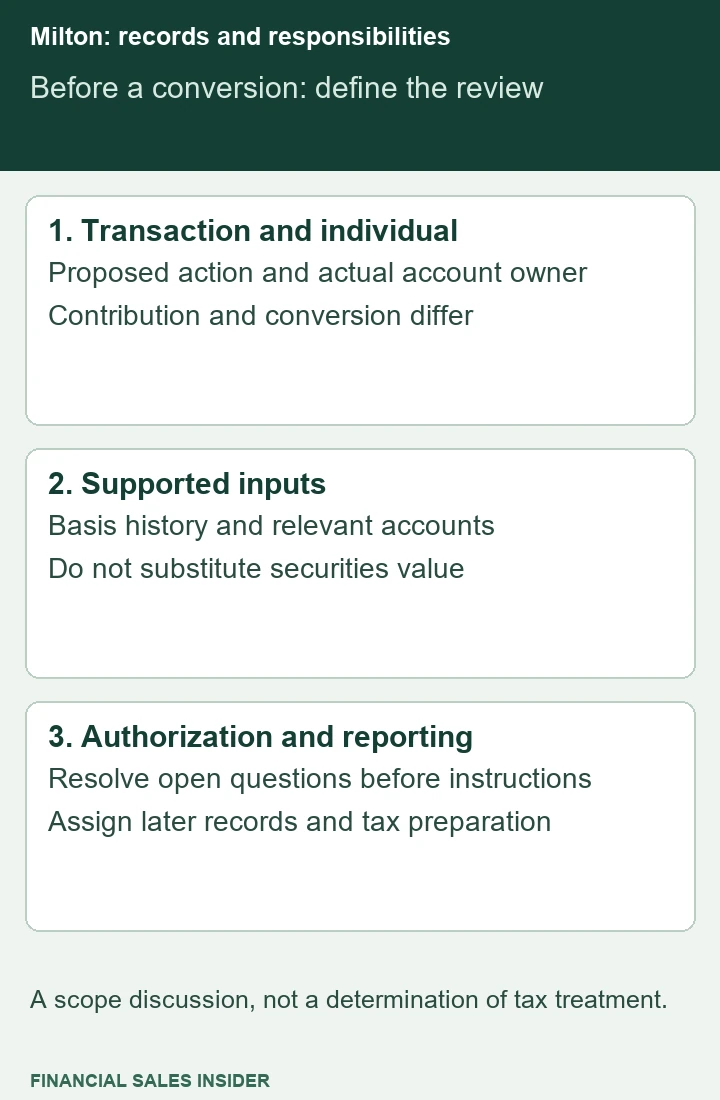
A scope discussion, not a determination of tax treatment.
Before authorizing a traditional IRA to Roth IRA conversion, ask who will establish the tax inputs behind the decision. A current account balance does not show the full history of nondeductible contributions, earlier distributions and other adjustments. The professional also needs to identify which of your accounts belong in the assessment.
This guide helps Milton owners commission a tax review; it does not recommend making a conversion.
Define the proposed transaction before giving instructions
Tell the prospective practitioner which individual owns the IRA, what account is involved and what you are considering. Explain whether you want an assessment of a possible conversion or help reviewing a transaction already completed. Those are different starting facts.
Keep the request specific. A traditional IRA conversion, an annual IRA contribution and a transfer involving a workplace retirement plan should not be treated as interchangeable descriptions. Identify any inherited account or employer-plan question separately for professional assessment.
The IRS lists conversions from traditional, SEP and SIMPLE IRAs to Roth IRAs among Form 8606's reporting uses, alongside nondeductible traditional IRA contributions. [1] That overview is a reason to define the actual transaction and reporting assignment, rather than assume an investment account instruction completes the tax work.
Ask for the supported IRA tax-basis history
The 2025 Form 8606 instructions define traditional IRA basis using nondeductible contributions and nontaxable rollover amounts, reduced by nontaxable distributions and adjusted where necessary. [2] It is a tax history, not simply the current market value or the investment cost basis shown for securities.
Provide earlier Forms 8606 and relevant returns, contribution records, rollover information and distribution records. Ask the practitioner which records support the starting basis and what remains missing. A remembered contribution or a recent statement may be useful evidence without establishing the complete carryforward.
For example, an owner may remember making nondeductible contributions years ago but also have taken distributions since then. Ask the reviewer to establish what basis remains, with the relevant adjustments explained. Do not assume the original contribution total is still the available tax basis.
The instructions also distinguish personal nondeductible contributions from employer contributions under SEP or SIMPLE arrangements. [2] If an account connects with your business, identify the arrangement and contribution history. Do not label every contribution after-tax merely because the account belongs to you.
Request a supported basis explanation or a clear account of the unresolved evidence before relying on a proposed taxable conversion amount. Have the practitioner confirm the rules and source edition applicable to the actual year. The final instructions inspected here are for 2025, not final 2026 filing instructions.
Check which accounts enter the review
Give the reviewer a list of your relevant retirement accounts and where they are held. Include accounts outside the institution that would process the conversion. Identify ownership, account type and any connection with a business SEP or SIMPLE arrangement rather than assuming one custodian's screen supplies the entire tax picture.
Ask the professional to identify the account population and values the applicable assessment requires. The 2025 instructions address traditional IRA values and adjustments as well as basis history. [2] This is not a direction to combine every retirement account or every family member's balances.
Flag your spouse's accounts, inherited accounts and workplace plans separately. Ask which facts need different treatment and which additional information is necessary. The useful output identifies the individual and accounts actually assessed, rather than leaving an unexplained total in a projection.
Compare actual Milton tax and advisory engagements
These public descriptions were checked on October 31, 2026. They illustrate services to clarify, not rankings, verified credentials, available FSI partners or confirmation that a provider will accept the assignment.
Westhollow Wealth Management's Milton tax-strategy page expressly discusses Roth conversion analysis, multiyear projections and working with a CPA. Its FAQ says it is a financial planning and investment management firm, not a CPA firm, and does not prepare tax returns. Its footer names WHWM, LLC doing business as Westhollow Wealth Management. [3]
If considering that arrangement, ask how the tax practitioner establishes the supported basis and relevant accounts before any conversion is authorized. A separate return-preparation role does not mean the adviser cannot coordinate useful analysis; clarify who accepts each part.
Franciscan Financial describes business and personal tax planning and preparation, including guidance on retirement savings and withdrawals. It publishes a Milton address. [4] Ask whether its proposed tax engagement includes the basis-history and conversion assessment you need. A broad retirement service description does not define every included review.
Weller Consulting's tax page describes business and personal planning and preparation, with an Alpharetta/Milton location published at its Milton address. [5] If you already have a combined tax relationship, establish whether the practitioner will assess this individual transaction and what evidence is required. Do not infer either specialist experience or unavailable work from a service menu.
Set the tax review before conversion authorization
The IRS distinguishes recharacterizing a regular annual IRA contribution from a conversion. Its guidance says a conversion made in 2018 or later cannot be recharacterized as a contribution to a traditional IRA. [2][6] Do not postpone the assessment on the assumption that those transactions can be treated the same way afterward.
Ask for the proposed transaction, supported inputs, unresolved questions and tax assessment before giving instructions. This boundary does not determine whether a particular processing error can be corrected or what remedy applies to an earlier transaction.
Agree who receives the eventual transaction records and performs the accepted reporting work. Then compare fees for the defined tax review. Confirm investment-advisory and custody charges separately; a tax-review quote does not establish all costs or a favorable conversion result.
Questions before commissioning the review
Does one IRA statement settle the taxable conversion amount?
No automatic conclusion follows. Ask the practitioner to establish the supported tax-basis history and relevant account population for the actual individual and year. Current balances and securities cost basis do not replace that assessment. [2]
Can a conversion be treated like recharacterizing an annual contribution?
The IRS distinguishes them and says conversions made in 2018 or later cannot be recharacterized. Have the actual proposed transaction reviewed before authorization. That rule does not establish that every possible account error is uncorrectable. [2][6]
Define the records and professional roles
Describe your business ownership, proposed IRA transaction and existing advisers. Request secure instructions before sharing returns or account records. Professional fit, availability and engagement terms require confirmation.
Sources and scope
[1] IRS, About Form 8606. [2] IRS, Instructions for Form 8606 (2025), definitions, basis and account context, and recharacterizations. [3] Westhollow Wealth Management, tax strategy. [4] Franciscan Financial, business and personal taxes. [5] Weller Consulting, tax services. [6] IRS, IRA frequently asked questions, a general overview rather than legal authority. Sources checked October 31, 2026. Provider descriptions are attributed observations. This guide does not determine conversion eligibility, taxable amounts, investment suitability, filing requirements or an individual tax result.
Preparation-choice sources: IRS Topic 254, IRS VITA/TCE, Georgia DOR tax help and Georgia individual filing, checked November 3, 2026 for the preparation and routing points above. Earlier specialist source dates and limitations remain as stated. Provider pages are attributed descriptions, not current rankings, verified credentials, available appointments or an FSI relationship.