
Tax preparation in Sandy Springs for individuals and businesses
A Sandy Springs household can choose personal preparation without needing the business-receivable analysis later in this guide. For a company, preparation may depend on resolving uncertain records first. Begin with the returns and years you need, then separate ordinary filing from a specific investigation or planning assignment.
Individual tax preparation
Collect the prior return, income forms and information about household, residence and work changes. Explain self-employment, rentals, investments or retirement income where relevant. Ask which federal, Georgia and other-state returns the fee includes, whether earlier years or amendments cost extra, and who follows up on missing or corrected forms.
A person with wages or pension income does not need to commission a customer-invoice review. An owner may instead need final company information before the individual return can be completed. Establish who supplies it, what is still provisional and how corrected figures will reach the personal preparer.
Use the Georgia individual filing route for the state process and applicable-year instructions. Georgia DOR explains that federal-return information is needed for the Georgia return. The personal preparation guide covers records, review and completion in greater depth.
Official basic options and private help
The IRS VITA/TCE guidance provides basic-help and locator information. Georgia DOR's help page also routes to assistance and software. Check the actual operator's eligibility, supported years and returns, season, meeting arrangements and any federal or state charge. A program description does not confirm a Sandy Springs appointment or support for separate company returns.
For paid work, confirm who prepares and signs the return, the relevant credentials and how to contact the firm after filing. IRS Topic 254 explains PTIN/signing, review and copy requirements. Do not sign a blank return or compare professionals by a promised refund alone.
Business tax preparation
Identify the entity classifications, owners, tax years, operating places and actual returns under consideration. Provide prior returns and elections, reconciled books and supporting records. Explain unresolved receivables or account adjustments before a preparer assumes the figures are ready.
For the customer-debt case below, ask whether the engagement includes assessing income inclusion and collection evidence, making an agreed accounting adjustment, preparing the return or all three. A book write-off and an invoice-aging total do not establish the tax conclusion. Keep disputed and supported figures identifiable and name the person resolving them.
The filing proposal should separately list company and owner returns, cleanup and other reports. Name the preparer and reviewer and the person sending final owner information. Agree client review/authorization, submission, acceptance or rejection checks, payment responsibility and copies. Confirm who handles corrected figures, later customer recoveries and notices within the accepted scope. The business preparation guide explains the general completion chain.
Request secure instructions before sharing customer records.
Compare the actual filing and advisory scope
Massey and Company, observed November 3, 2026, advertises substantial individual and business preparation, planning and representation from an Atlanta-based practice. The October 31 HDWK service capture separately describes individual and business federal/state preparation, projections and management advice. Its affiliated wealth service is a different stated arrangement.
The dated Siegel & Siegel page lists individual and business preparation, planning and bookkeeping; its history refers to Sandy Springs while its contact address uses Atlanta. Confirm the actual office or remote process rather than infer it from a search or mailing label.
These descriptions already include meaningful tax services. The comparison is which returns, receivable assessment and follow-up each candidate actually accepts, not a claim that other firms lack planning. They are not rankings, independently verified credentials, available appointments or FSI partner listings.
Planning beyond the return
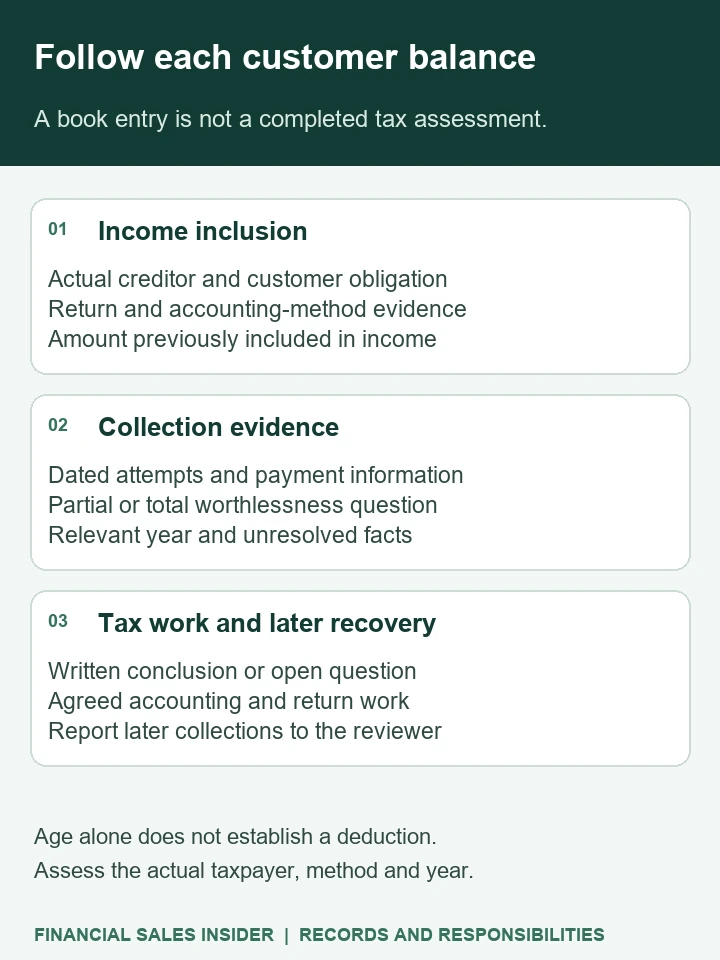
Age alone does not establish a deduction. Assess the actual taxpayer, method and year.
An overdue customer invoice creates a collection problem. Whether it also supports a tax deduction is a separate question. Before asking a Sandy Springs tax professional to write off receivables, define the assessment you need: whose debt it is, whether the amount entered taxable income, what the collection evidence shows and which tax year needs review.
Start with the customer debt you want assessed
Choose the receivables causing concern and identify the business owed the money. Provide the customer agreement, invoices, payments received, credits or adjustments and current balance. Explain any dispute over the work, price or obligation to pay. An aging report shows how long an amount has remained open; it does not settle all those facts.
Keep the assignment about customer credit sales. Money you personally advanced to your company, an intercompany loan or a personal guarantee can raise different questions. Tell the practitioner if those items appear in the same accounts, rather than assume every debit balance receives the same treatment.
Request a separate conclusion for each material receivable: the evidence examined, tax question, relevant year and facts still missing. A single proposed total for bad debts should not conceal which customer amounts support it.
Trace tax-income inclusion before assuming a deduction
The IRS explains that a bad-debt deduction generally requires an amount previously included in income or cash that was loaned out. For cash-method taxpayers, unpaid fees and similar amounts generally cannot support a deduction if they were never included in income. [1] This customer-invoice discussion does not assess a separate cash loan.
Ask the practitioner to connect each receivable with the business's actual tax treatment. Which amount was included in gross income in the current or an earlier tax year? What accounting and return evidence supports that answer? The amount on an invoice or management report may not answer the tax question.
For example, two businesses might each show an unpaid customer invoice in their accounts. One may have included the revenue in taxable income; the other may not have done so. Ask the reviewer to establish the actual position before proposing a deduction. Neither an accrual label nor the invoice amount alone proves the result.
Publication 334's 2025 guidance for individuals using Schedule C expressly distinguishes cash and accrual treatment of uncollectible receivables. [2] Use that distinction to frame the evidence request. Have the professional confirm the rules applying to your taxpayer, accounting method and year.
Ask what establishes worthlessness and the relevant year
The IRS describes worthlessness in terms of facts and circumstances showing no reasonable expectation of repayment, with reasonable steps taken to collect. It says court action is unnecessary if a judgment would be uncollectible. [1] A long overdue balance therefore calls for assessment rather than an automatic age-based write-off.
Supply dated collection correspondence, payment arrangements, settlement discussions and information about the customer's ability to pay. Ask which evidence matters and what remains uncertain. Explain payments or new information received after the initial review.
The practitioner should distinguish a partly uncollectible debt from one considered wholly worthless and explain the applicable timing and accounting requirements. Publication 334 discusses different charge-off treatment for partial and total worthlessness within its stated scope. [2] Do not turn a general year-end message into a universal December 31 deadline or assume a journal entry alone establishes a deduction.
Compare the work behind the local service descriptions
The following public descriptions were checked on October 31, 2026. They illustrate work to clarify, rather than ranked recommendations, verified credentials, FSI partners or confirmed availability.
CS CPAs' Sandy Springs page links to a detailed Metro Atlanta bad-debt article and an appointment offer. The full article already discusses accounting method, tax basis, collection records, partial and total worthlessness, and later recoveries. [3][4] Ask whether the proposed engagement will assess your specific customer receivables and explain any unresolved facts. Its published office is in Alpharetta; the city page markets regional services.
HDWK's services page describes business returns and tax planning, individual projections and estimated payments, and management advice. It publishes a Sandy Springs office. [5] If you already use a broad tax relationship, ask whether this receivable assessment is included. Its separate wealth-management disclosure names affiliated HC Advisors; do not assume that service performs the business tax review.
Siegel & Siegel lists business tax planning, preparation and bookkeeping. Its history refers to Sandy Springs, while its contact address uses Atlanta. [6] When accounts and returns are handled together, clarify who checks the income-inclusion and collection evidence before a book adjustment reaches the tax work. A combined service list does not itself define that assessment.
Separate the tax conclusion from the accounting entry
Ask for an explanation you can follow from the customer balance to the proposed tax treatment. It should identify the taxpayer and year, supporting evidence, conclusion or open question, and any further review needed. Confirm which accounting adjustments and return work are included after that assessment.
Also agree how a later customer payment or settlement reaches the responsible tax practitioner. Publication 334 discusses recoveries and related tax-benefit qualifications. [2] Have the practitioner assess the actual earlier treatment and later collection rather than assume a recovery is always taxable or always tax-free.
Once the assignment is defined, compare fees for the defined receivable review. Establish whether the quote covers the assessment, accounting work, return work or separate stages.
Questions before commissioning receivable tax work
Does an old unpaid invoice automatically create a deductible bad debt?
No conclusion follows from age alone. Ask the practitioner to establish the actual obligation, tax-income inclusion, collection facts and relevant year. An open item in the accounts is the starting evidence, not a completed tax assessment. [1]
Is a book write-off enough to complete the tax work?
Ask for the separate tax conclusion and agreed reporting work. The applicable method, partial or total worthlessness, year and supporting facts still matter. Confirm what the professional has accepted responsibility for before treating the entry as a finished engagement. [1][2]
Sources and scope
[1] IRS, Topic 453, Bad debt deduction. [2] IRS, Publication 334 (2025), Tax Guide for Small Business, complete Bad Debts subsection in chapter 8, for individuals using Schedule C. [3] CS CPAs, Sandy Springs services. [4] CS CPAs, Metro Atlanta bad-debt article, published October 15, 2026. [5] HDWK, services. [6] Siegel & Siegel, service overview. Sources checked October 31, 2026. Provider statements are attributed public descriptions. This guide does not determine a deduction, accounting method, filing procedure, refund right or individual tax result.
Preparation-choice sources: IRS Topic 254, IRS VITA/TCE, Georgia DOR tax help and Georgia individual filing, checked November 3, 2026 for the narrow preparation and routing points above. Earlier specialist source dates and limitations remain as stated. Public provider descriptions do not establish current capacity, credentials or an FSI relationship.