
Tax preparation in Marietta for individuals and businesses
Compare Marietta tax preparation using the return you need completed and the work behind the quote. A household with wages or retirement income needs a different scope from a company adding employees. The staffing and city-license analysis later in this guide is optional business work, not an eligibility condition for personal help.
Individual tax preparation
Prepare your prior return, current income documents and a summary of household, residence and work changes for the year. Identify self-employment, rental or investment records before comparing fees. Ask whether the quote includes the applicable federal, Georgia and other-state returns, any missing-year filing and corrections to a return already submitted.
For an owner whose company is hiring, the personal preparer may need final company information, payroll documents and records of owner payments. Confirm who supplies those records and how revised figures are communicated. A hiring forecast is not a completed household return, and a household filing fee does not automatically include business planning.
Georgia DOR explains the federal information used to complete Georgia filing. Confirm the right instructions for your year and residence circumstances. The personal preparation guide provides the general record, review and completion process.
Choose basic assistance or paid help for the actual return
Use Georgia DOR's assistance and software routes and the IRS VITA/TCE information to check basic-help options. Verify the current season, eligible taxpayer, supported return and tax year with the actual site or software operator. Check federal and state charges separately. A directory or program page does not establish an available Marietta appointment.
When paying a preparer, ask about the named professional, review, signing/PTIN and support after filing. IRS Topic 254 explains the relevant checks and warns against promises of a larger refund. Optional refund-related financial products are separate from deciding who should prepare your return.
Business tax preparation
List the company entities, actual tax classifications, owners, years and jurisdictions. Give the preparer prior returns and elections, reconciled books, payroll reports and asset records relevant to the accepted work. Explain whether new workers, changed locations or incomplete records need investigation before the figures can be used.
Ask which company and owner returns the engagement accepts. Identify bookkeeping cleanup, worker-classification review, payroll reporting and city-license work as included or separate assignments. A tax-preparation package should not leave each provider assuming someone else has checked the staffing inputs or local fee records.
Name the person who prepares and reviews each return and the person who delivers final company information to the owner preparer. Agree client review and authorization, submission, acceptance/rejection checks, payment responsibility and delivery of copies. Also identify who handles later corrections or notices and what costs extra. The business preparation guide provides a fuller company/owner handoff framework.
Read Marietta preparation and planning descriptions separately
ATC's Marietta location page advertises federal and state preparation alongside optional refund-related products. Leonard G. Nelms' preparation page separately describes personal and business returns, including businesses with multiple-state operations. Both were observed November 3, 2026; neither public description fixes your price, supported work or current availability.
The previously inspected Manay planning page describes quarterly reviews for active businesses and investment activity, with Marietta headquarters and remote delivery. That October 30 observation concerns a wider planning offer, not a newly ranked preparation result. Compare its accepted ongoing work with an annual filing proposal. Do not adopt vendor savings, tax calculations or quality claims as facts about your outcome.
These are educational service comparisons, not rankings, endorsements, verified credentials or an operating FSI provider list. Ask each candidate to price the same returns, years and record condition.
Planning beyond the return
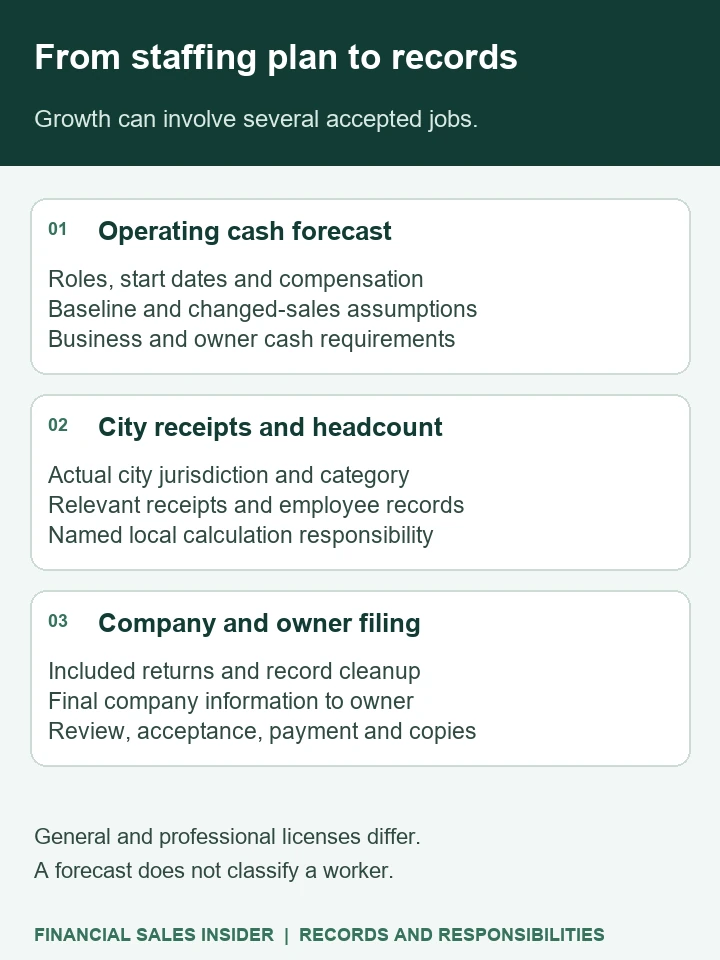
General and professional licenses differ. A forecast does not classify a worker.
Adding people changes the cash your company needs before it changes the amount you can take home. A useful Marietta business tax-planning engagement should examine that staffing decision, update the business and owner forecasts, and identify the local reporting work that growth brings into scope.
Start with the staffing decision and the cash it requires
Give the prospective adviser a short operating plan. State which roles you expect to add, the intended start dates, the compensation budget and the revenue assumptions behind the decision. Explain whether the new people will support existing work or depend on contracts you have not yet secured.
Include the costs you already know and identify estimates that need checking. Wages, benefits, recruitment, payroll-provider charges, equipment and space may enter the decision in different ways. Ask the professional which costs need further analysis and which assumptions are too uncertain for a reliable forecast.
Request a comparison between the business's current course and the proposed staffing plan. It should show the cash committed, the timing of that commitment and the effect on projected business results. A statement that spending reduces tax does not tell you whether the business can comfortably fund the expenditure.
If a proposal compares employees with contractors, ask who assesses the appropriate classification before relying on the comparison. Do not treat the label used in a spreadsheet as a completed classification review. This guide does not determine the status of any worker.
Make the Marietta receipts-and-headcount check explicit
For general business licenses, the City of Marietta says license fees are based on annual gross receipts or the number of employees, whichever is greater. [1] A growing business therefore needs to ask about the employee measure as well as its revenue information. A revenue-only assumption does not explain the city's published basis.
Confirm that the actual business location and activity fall within the city requirements before using this information. A Marietta mailing address should prompt a jurisdiction check, rather than substitute for it. Do not apply the city description automatically to another Cobb County jurisdiction.
Ask whether your tax engagement includes the local calculation or whether the person handling the business license needs a separate assignment. The city's page treats professional licenses separately; this general-business discussion does not establish the category or fee for a professional practice. [1]
What should the local calculation show?
Request the reporting period, relevant business classification, receipts figure and employee count used. Ask for the source of each figure and the method used to determine the charge. The professional should identify which counting or allocation questions need confirmation with the city.
Provide the prior city filing, current accounts and staffing records. If the figures differ from those in your operating plan, ask for a reconciliation. The city fee measure, accounting revenue and your personal income are not interchangeable labels.
This guide does not provide a per-employee rate, decide which workers count or calculate your bill. Those details need the applicable city instructions and your actual facts. The useful selection test is whether someone has accepted responsibility for resolving them.
Ask how the hiring case reaches your personal forecast
An operating forecast is only one part of the owner decision. Explain the business's tax treatment, ownership and existing arrangements for owner payments. Include any other business or property entity that affects the work you want assessed.
Ask how the proposed staffing costs and expected results will reach your personal tax projection. If the entity return and individual return are handled by different professionals, establish which information must move between them and who updates the assumptions.
Use a hypothetical comparison carefully. A plan that can fund new staff under an optimistic sales forecast may create a different owner-cash position if those sales arrive later. Ask the adviser to show that alternative, including the assumptions that change. This does not establish a particular tax saving, deduction or appropriate level of owner pay.
Set a reason to revisit the forecast. A delayed start date, a changed compensation package or a lost contract should reach the person maintaining the model. Agree how material changes are reported and who decides whether another review is needed.
Choose the scope and the people responsible
Ask who will lead the engagement, who reviews the business and personal figures, and who handles local questions outside the lead practitioner's experience. Confirm whether payroll instructions, city filings and implementation checks are included or excluded.
A useful first-stage proposal might cover establishing reliable records and comparing the staffing cases. An ongoing engagement may add agreed forecast updates. Neither description should be assumed from a promise of proactive service; get the actual work and responsibilities in writing.
Check credentials separately from experience with a growing business. The IRS explains the different preparer credentials and representation rights. [2] Then ask the practitioner how they would handle your entity, staffing assumptions and city reporting question. A credential alone does not establish that every service is included.
For the price discussion, compare tax-planning fees by scope. You can also prepare the broader planning documents after the firm identifies what it needs. Keep the specific hiring and local reconciliation records visible alongside that general checklist.
Questions before you appoint a Marietta tax adviser
Does rising payroll automatically mean a lower total cost?
No individual result follows from that assumption. Ask for the complete operating, cash and tax comparison, with timing and uncertain inputs identified. The expenditure still needs a business purpose and a funding plan; a potential tax effect is only part of the decision.
Is the general business-license fee based only on revenue?
The city's published description uses annual gross receipts or employee numbers, whichever is greater. Have the responsible professional confirm the applicable classification, period and counting method before calculating the charge. [1]
Sources and scope
[1] City of Marietta, Applications & Forms, general business and professional license sections. [2] Internal Revenue Service, Understanding tax return preparer credentials and qualifications. Sources checked October 30, 2026. General guidance for choosing and defining professional work, not a worker-classification decision or a calculation of tax or license fees.
Preparation-choice sources: IRS Topic 254, IRS VITA/TCE, Georgia DOR tax help and Georgia individual filing, checked November 3, 2026 for the narrow preparation and routing points above. Earlier specialist source dates and limitations remain as stated. Public provider descriptions do not establish current capacity, credentials or an FSI relationship.