
Tax preparation in Lawrenceville for individuals and businesses
For Lawrenceville tax preparation, identify the personal or company returns needed before comparing service packages. Payroll processing, accounting entries and review of employment-tax completion are separate jobs. The payroll-arrangement distinctions later in this guide matter when that review is needed; they are not prerequisites for ordinary personal filing.
Individual tax preparation
Start with the tax year, prior return and current income documents, plus changes in household, residence and work. Identify self-employment, retirement income, investments or rentals that require further records. Ask which federal, Georgia and other-state returns, earlier years and corrections are included in the quote.
If an income form is missing or corrected, ask how the preparer obtains and evaluates the necessary information before finalizing the return. An employee's household filing and the employer's payroll-provider arrangement are different assignments. A business owner may also need final company information sent to the personal preparer; make that handoff explicit.
Use the Georgia filing guidance for the federal-to-state information connection and the relevant year's instructions. The personal preparation guide covers the wider records, review and completion process.
Compare language, basic help and private delivery
Georgia DOR's tax-help options and the IRS VITA/TCE program and locator offer starting routes for basic help. Confirm actual eligibility, supported years and returns, seasonal opening, language assistance and delivery arrangements. Check both federal and state software charges. No program link guarantees an open Lawrenceville appointment.
For private preparation, confirm the language support of the person assigned, how questions and secure documents are exchanged, and who reviews the return with you. A translated locator does not establish every practitioner's language ability. IRS Topic 254 explains signing/PTIN, copies and taxpayer review. Credentials, communication and experience with your returns need separate checks.
Business tax preparation
Provide the actual entity classifications, owners, years, jurisdictions, prior returns and elections, with reconciled books and payroll records relevant to the work. Name unresolved payroll filings or payments rather than assume a processor total or journal entry proves completion.
Ask the proposal to list company and owner returns, bookkeeping cleanup, payroll reporting and any employment-tax evidence review separately. For the review below, the actual third-party payer arrangement determines whose account and records can be examined. Do not commission a universal promise to check every provider's deposits through the employer's own account.
Identify who resolves missing records, who prepares and reviews each return and who supplies final owner information. Agree your review/authorization, submission, acceptance or rejection checks, payment responsibility and copies for the accepted filings. Confirm who investigates an unexplained payroll item or later notice and whether that is separately priced. See the business preparation guide for the general filing handoff.
Keep EINs, account credentials and employee details out of the initial inquiry.
Read the local and regional preparation offers carefully
ATA Accounting & Tax Assistance, observed November 3, 2026, advertises bilingual personal/business preparation, bookkeeping, payroll and representation. Confirm the named preparer, actual returns and language arrangement; broad legal-support language or testimonial placeholders are not verified qualifications.
The Jackson Hewitt Lawrenceville locator, also observed November 3, lists local addresses. A locator is a way to identify a location, not proof of the assigned professional's credentials, supported company returns or current capacity.
MSM Advisors' regional business-tax page identifies its Lawrenceville base while marketing virtual Duluth service, with preparation, cleanup and planning. It is a regional comparison here, not a claimed Lawrenceville search ranking. Compare the actual accepted work rather than infer a city-specific office or complete household package from the page title.
These descriptions do not establish rankings, endorsements or FSI relationships. Give each candidate the same taxpayer, year, record condition and delivery requirements.
Planning beyond the return
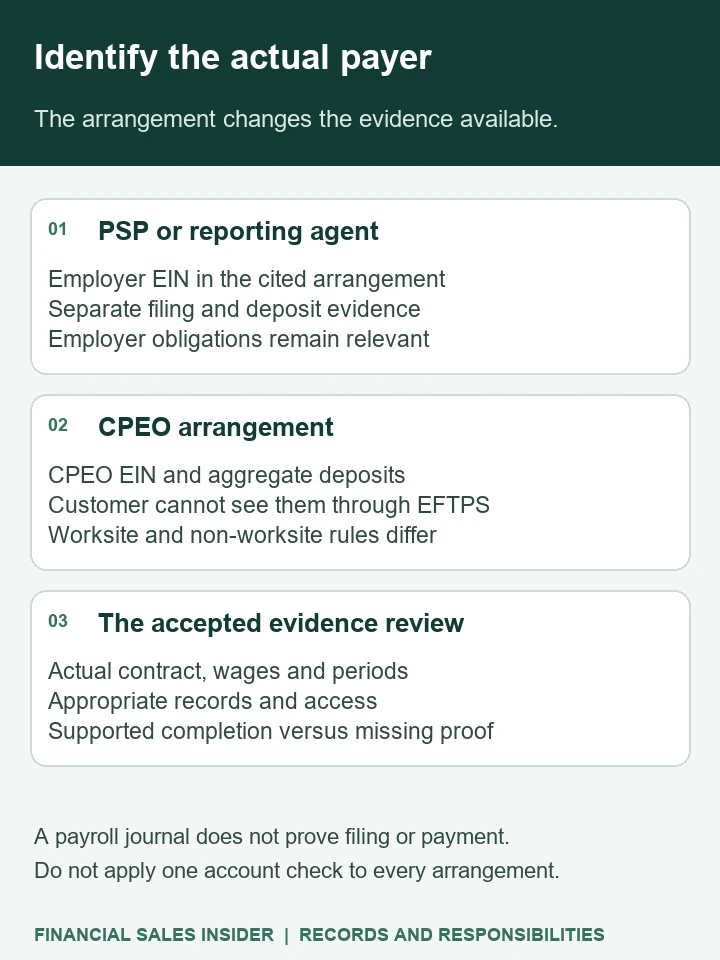
A payroll journal does not prove filing or payment. Do not apply one account check to every arrangement.
Outsourced payroll can involve several firms doing different jobs. One processes wages, another posts the accounts, and a tax practitioner may review filings or payments. For a Lawrenceville business owner, the useful question is what evidence the proposed engagement will examine under your actual payroll arrangement.
Separate the payroll journal from tax completion
Reno M. Borgognoni, CPA, PC's Lawrenceville payroll page describes helping clients choose among affiliated payroll providers. It separately says payroll activity is journaled into the accounts as part of monthly or quarterly accounting, and describes checking that payroll tax filings remain current. [1]
Those are specific responsibilities to clarify in a proposal. Ask whether the professional will post the processor's figures, examine filing evidence, examine tax-payment evidence or perform several separately defined tasks. An accounting entry and evidence that a federal return was filed answer different questions.
Identify the employer, the payroll provider, the period and the tax matters you want reviewed. Explain who holds the contracts and records. Do not assume the accountant's relationship with a processor establishes the processor's legal tax role or the scope of your review.
Identify the actual third-party arrangement
The IRS's 2026 Publication 15 distinguishes several third-party payer arrangements. For a payroll service provider or reporting agent, it explains that the functions use the employer's EIN and that the employer remains liable for its employment-tax obligations. Other agent and certified professional employer organization arrangements have different provisions. [4]
Have the practitioner identify which arrangement applies before deciding what records will establish completion. A provider's trading name, an affiliate relationship or the phrase full-service payroll does not supply that determination.
Request an explanation of the relevant contract, payer, covered wages, tax and period. Ask whose EIN is used for the returns and deposits. That answer affects both the evidence being requested and the account through which information can be checked. This guide does not classify any named provider as a particular type of third-party payer.
Request filing and payment evidence for the right account
For an actual payroll service provider or reporting-agent arrangement using the employer's EIN, ask what will support the filing and payment review separately. Publication 15 describes employer access to confirm federal deposits made on its behalf through EFTPS in these arrangements. [4]
The review should distinguish the payroll figures, the return submitted and the tax payments attributed to the relevant employer and period. Ask the professional what submission and payment evidence is available and how it will be compared with the payroll records.
A bank debit or processor summary may explain money leaving the business or a calculated payroll amount. It does not, by itself, establish that the appropriate return was filed and the payment reached the correct tax account and period. Request an explanation of any missing evidence or difference, rather than treating an unexplained total as completion.
Confirm how your business will continue receiving relevant correspondence. Publication 15 recommends retaining the employer's address as the IRS address of record because sending correspondence to the third-party payer can limit awareness of tax matters. [4] Have the practitioner assess the actual record; this is not an instruction to submit an address change.
Use different evidence questions for a CPEO arrangement
Do not apply the employer-account approach universally. The IRS explains that a certified professional employer organization, or CPEO, files aggregate employment-tax returns and makes deposits using the CPEO's EIN. Its customer guidance expressly says customers cannot view those federal deposits and payments through EFTPS. [5]
Liability also needs the full distinction. Generally, the CPEO is solely liable for the employment taxes concerning remuneration it pays to covered worksite employees. For remuneration it pays to non-worksite employees, the CPEO and customer may both be liable. [5] A CPEO label therefore does not establish a complete transfer for every worker, wage or period.
If this is your arrangement, have the practitioner assess the actual contract and coverage. Ask what customer-specific allocation, filing and payment support can appropriately be obtained and evaluated. Do not commission a review that promises to inspect CPEO deposits through your own EFTPS account.
Compare the proposed processing scope with the tax review
Nicoll Consulting's Lawrenceville page publishes comprehensive, after-the-fact and online payroll-processing options. All three descriptions include tax reporting and EFTPS deposits. [2] After-the-fact processing should not be presented as excluding those services.
Use the actual option to clarify which records your staff supply, what the provider produces and what further review is being commissioned. Do you need processing, an assessment of tax completion evidence, or both? Request the accepted deliverables without assuming a website menu answers every contract question.
Reynolds Financial Services' Lawrenceville payroll page describes processing, federal and state filings, accounting summaries and payroll reports. [3] That provides another actual scope to discuss. Its public service wording does not determine the legal arrangement, verify a completed filing or establish that tax risk has disappeared.
These are attributed service observations, not rankings, recommendations, verified credentials, current capacity or FSI relationships. Confirm the actual provider and meeting arrangement directly.
Agree what the completed review will explain
Ask for an output that identifies the arrangement assessed, relevant payer and EIN, taxes and periods, evidence examined and unresolved questions. It should distinguish supported completion from missing information and explain what further assessment is needed. One universal checklist or document format will not fit every arrangement.
Agree who addresses an unexplained filing or payment item and what work falls outside the review. Then compare fees for the defined tax review. Confirm payroll-processing charges separately; that broader guide does not quote a processor's price.
Questions before choosing payroll-related tax help
Does posting payroll prove that federal taxes were filed and paid?
No. Ask what separate filing and payment evidence the review examines for the actual payer and period. A journal records accounting information; the proposed tax review needs to explain the supporting completion evidence and any gaps.
Can every customer check provider deposits through its own EFTPS account?
No. The IRS expressly distinguishes CPEO payments under the CPEO's EIN, which customers cannot view through EFTPS. Identify the arrangement and appropriate evidence access before accepting the proposed review. [5]
Sources and scope
[1] Reno M. Borgognoni, CPA, PC, payroll and payroll taxes. [2] Nicoll Consulting, payroll services. Both complete official web-rendered pages retained after direct DNS failures. [3] Reynolds Financial Services, payroll. [4] IRS, Publication 15 for 2026, complete section 16. [5] IRS, CPEO customers: what you need to know. Provider and IRS evidence captured October 31, 2026. Published addresses and service descriptions do not establish a provider's legal payer category or current availability. No individual employment-tax liability, required filing, deposit amount, deadline or provider certification is determined here.
Preparation-choice sources: IRS Topic 254, IRS VITA/TCE, Georgia DOR tax help and Georgia individual filing, checked November 3, 2026 for the narrow preparation and routing points above. Earlier specialist source dates and limitations remain as stated. Public provider descriptions do not establish current capacity, credentials or an FSI relationship.