
Tax planning questions for tax professionals
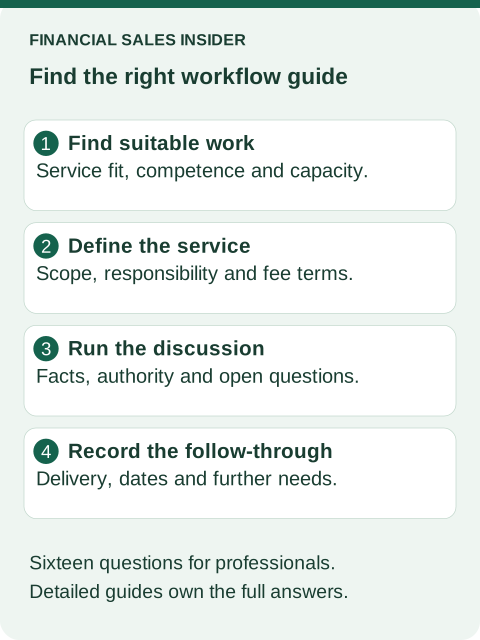
This index covers 16 practice questions about finding suitable clients, defining a planning service and managing the work. The answers introduce the decision and link to a detailed guide. They are not questions to put to a taxpayer during a consultation; that separate guide is linked below. For terminology, use the tax planning glossary.
On this page
Finding planning clients
How do I get more tax planning clients from the clients I already have?
Identify actual client needs through information your firm may lawfully use. Before selecting people from preparation records or promoting another service, check section 7216, permitted uses and any required consent. Explain the proposed scope rather than assuming a large balance or changed income means a planning engagement is appropriate. Read more: Finding tax planning clients.
How do tax firms get new clients without relying on word of mouth?
Test one additional source your firm can support, such as relevant content, professional introductions or permitted outreach. Define the audience and record inquiry, booking and accepted-work events separately. Read more: Inbound vs outbound and Leads, meetings and referrals.
How do I build referral relationships with financial advisors and attorneys?
Build relationships around complementary competence and a suitable client handoff. Discuss permission, confidentiality and any restrictions on referral fees or reciprocal arrangements. No partner owes a quota of introductions. Read more: Finding tax planning clients.
How do I market tax planning services?
Choose a service, audience and calendar your team can deliver. Preparation, notice work and planning have different timing, and capacity varies by firm. Treat any marketing schedule as a working example. Read more: Tax-practice marketing.
What kind of business owner is the best fit for tax planning?
A suitable client has a question within your competence, usable evidence and a scope your team can deliver. An entity type or higher profit is a prompt to investigate, not proof of fit. Personal and business preparation or notice help may be the actual need. Read more: Tax preparer niches.
Pricing planning work
How much should I charge for tax planning?
Price the defined work using complexity, responsibility, delivery effort and applicable fee rules. Fixed, hourly or staged terms may fit different engagements. Explain what is included and how changes are handled. Read more: Planning fee discussions.
Should tax planning be a one time project or a retainer?
Compare the client's decisions, responsibility for implementation and need for continuing review. A count of three actions does not require a retainer. Read more: Retainer vs one-time work.
How do I stop giving tax planning advice away for free?
Explain the introductory meeting's purpose and what requires a separately agreed review. Records can be needed before an engagement, using a proportionate secure process. Payment alone does not make an answer supported or remove professional duties. Read more: Consultation boundaries.
How do I handle "your fee is too high" from a planning prospect?
Ask what they are comparing it to before you defend the number. Often it is the prep fee, and the fix is to show what planning covers that prep doesn't. Read more: Tax planning fee objections.
Running the consultation
What should I cover in an introductory meeting with a prospective planning client?
Find out what made them look now, what they expect from planning, and whether your firm can deliver it. End with a clear next step and a date. Read more: How to run a tax planning consultation and Tax planning consultation questions.
How do I explain the difference between tax planning and tax preparation?
Preparation produces returns using the facts and applicable law. Planning evaluates choices and consequences for a defined period. The work can overlap, and planning does not guarantee lower tax. Read more: Explaining planning and Explaining value without savings promises.
How do I spot a bad fit planning lead before the meeting?
Ask what help the person needs, the relevant period and any urgent deadline. Someone needing a return or notice response belongs in the appropriate service route, not a bad-client category. Read more: Assessing fit and Pre-booking questions.
What do I do when a prospect says they need to think about it?
Ask what remains uncertain and answer within the facts and agreed scope. Offer a further discussion if useful, while allowing the person to decline or take time without a forced follow-up appointment. Read more: Planning objections and Consultation mistakes.
After the booking
How do I reduce no-shows for tax planning consultations?
Confirm the purpose, time zone, participant and joining details. Agree appropriate reminders and make cancellation or rescheduling clear. After a missed meeting, use a proportionate agreed follow-up rather than a mandatory same-day chase. Read more: Reducing no-shows.
How fast should I follow up with a new planning inquiry?
Set a response target the team can meet and show when the firm is closed. Route deadline-sensitive matters promptly to an appropriate professional. Measure actual response times instead of treating one hour as a proven conversion threshold. Read more: New-client intake.
How do I keep planning clients after the first year?
Review what was delivered, actions still open and whether further work is needed. A report supports an informed continuation decision; it does not require renewal. Read more: Report template, Year-end letter and Growth metrics.
State rules worth a meeting
Use the 2026 PTET state reference and review checklist to locate official sources and separate entity eligibility, election timing, payments and owner treatment. Its unresolved entries remain questions to verify, rather than confirmed answers for a client.