
Inbound vs outbound marketing for tax firms
Inbound means a prospective client finds or is introduced to your firm. Outbound means your firm initiates contact. Paid advertising can support either route. Compare the audience, permissions, work involved and actual results before choosing a channel. This guide covers channel selection for tax professionals; a referral, inquiry, booked meeting and accepted engagement are separate events.
On this page
The two, defined
- Inbound: the owner finds you. Referrals, search, your website, articles, talks, word of mouth.
- Outbound: you reach the owner first. Email, phone, mail, messages on LinkedIn, events where you approach people.
- Paid ads sit between the two. You choose who sees the ad, but the owner chooses to respond.
How they compare
| Inbound | Outbound | Paid ads | |
|---|---|---|---|
| Who starts it | The owner | You | You show the ad, the owner responds |
| Timing | Search and relationships can take time; no fixed pace | You control sending, not replies or bookings | You control launch and spend, not suitable inquiries |
| Audience selection | Content and relationships influence reach | You select lawful recipients; response and fit remain uncertain | Targeting narrows reach but does not establish fit |
| Your time | Content and relationships, every week | List building, writing, follow-up | Setup and daily management, unless someone runs it |
| Main risk | Too slow for a target date | Rules, reputation, reply rates | Paying for the wrong clicks |
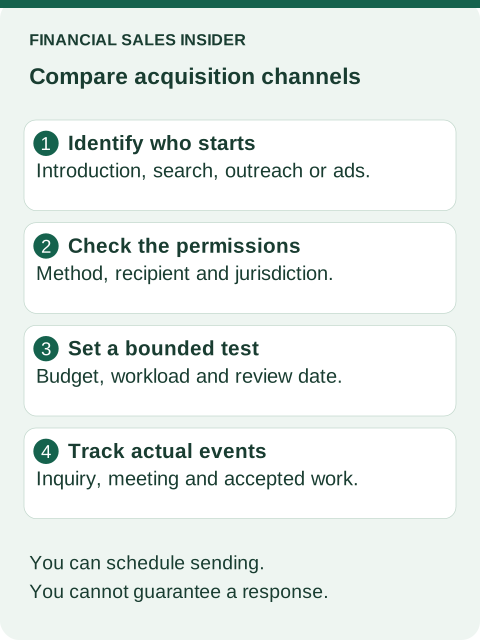
Use the comparison to choose a test your team can support. No channel guarantees trust, qualified meetings or a full calendar by a chosen date.
Inbound that works for planning
Referral partners. Discuss which clients and services each professional can handle. Seek permission for introductions and protect confidential information. A referral should serve the client, without a promised reciprocal volume or assumption that a payment arrangement is permitted.
Your own prep clients. Existing clients may have preparation or additional review needs. Check the section 7216 purpose, permitted use and consent requirements below before selecting recipients or using return information to offer a different service.
Content that answers real questions. Explain the actual task and link the relevant authority. For example, Form 2553 has a general preceding-year or two-months-and-15-days timing rule, plus eligibility, consent, first-year and possible late-election issues. A deadline excerpt alone does not establish an owner's eligibility (IRS instructions).
Outbound marketing for tax firms: rules that apply
This section is general information, not legal advice. Check the method, recipients, jurisdiction and professional rules with your adviser before starting outreach. A business contact or published phone number does not establish permission for every channel.
Circular 230 section 10.30
For IRS matters, a practitioner's advertising and solicitation are covered by Treasury Circular 230 section 10.30 (31 CFR 10.30). The ban on unlawful uninvited solicitations reaches ones you make "directly or indirectly", and the labelling rule reaches any lawful solicitation "made by or on behalf of" a practitioner. Key points in plain words:
- You may not use, or take part in using, any public communication or private solicitation with a false, fraudulent or coercive statement or claim, or a misleading or deceptive one (10.30(a)(1)).
- An uninvited written or oral solicitation that breaks federal or state law, or another rule that applies to you, is not allowed. Any lawful solicitation made by you or for you must still clearly say it is a solicitation and, if applicable, name the source of the information used to choose the recipient (10.30(a)(2)).
- If a prospect has made it known they don't want to be solicited, you may not keep trying to contact them (10.30(c)).
- For direct mail and what the rule calls "e-commerce communications", keep a copy of the actual message and a list or description of who received it for at least 36 months from the last time it was sent or used (10.30(c)).
- Fee information for matters where costs may be incurred must say whether the client will pay those costs, and you may charge no more than the rates you publish for at least 30 calendar days after the last date they were published (10.30(b)).
- Enrolled agents may not use the term "certified" to describe their designation or imply an employer and employee relationship with the IRS. "Enrolled to practice before the Internal Revenue Service" is one of the descriptions the rule accepts (10.30(a)(1)).
- You may not assist, or accept help from, anyone who to your knowledge gets clients in a way this section forbids (10.30(d)).
Section 10.51(a)(5) addresses prohibited solicitation and misleading statements to obtain work, including claims of improper influence over the IRS (31 CFR 10.51). Sanctions depend on the applicable standards and conduct, not simply a disappointing campaign (31 CFR 10.52). Section 10.36 concerns individuals with principal authority over the specified aspects of a firm's practice; identify the responsible person and procedures for the activity involved (31 CFR 10.36).
The IRS adds that all states regulate advertising and solicitation by attorneys and CPAs, and that no practitioner may use a sign, symbol or design that resembles those of the IRS or the United States, such as the IRS seal (IRS, practitioner FAQ, Q15). Check the rules for every state you market in.
Using your prep client list
Section 7216 makes it a misdemeanor for a preparer to knowingly or recklessly disclose information given to them to prepare a return, or to use it for any purpose other than preparing or helping to prepare the return, unless the statute or a regulation allows it. In most cases the penalty is a fine of up to $1,000, up to a year in prison, or both, plus the costs of prosecution (26 USC 7216).
The regulations let you keep a list of prep clients' names, addresses, emails, phone numbers, entity type and return form number. You may use it to send tax information and general business or economic information for educational purposes, or to offer more tax return preparation. The rule also says, "The list may not be used to solicit any service or product other than tax return preparation services" (26 CFR 301.7216-2(n)).
Unless section 7216 or one of the exceptions in 26 CFR 301.7216-2 allows a use, it needs the client's written consent first (26 CFR 301.7216-3). The consent must:
- name your firm and the client, and be signed and dated by the client;
- describe the use and each type of product or service you will offer, and say which return information you will use;
- come before the use, and be given freely. Making any of your services depend on it makes the consent involuntary, so it doesn't count.
You may not ask for consent to solicit business unrelated to return preparation after you hand over the completed return for signature, and you may not ask again for a substantially similar purpose after a client says no. A copy goes to the client when they sign. If the consent sets no end date, it lasts one year. For Form 1040 filers, the consent must also use the IRS wording in Revenue Procedure 2013-14 (IRS, section 7216 FAQ). For clients who don't file Form 1040, such as corporations, the consent can be in any format, including an engagement letter, as long as it has the required contents (26 CFR 301.7216-3(a)(3)(iii)).
One exception matters for CPA firms. A preparer lawfully in the practice of law or accountancy may use a client's return information to provide other legal or accounting services to that client (26 CFR 301.7216-2(h)). That exception is about doing the work for the client. When the IRS finalised the list rules, it declined to add an exception for using return information to solicit accounting services and said clients may consent in writing to that use instead (T.D. 9608, Internal Revenue Bulletin 2013-03). The regulations don't say whether tax planning counts as "tax return preparation services". Ask your adviser before you rely on either reading.
Email and phone laws
The FTC CAN-SPAM guide explains commercial-email duties, including business-to-business messages: accurate routing information and subjects, required advertisement identification, a valid postal address and a working opt-out. Honour opt-outs within ten business days, and check primary-purpose and applicable exception rules. Hiring a sender does not remove the firm's responsibility.
Calls and texts need a separate method-specific check. Autodialed calls or texts, prerecorded or artificial voices, marketing content and residential or wireless numbers can trigger different consent requirements. Check federal and state do-not-call, calling-time, identification and revocation rules as well. Do not treat a manual call, existing relationship or business number as a universal exemption (FCC guide; 47 CFR 64.1200).
Picking your mix
- Start with your own book, once you're clear on the section 7216 point and have written consent where it's needed.
- Add one referral partner who serves the owners you want.
- Choose one additional source to test: permitted outbound or paid advertising, with a budget, workload and review date.
- Measure each source separately, from inquiry to signed engagement. See weekly growth numbers.
- Drop what doesn't produce signed work after a fair test, and say in advance what a fair test is.
Worked example, not a forecast: A firm sets a five-month target of 12 new planning engagements. If it assumes five will arrive through referrals, seven remain. An assumed one-in-four held-meeting-to-engagement rate implies 28 held meetings for those seven, before allowing for bookings that do not happen. That calculation tests an assumption; it does not establish actual referral volume, a conversion rate or a channel's delivery timetable.
Where to start this week
- Write down your target number of new planning clients and the date.
- Count what your referral partners and your own book produced last year.
- Read section 10.30 and the section 7216 rules before any outreach.
- Check your state board's advertising rules.
- Pick one additional channel and define the budget, permissions, review date and evidence needed to continue.
Questions firm owners ask
What is outbound marketing for tax firms? Any marketing where the firm reaches the business owner first, such as email, calls, mail or LinkedIn messages. For IRS matters, Circular 230 section 10.30 applies, and state board advertising rules, email laws and phone laws may apply too.
Is inbound or outbound better for a tax planning practice? Neither is inherently better. Compare whom you can lawfully reach, the client task, workload and observed results. You can schedule outreach activity, but suitable replies, referrals and accepted engagements remain uncertain.
Can I email my tax prep clients about planning services? Check section 7216 first. A prep client list kept under 26 CFR 301.7216-2(n) may not be used to solicit any service other than tax return preparation. Using return information to solicit other services generally needs the client's signed written consent first under 26 CFR 301.7216-3. Ask your adviser whether your planning offer needs that consent.
What does Circular 230 say about solicitation? Section 10.30 bans false, fraudulent, coercive, misleading or deceptive claims. Uninvited solicitations that break federal or state law are not allowed, and any lawful solicitation must say it is one. Stop when a prospect says they don't want to be solicited, keep copies and recipient lists of direct mail and e-commerce messages for at least 36 months, and don't assist or accept help from anyone you know gets clients in a way the section forbids.
Sources
General information from the official sources listed below, checked 25 Oct 2026. Not tax or legal advice.
- 31 CFR 10.30, solicitation (eCFR)
- 31 CFR 10.36, procedures to ensure compliance (eCFR)
- 31 CFR 10.51, incompetence and disreputable conduct (eCFR)
- 31 CFR 10.52, violations subject to sanction (eCFR)
- IRS, frequently asked questions for practitioners (Q15, advertising)
- 26 USC 7216 (govinfo)
- 26 CFR 301.7216-2, uses without consent (eCFR)
- 26 CFR 301.7216-3, uses with consent (eCFR)
- IRS, section 7216 information center
- IRS, section 7216 frequently asked questions
- Internal Revenue Bulletin 2013-03, T.D. 9608 (section 7216 final rules)
- 15 USC 7704, CAN-SPAM requirements
- 16 CFR 316.2, CAN-SPAM definitions (eCFR)
- 47 CFR 64.1200, telephone and text rules (eCFR)
- IRS, instructions for Form 2553
Related: Weekly numbers to track · Who should handle new inquiries · Signs a lead is a bad fit