
Tax firm new client intake: who should handle planning inquiries?
A tax firm can assign administrative intake to a trained team member who identifies the requested service, records essential details and routes the inquiry. Personal preparation, business returns, IRS notice help and planning need different handoffs. Advice and urgent deadlines go to an appropriately competent professional; intake staff should not improvise answers outside their remit.
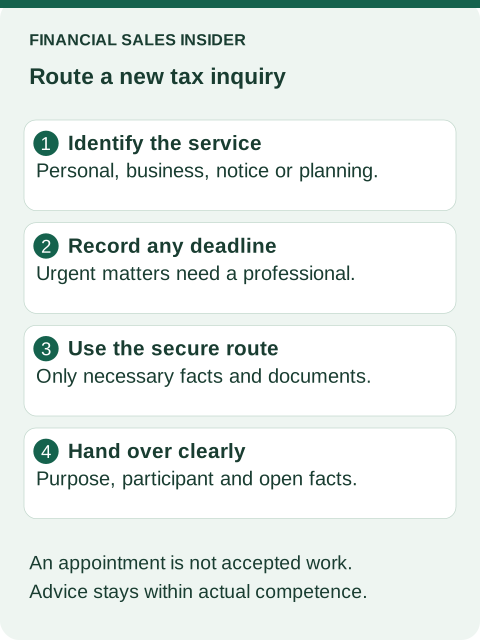
Define the role, escalation route and response arrangements before choosing who does it. This guide compares four options and provides a five-step process and adaptable script.
On this page
The four options
| Who answers | Strengths | Watch out for |
|---|---|---|
| The firm owner | Knows the work, can judge fit on the spot | Owner time is the scarcest thing in the firm. Inquiries wait during busy weeks |
| Admin or front desk | Familiar with the firm's administrative process | Training, secure records and clear advice/escalation boundaries |
| A credentialed staff member | Can judge fit and talk about the work | Pulls billable time from client work |
| An outside intake provider | May supply agreed answering, screening or booking support | Verify the actual service, permissions, access, confidentiality and quality; do not assume it supplies clients |
There's no single right answer. A small firm can start with the owner and move to a trained admin once inquiries pick up. What matters is that the first reply is quick and the person giving it knows where their job ends.
Rules that shape intake
The firm head owns the procedures
Circular 230 section 10.36 addresses individuals with principal authority over specified aspects of a firm's practice, including practice before the IRS. Identify the responsible person and reasonable procedures for the actual activity. Its disciplinary provisions involve stated knowledge and conduct standards; the title "owner" does not alone establish every legal responsibility (31 CFR 10.36).
Write down what intake staff can do, which professional handles tax questions and who reviews the process. Staff credentials and actual competence matter to that assignment.
Intake staff don't give tax answers
Written advice on federal tax matters, including electronic communications, has standards under section 10.37. Section 10.22 also addresses practitioner due diligence. An administrative response can be: "That needs the appropriate tax professional. I can record the question and arrange the next step." Do not promise an answer or imply an introductory appointment includes analysis that has not been agreed (31 CFR 10.37; 31 CFR 10.22).
Intake handles client data
Tax preparation firms can be covered financial institutions under the FTC Safeguards Rule. Covered firms need an appropriate information security program and a designated Qualified Individual; the exemption for information concerning fewer than 5,000 consumers applies to specified provisions, not the entire rule. The FTC notification requirement concerns a qualifying unauthorized-acquisition event involving at least 500 consumers' unencrypted information, generally including information whose encryption key was accessed. Notice is due as soon as possible and no later than 30 days after discovery. Unauthorized access is presumed acquisition unless reliable evidence shows otherwise. Use the FTC guide and linked rule for the full definitions and incident assessment. This intake checklist does not replace that assessment.
Intake is a security checkpoint
The IRS 2026 Dirty Dozen warning identifies malicious new-client and document-request messages targeting tax professionals. Verify unexpected senders and requests through trusted contact details before opening links or attachments. Use the firm's approved secure channel for necessary documents, including proportionate pre-engagement review where needed; a phone call or booking page alone does not authenticate a sender.
A five-step tax firm new client intake process
- Acknowledge and triage. Use a realistic business-hours response target. Escalate an imminent filing or notice deadline without promising the firm can take the case.
- Identify the service. Ask whether the person needs personal preparation, business preparation, notice help or a planning review. Record the relevant year, jurisdiction, basic entity details and deadline where applicable. Ask only the additional questions needed for that route.
- Route the request. Arrange the appropriate professional or administrative next step, seek missing information securely, or explain that the firm cannot assist. Preparation is not an unsuitable client category.
- Confirm the purpose. State the participant, time zone, meeting purpose and any known charge. An introductory appointment does not itself establish accepted work or representation.
- Hand over securely. Share the recorded facts, unresolved questions and deadline with the responsible person, limiting access to those who need it.
Request only the documents needed for a stated purpose, through an approved secure process. Some conflict, urgency or scope checks can require information before engagement. If IRS information access is needed, Form 8821 authorizes the listed information and periods; it does not authorize representation. Form 2848 serves a different purpose for eligible representatives (IRS Form 8821; IRS Form 2848).
A script for the person who answers
"Thanks for getting in touch with [firm]. Is this about a personal return, a business return, an IRS notice or a planning question? Is there a deadline we should record?"
Then the fit questions, one at a time.
If they ask for advice outside the intake role: "That needs the appropriate tax professional. I can record the question and explain the next step."
If they fit: "[Name] has [day] at [time] or [day] at [time]. Which works?"
If the firm cannot help: "We do not handle [service or issue]. Please seek a professional who does, particularly before [the stated deadline]." Offer a resource or referral only where it is appropriate and truthful.
Where to start this week
- Decide who answers new inquiries and write it down.
- Give them the script and the fit questions on one page.
- Set a response time target and start measuring it.
- Train the team to verify unexpected messages and use the approved secure document process.
- Name your qualified individual for the Safeguards Rule if you haven't.
The same line helps you stop giving free tax advice before the meeting starts.
Questions firm owners ask
Can a non-CPA staff member handle tax firm new client intake? Yes, a trained administrative team member can acknowledge requests, gather proportionate information and arrange a handoff within a defined role. Advice, representation and deadline-sensitive judgments need the appropriate professional. The firm should document supervision and escalation arrangements.
What should a tax firm client intake form ask before the first meeting? Start with the service needed, relevant year or entity, jurisdiction, contact details and any deadline. Add only what is necessary for the next step. Use secure channels when a pre-engagement review requires sensitive information; neither a profit band nor willingness to buy planning belongs in every intake route.
Does the FTC Safeguards Rule apply to tax firms? Tax preparation firms can fall within the rule's financial-institution definition. Covered firms need an appropriate security program. Qualifying notification events have an at-least-500-consumer threshold and notice deadline of as soon as possible, no later than 30 days after discovery; use the linked FTC guide for acquisition, encryption and other conditions.
Sources
General information from the official sources listed below, checked 25 Oct 2026. Not tax or legal advice.
- 31 CFR 10.36, procedures to ensure compliance (eCFR)
- 31 CFR 10.37, requirements for written advice (eCFR)
- 31 CFR 10.22, diligence as to accuracy (eCFR)
- 16 CFR 314.2, Safeguards Rule definitions (eCFR)
- 16 CFR 314.4, Safeguards Rule elements (eCFR)
- 16 CFR 314.6, Safeguards Rule exceptions (eCFR)
- FTC, Safeguards Rule: what your business needs to know
- IRS, Dirty Dozen tax scams for 2026 (IR-2026-30)
- IRS, about Form 8821
Related: Questions to ask before you book · Cut no-shows · Weekly numbers to track