
Tax planning leads vs booked meetings vs referrals
A tax planning lead might be a contact record, a request for help or a reply to outreach. A booked appointment establishes a time; it does not establish attendance, service fit or an accepted engagement. Before comparing offers, name the event being delivered and the work that remains with your practice.
This guide explains the delivery labels, the responsibilities behind them and a consistent way to track acquisition costs. It is for tax professionals assessing sources of planning inquiries, not taxpayers choosing a preparer.
What "lead" means in each offer
| Offer label | What it might deliver | What still needs checking |
|---|---|---|
| Shared lead | Contact details or an inquiry also supplied to other firms. | Requested service, contact expectations, number of recipients and follow-up responsibilities. |
| Exclusive lead | A contact or inquiry subject to an exclusivity agreement. | Its category, period, geography and exceptions, as well as service fit. |
| Pay per appointment | A booked time slot. | Booking criteria, attendance, no-show treatment and who checks fit. |
| Done-for-you qualified meeting | A provider-defined meeting service with some screening or booking work included. | The written qualification criteria, evidence, attendance requirement and division of work. |
Sharing and the delivered event are separate dimensions. An exclusive contact is still a contact; a shared inquiry could have a clearly expressed planning need. There is no universal price or quality ladder across these labels.
Shared leads
A shared inquiry may be supplied to several practices. Find out what the person requested and was told about contact from those firms. A broad tax-help form may include individual preparation, business returns, notices and planning requests.
Your team may still need to make contact, clarify the service, book a suitable discussion and follow up. Agree a response process that fits the person's request and your capacity. A universal rule to call every contact within minutes does not establish quality or permission to contact them.
Exclusive leads
Exclusive generally describes a restriction on distribution, not a completed fit assessment. The agreement needs to say what is exclusive and for how long. It may not address a person who separately contacts another firm.
Identify the work left with your team: making contact, checking the need, arranging the meeting and handling reminders. Exclusivity does not establish personal income, authority to engage you or a particular tax result.
Pay per appointment
This model charges for a booked slot under the provider's terms. Ask whether the person agreed to discuss your specific service and what information supports the booking.
Track booked and attended meetings separately. Confirm who sends reminders, handles changes and follows up on missed consultations. A no-show can still be billable under some agreements; a calendar entry alone does not answer that question.
Done-for-you qualified meetings
Some providers handle outreach, screening and booking. The phrase qualified meeting has no useful meaning without the actual criteria and evidence. A provider may assess initial fit before booking; your professional may need further discussion or records before accepting the work.
Specify whether delivery requires booking, attendance or both, and which checks the provider performs. Your practice remains responsible for its own professional acceptance, scope, fees and engagement agreement. This is a description of a possible provider model, not a claim that Financial Sales Insider sells that service.
Referrals and referral partners
A referral is an introduction from a client, professional contact or another source. The introduction may explain why the person contacted you, but it does not replace assessment of their requested work or your capacity.
Permissioned introductions can be supported by a deliberate referral process, although timing and outcomes remain uncertain. Keep the source and any contact expectations on the record. For that process, see how tax professionals can get more planning clients and referrals. Broader acquisition channels belong in the tax-practice inquiry-source guide.
Side by side
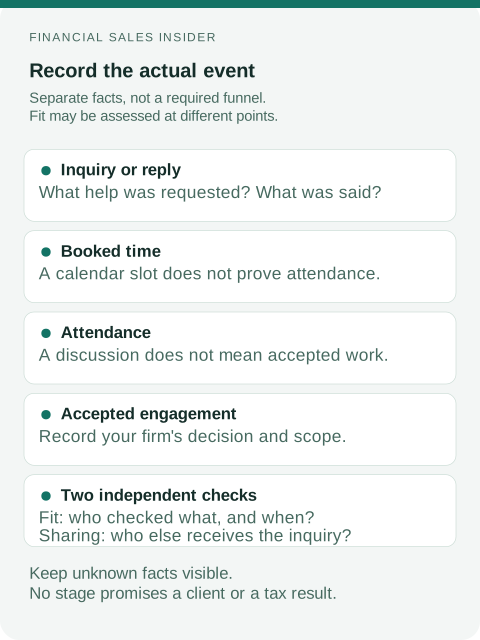
Record these facts independently rather than treating every inquiry as a mandatory funnel:
| Record | What it establishes | What it does not establish |
|---|---|---|
| Contact or inquiry | The details supplied and, where stated, the requested help. | Consent to every type of outreach or suitability for planning. |
| Positive reply | A response to a particular message. | A booked consultation or agreement to engage. |
| Booked slot | An agreed meeting time. | Attendance or professional acceptance. |
| Attendance | The person joined the discussion. | Complete facts or a suitable engagement. |
| Fit assessment | The criteria assessed, by whom, using which reported or checked facts. | A signed agreement or promised outcome. |
| Accepted engagement | Your firm's recorded acceptance and agreed scope. | A result beyond the actual agreement. |
Fit assessment can happen before booking, during a meeting or after further evidence review. Record sharing separately. A referral may enter the process through an introduction rather than a form.
How to work out cost per signed client
Choose an observation period and record the source of each engagement. Include the provider charge and the relevant staff and owner time, using disclosed internal cost rates. Apply the same scope to each option.
Cost per signed client = included acquisition costs divided by signed clients attributed to that source. With no signed clients, that ratio is undefined; report the spend and zero engagements instead.
Two hypothetical examples show why the cost basis matters. These are arithmetic illustrations, not prices, forecasts or real results:
| Example | Included costs | Recorded outcomes | Result on that limited basis |
|---|---|---|---|
| A: 100 shared contacts | $3,500 provider charge plus 30 staff hours at $50, totaling $5,000. | 10 bookings, 7 attendees, 2 signed clients. | $2,500 per signed client, excluding owner consultation and proposal time. |
| B: 10 attended meetings screened to agreed criteria | $6,000 provider charge plus 10 owner hours at $150, totaling $7,500. | 10 attendees, 3 signed clients. | $2,500 per signed client, excluding any separate staff follow-up or other omitted acquisition work. |
The equal ratios are not a complete comparison: the examples include different kinds of time. To compare full costs, add the omitted owner work to A and any omitted staff work to B, use consistent attribution and allow the same time for engagements to mature. Do not conclude that B saves 30 hours or produces a better client mix from these figures.
Use the tax planning revenue calculator only with your own assumptions and observed outcomes. A quoted cost per inquiry is not a cost per suitable signed engagement.
How meeting guarantees differ
A provider may promise a replacement for a no-show, a credit for an out-of-scope meeting, payment only for a defined event, or an outcome counted in signed clients. These are different commitments.
For each promise, establish what triggers it, what evidence is required, who decides and when the remedy arrives. Payment per booked appointment does not remove the need to define attendance and fit. A guarantee involving signed clients also depends on decisions the provider may not control, including your acceptance process and the prospect's decision.
The detailed provider comparison worksheet covers sharing, duplicates, commercial terms, evidence and exit conditions.
Questions to ask any provider
Keep the operational handoff short and explicit:
- What exact event are you delivering, and which fit facts will be recorded?
- Who handles first contact, screening, booking, reminders and missed meetings?
- What must our team supply, approve and spend time on each week?
- What does the report distinguish between inquiries, bookings, attendance and accepted engagements?
Put source, sharing, duplicate, remedy, data and cancellation questions in the comparison worksheet rather than relying on a delivery label. For channel choice, the separate inbound and outbound guide addresses the broader distinction.
Rules to know before outreach in your firm's name
Outsourcing outreach does not settle your professional obligations. For solicitation concerning IRS matters, 31 CFR 10.30 addresses false or misleading communications, unlawful uninvited solicitation and requirements for lawful solicitation made by or on behalf of a practitioner. It also addresses stopping unwanted contact and retaining specified direct-mail and e-commerce communications and recipient records for at least 36 months after their last transmission or use.
If a campaign publishes fees, check the rule's permitted fee descriptions, cost disclosures and 30-day published-rate requirement. Agree how your practice will approve messages, retain the required records and handle requests to stop. A provider's assurance is not a legal review of the campaign. Applicable state professional rules and other email, telephone and privacy laws need their own assessment.
Do not treat an existing preparation-client list as a general marketing database. The IRS Section 7216 Information Center explains the restrictions, consent rules and particular exceptions for uses and disclosures of tax return information. It includes limited client-list and third-party service arrangements; neither a blanket ban on every transfer nor blanket permission to share a list is accurate. Establish the proposed purpose, recipient and applicable rule before giving an outside provider access. The broader inquiry-source guide provides related marketing context.
This is general information, not a determination that a particular outreach method is lawful. The IRS also publishes Circular 230 information for tax professionals.
Questions firm owners ask
Is a tax planning lead the same as an appointment? No. A contact, inquiry or reply does not establish a booked time. A booked time does not establish attendance, and attendance does not establish professional acceptance.
Are shared tax leads suitable for planning work? That depends on the actual request, contact expectations, fit information and your practice's follow-up capacity. Sharing alone does not answer those questions.
What should a tax planning appointment guarantee cover? The delivered event, qualification criteria, no-show and duplicate treatment, required evidence and exact remedy. Confirm those terms in writing rather than assuming a replacement or refund.
Can a referral replace qualification? No. An introduction provides source context, but your practice still needs to establish service fit, authority, capacity and engagement terms.
Related: A marketing plan for a tax practice · Warning signs and service mismatch
Editorially updated November 4, 2026. General information for tax professionals, not tax or legal advice.