
Reduce tax consultation no-shows with clear booking and reminders
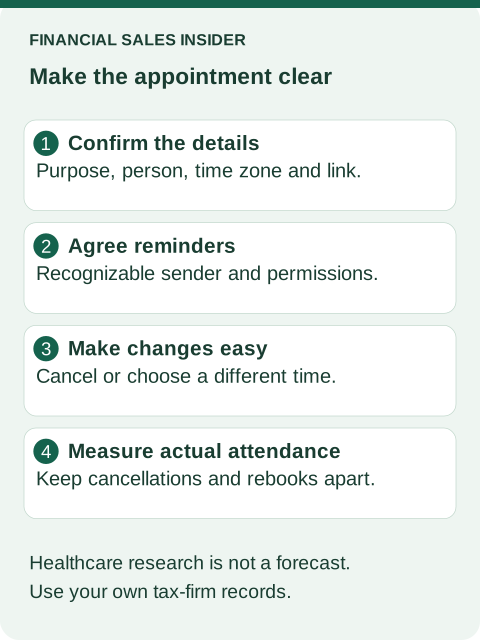
To reduce tax consultation no-shows, make the appointment clear: who the client will meet, its purpose, length, time zone and joining instructions. Send a recognizable invitation and the reminders agreed at booking. Keep cancellation and rescheduling easy, then measure attendance using actual meeting records.
That last point about expected reminders matters more in tax than in most fields. The IRS warns taxpayers not to click links in unexpected texts and emails, so a reminder that looks like a scam can do more harm than no reminder at all.
What the research says about reminders
A 2013 Cochrane review studied reminders for healthcare appointments. Its text-versus-no-reminder analysis included seven studies and 5,841 participants, with a risk ratio of 1.14; the review reported broadly similar attendance effects for text and telephone reminders. The wider review comprised eight trials and 6,615 participants. These are different analysis totals, not tax-firm benchmarks (original PubMed record, publisher summary).
The study does not tell a tax firm its expected attendance rate, best reminder schedule or best communication channel. Use the workflow below as an operational test and review your own delivery failures, cancellations, held meetings and client preferences. Do not treat healthcare results as a forecast.
Why tax reminders need extra care
The IRS 2026 Dirty Dozen list puts IRS impersonation by email and text first. It warns of messages using alarming language and QR codes that lead to fake sites, and urges taxpayers not to click links or open attachments from unexpected messages (IRS, Dirty Dozen 2026).
Your planning prospects have heard that warning. A text from an unknown number saying "Your tax appointment is tomorrow, click here to confirm" looks exactly like what they've been told to ignore.
So make every reminder expected and recognisable:
- Tell them at booking how you'll remind them: "You'll get an email from [name] at [firm] the day before."
- Use your firm's name and a real person's name in every message.
- Skip shortened links and QR codes. Point to the calendar invite they already have.
- Never ask for documents or ID numbers in a reminder.
- Send texts only under an appropriate permission process agreed with the recipient when they booked.
Six habits that reduce appointment no-shows
1. Book close to the inquiry
The longer the gap between the inquiry and the meeting, the more time the owner has to lose interest or forget why they booked. Offer times within the next few days. Track your own gap and see how it relates to attendance.
2. Send a calendar invite straight away
An email confirmation is easy to miss. A calendar invite puts the meeting where the owner manages their week. Include the meeting length, who they'll meet and how to join.
3. Give one reason to attend
Tie the purpose to what the prospective client actually requested: "We will discuss the records needed to review your estimated payments and the proposed scope." Do not promise a calculation before the evidence is available, or insert a tax deadline that has not been checked for the actual taxpayer.
4. Remind them the day before
A reminder the day before is one schedule to test, not an established optimum for tax firms. Use the channel and contact details agreed with the recipient, and offer a clear way to change the time.
5. Make rescheduling easy
Put a reschedule link or a phone number in every message. An owner who can move the meeting in ten seconds often will, instead of skipping it.
6. Invite everyone who decides
When a partner or spouse needs to be there, invite them directly. An owner who realises the night before that their partner can't come may skip the meeting entirely.
What to do after a no-show
If appropriate under the agreed contact process, send a brief follow-up after a missed appointment. Keep the tone neutral and offer a practical next step rather than assuming the reason for the absence.
"Hi [name], we missed you today. No problem at all. Would [day, time] or [day, time] work instead?"
Offer two specific times. "Let me know when suits you" asks the owner to do the work, and some won't.
Choose a short follow-up sequence appropriate to the inquiry and permissions. Respect a request to stop, do not keep adding automated messages and record whether the person rescheduled, declined or did not respond.
If considering a cancellation or no-show fee, have the actual terms, advance disclosure, agreement and applicable rules reviewed. A clause in an engagement letter does not alone establish enforceability. Decide whether a fee serves the relationship and service you actually offer.
Count no-shows honestly
Track the original booked slot, cancellation timing, whether it was held and any replacement appointment. Define a no-show separately from timely cancellation, firm cancellation and a completed rebooking. Use a consistent cohort and report pending future meetings separately. Our growth numbers guide supplies the wider context.
Where to start this week
- Rewrite your confirmation email with a named sender, a calendar invite and one reason to attend.
- Add a line at booking saying how and when you'll remind them.
- Remove shortened links and QR codes from every reminder.
- Prepare a brief optional rescheduling message consistent with the agreed contact process.
- Start counting booked, held and rebooked separately.
Questions firm owners ask
How can a tax firm reduce consultation no-shows? Confirm the purpose, person, time zone and joining details. Agree recognizable reminders and test timing with your own records. Make cancellation and rescheduling easy; any follow-up after a miss should respect the agreed contact process and a request to stop.
Do appointment reminders reduce no-shows? A historical Cochrane healthcare review found improved attendance with some reminder comparisons. It did not study tax consultations. Test recognizable, expected reminders in your own practice and measure actual held appointments.
Should I text tax planning prospects reminders? Send texts only under an appropriate permission process agreed with the recipient when they booked, and only from a recognisable firm and person name. The IRS warns taxpayers about scam texts, so avoid links, QR codes and requests for documents.
Should a tax firm charge a no-show fee? Review the actual service, advance terms, consent and applicable rules before charging one. A written policy can explain the arrangement but does not by itself make a fee enforceable.
Sources
Selected claims and editorial wording reviewed November 4, 2026 against the linked primary guidance. Source publications retain their stated years and scope. This is a professional workflow aid, not an individual tax determination or a ready-to-use legal agreement.
- Gurol-Urganci I and others, Mobile phone messaging reminders for attendance at healthcare appointments, Cochrane Database of Systematic Reviews 2013 (PubMed abstract)
- IRS, Dirty Dozen tax scams for 2026 (IR-2026-30)
- IRS, estimated tax due dates (FAQ)
Related: Who should handle new inquiries · How to run the consultation · Weekly numbers to track