
Tax preparation leads and referral sources: a practical guide
A tax preparation lead is an enquiry from someone who may need return-preparation services. It is not an accepted client, a completed scope assessment or a promise that the person will attend a meeting.
Tax firms also receive introductions from existing clients and other professionals. People may call all of these contacts referrals, but their origin, permissions and expectations can differ. Establish what the person requested and which work your practice can accept before judging a source by its volume.
This guide helps tax preparers, enrolled agents and tax advisers compare sources for individual and business preparation. It covers fit, information use, response responsibility and the cost of accepted work. It does not offer a lead-delivery service or recommend a provider.
On this page
- Distinguish the contact from the engagement
- Define personal and business preparation fit separately
- Compare how each source works
- Questions to ask before paying for tax preparation leads
- Check taxpayer-information permissions before using a client list
- Apply communication and professional rules
- Assign responsibility for the first response
- Measure outcomes without losing the cause of a problem
- Sources and scope
Distinguish the contact from the engagement
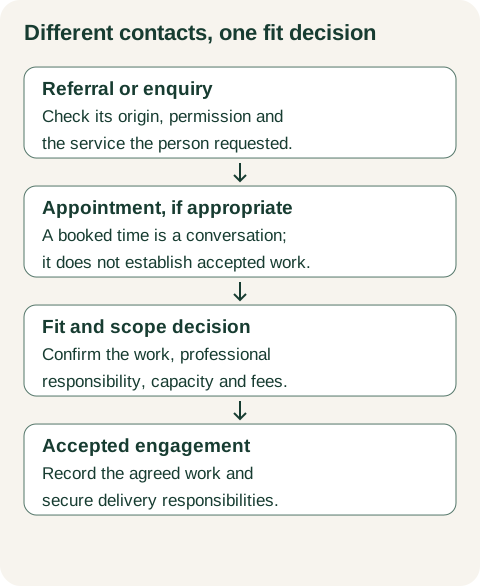
| Term | What it can establish | What still needs checking |
|---|---|---|
| Client or professional referral | Someone suggested your firm or introduced the person | Permission to contact, actual need, scope and capacity |
| Enquiry or lead | A person expressed interest or requested information | How the interest was collected, relevance, timing and an appropriate next step |
| Purchased enquiry | A provider supplied contact information under its terms | Provenance, permissions, age, duplication, fit and contractual remedies |
| Booked appointment | A time was arranged | Whether the person understood the service, attends and is suitable |
| Accepted engagement | The client and firm agreed the work | Delivery responsibilities, records, fees and any later separately agreed work |
A word such as qualified is only useful when its criteria are written down. The same applies to exclusive: ask whether it means no resale, no other firm receiving the contact, a time-limited arrangement or something else.
For specialist advisory work, tax planning leads, booked meetings and referrals addresses that narrower comparison. A request for return preparation should not be assumed to include a planning engagement.
Define personal and business preparation fit separately
For an individual or family, establish the return years, residence and work states, broad income types, requested service and timing. Prior-year work, amendments, self-employment and more than one state can change the scope. Collect sensitive details only through an appropriate secure process once their purpose is clear.
For a business, establish the entity and return types, operating jurisdictions, bookkeeping readiness, relevant years and who coordinates with the owner. A business return, owner return, payroll work and bookkeeping cleanup may be separate responsibilities. A request mentioning a business does not establish that the books are ready or that every related return is included.
Notice response, collections and representation need their own scope and professional-authority assessment. A tax-debt enquiry is not interchangeable with a preparation request simply because both concern tax.
Compare how each source works
| Source | What the firm can clarify | Main limitation to examine |
|---|---|---|
| Existing-client introduction | The service and an appropriate introduction process | The new person's circumstances and permission are not established by the existing relationship |
| Professional referral partner | Complementary expertise and the situations each firm accepts | Information sharing, responsibility and any payment arrangement need separate checks |
| Existing preparation relationships | Relevant services and permitted communications | Taxpayer-information restrictions limit uses and disclosures |
| Website and search | Service descriptions and the enquiry process | Search visits do not establish fit or capacity |
| Educational events | Audience, topic and how people express interest | Attendance or a registration is not acceptance of an engagement |
| Advertising or an outside provider | The brief, budget, delivery terms and reporting | Collection method, expectations, permissions and actual outcomes still need verification |
The tax-client and referral guide covers how to handle introductions. The marketing guide for tax professionals covers the wider campaign plan.
Questions to ask before paying for tax preparation leads
Get the answers in writing and compare them with the agreement and actual sample reporting:
- Origin: where did the person request help, and what did the page or conversation promise?
- Service: did they request personal preparation, business preparation, planning or resolution work?
- Permission: what contact and disclosure permissions were collected, for which firms or recipients and purposes, and when?
- Age: when was interest recorded, and has anyone already contacted the person?
- Distribution: who else receives the enquiry, and what does any exclusivity description actually cover?
- Location and fit: which jurisdictions and agreed acceptance criteria are checked, and which remain unknown?
- Delivery: what information is supplied securely, who receives it and what triggers any charge?
- Problems: how are duplicates, inaccurate details, mismatched service requests and unavailable contacts handled?
- Reporting: can the firm reconcile delivered enquiries, charges, disputes and later engagements?
An advertised number of contacts does not answer these questions. Avoid treating a sample conversion rate or another firm's client value as your own forecast. A provider's assurance is not a substitute for checking the firm's own responsibilities.
Check taxpayer-information permissions before using a client list
26 CFR 301.7216-2(n) permits specified preparation-client list information and limits its use. The permitted items include names, contact details, entity classification and return form number. The list can be used for educational tax/general business information and soliciting additional return preparation. That rule does not permit soliciting unrelated products or services, or general transfer of the list to another business.
Paragraph (h) separately addresses certain uses and disclosures by preparers lawfully practising law or accountancy when providing other legal or accounting services to the taxpayer, consistently with applicable legal and ethical responsibilities. It is not blanket permission for any tax preparer or external marketer to use return information.
When written taxpayer consent is required, 26 CFR 301.7216-3 requires it before the use or disclosure. The regulation also limits when consent for solicitation unrelated to preparation may be requested and prohibits repeat requests for substantially similar rejected solicitation consent. It distinguishes Form 1040-series consent requirements from other taxpayers.
Check the actual intended use, information, recipient and applicable requirements before building a campaign or passing records to a provider. Permission to prepare a return, permission to make an introduction and permission for a separate marketing use are different questions.
Apply communication and professional rules
Commercial email
The FTC's CAN-SPAM compliance guide covers commercial messages, including business-to-business email. It addresses truthful sender details and subject lines, advertising identification, a valid postal address, a clear opt-out and timely handling of opt-outs. Opt-out requests must be honored within 10 business days, and the mechanism must operate for at least 30 days after sending.
The purpose and content of a message affect how it is treated. A routine service message is not automatically permission to insert unrelated promotion. The FTC also explains that hiring another sender does not remove the promoted business's responsibilities.
Phone calls and messages
The federal telephone rules in 47 CFR 64.1200 address consent, calling methods, do-not-call requirements and restrictions on telephone solicitations. State rules and the actual number and technology matter too. A mobile number used by a business owner should not be assumed exempt from consumer protections.
Before an outreach campaign, check which rules apply to the recipient, number, channel and calling method. Maintain appropriate suppression and permission records. A purchased contact or a professional title alone does not establish permission for every type of call or text.
Practitioner marketing
Circular 230 section 10.30 addresses misleading claims and unlawful solicitation in IRS matters. It requires lawful solicitations to identify their nature and, where applicable, the source used to select the recipient. It also addresses stopping unwanted contact and retaining direct-mail and electronic solicitation records for at least 36 months after the last transmission or use.
Applicable state and professional rules may add requirements. These summaries are general information, not approval of a particular campaign, consent form, referral fee or provider arrangement.
Assign responsibility for the first response
Decide who replies, how a suitable enquiry is recorded and when a tax professional reviews the scope. The response should identify the requested service, clarify the next step and explain any information needed before discussing an engagement.
For business preparation, check whether your team accepts the entity return and whether owner returns or bookkeeping work require separate arrangements. For personal preparation, clarify relevant years and states. For planning or notice work, route to the appropriate professional rather than promising a preparation appointment will resolve the issue.
The guides to handling new tax planning enquiries and a planning consultation agenda provide more specific advisory workflows. Apply them to planning work rather than presenting them as the process for every filing request.
Measure outcomes without losing the cause of a problem
Record enquiries received, suitable enquiries, meetings held, proposals and accepted engagements by source and service type. Include provider charges, advertising spend and staff handling time in the cost comparison. Keep recent unresolved enquiries separate from completed outcomes.
Hypothetical example: a firm spends $600 on one source and $300 of staff time handling its enquiries. Three preparation engagements are accepted, so the example's acquisition cost is $300 per accepted engagement. If two require work the firm cannot provide, that fit problem still matters; the cost calculation does not establish quality or profitability.
Review why people do not proceed. Was the original service description accurate? Was the person expecting a free service, filing help or representation? Was the enquiry duplicated, stale or outside your jurisdictions? Did the firm reply and explain its fees and scope clearly?
Passing a written qualification checklist does not prove the source did its job. Equally, an unaccepted enquiry does not establish a bad source when the firm lacked capacity or the person chose a different professional. Evaluate the evidence across collection, expectation, response and engagement, allowing for timing and small samples.
For consistent definitions, use the tax-practice numbers guide. Compare sources over an appropriate period rather than selecting the largest contact count.
Sources and scope
This is an educational evaluation framework for tax practice owners. It does not establish a provider ranking, available enquiries, FSI appointments or expected revenue. Examples use invented numbers solely to explain the process.