
How to sell tax planning services to business owners
Selling tax planning starts before anyone sits down with you. Owners have to know you offer it, have a reason to ask, and reach the people who can authorize the proposed work. This guide covers those steps and the rules on how you market planning. The meeting itself has its own guide.
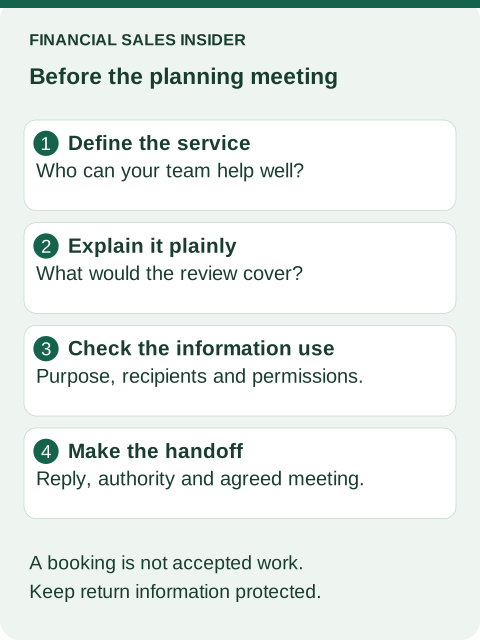
Firms that struggle to sell planning often let the early steps drift. The owner who said "send me something" in June hears back in August, and by then the moment has gone.
On this page
- The five steps before the meeting
- Step 1: pick the owners you market planning to
- Step 2: what you say in ads, posts and your website
- How to stop sounding like every other firm
- Step 3: offering planning to your own prep clients
- Step 4: reply with a reason to meet
- Step 5: book the person who signs
- Where to start this week
- Questions firm owners ask
- Sources
The five steps before the meeting
| Step | The job | What usually goes wrong | Guide |
|---|---|---|---|
| 1. Who you market planning to | Pick the owners you serve well | Marketing to everyone, so nobody feels it is for them | Niches for tax planning |
| 2. What you say in public about planning | Say plainly what planning does for those owners | The same words every other firm uses | Explain planning in one minute |
| 3. Your prep clients | Offer planning to owners you already serve | Not checking the section 7216 rules first | See the 7216 section below |
| 4. The inquiry and first reply | Reply fast with a reason to meet | The reply waits until the partner is free | Who handles new inquiries |
| 5. The booked meeting | Identify decision authority | The wrong person turns up, or nobody does | Hand it to your agenda: tax planning meeting agenda |
Step 1: pick the owners you market planning to
Planning is easier to market when you can say who it is for. Look at the business owners you already serve well. Note the entity types, industries and situations where your advice made a real difference, and start there.
A firm that plans for restaurant owners or construction firms can write about their deadlines, their margins and the questions they ask. A firm that plans for "small businesses" has to explain itself every time.
Step 2: what you say in ads, posts and your website
What you say in public decides who inquires. Name the owners you plan for, the situations you help with and what a first meeting covers. Owners who see their own business in your words are more likely to ask.
Be careful what you promise. Our guide to selling planning without promising a savings number covers what to say in place of a dollar figure.
For IRS matters, Treasury Circular 230 sets out what a practitioner may say in marketing. Key points, in plain words:
- No misleading claims. Section 10.30(a)(1) bans false, fraudulent, coercive, misleading or deceptive statements in any public communication or private solicitation (31 CFR 10.30).
- Published fee information. Section 10.30(b) lets you publish fixed fees for specific routine services, hourly rates, a range of fees for particular services and the fee for an initial consultation. If you publish a schedule, you may charge no more than those rates for at least 30 calendar days after the last date it was published.
This is a plain-words summary and not legal advice. Your state board has its own advertising rules too.
How to stop sounding like every other firm
Many firm websites use the same words, such as proactive and year-round. Owners remember the firm that talked about their kind of business.
- Name the owner types and situations you plan for on your website and in your first reply.
- Use the same words in your LinkedIn headline and email signature, so every place an owner finds you says the same thing.
- Show your process. A sample plan for a made-up business tells an owner more than a list of services.
Step 3: offering planning to your own prep clients
Existing preparation clients may ask about additional planning, but possession of return information is not general marketing permission. Decide the specific use, intended recipient and service before contacting them.
The IRS Section 7216 information center describes limited permitted client-list uses under 26 CFR 301.7216-2(n), including tax and general business information and solicitation of additional return-preparation services. It also identifies restrictions on using that list to solicit other services. A list permission is not permission to disclose the underlying return to a marketer.
Other exceptions and consent requirements may apply to a particular use or disclosure, including the accounting-services provisions. Do not assume every planning offer, EA practice or outside supplier fits the same exception. Have the proposed service, information, recipients, consent wording and timing reviewed under the applicable rules before using return data. Separate a permissible use within the practice from disclosure to another business; a generic booking agreement does not resolve those questions.
Step 4: reply with a reason to meet
An owner who inquires about planning has a reason, even if the form doesn't say it. A new entity, a big profit year, a sale on the horizon, a bill that surprised them in April. Your first reply should reflect the reason actually given, or ask what prompted the inquiry, then offer an appropriate next step.
Keep the reply short. Say who you help, what the meeting covers and how long it takes. Offer two times. Leave the explanation of planning for the meeting itself.
Decide in advance who sends that reply and how fast. If it waits for the partner to be free, the owner often books with someone else.
Step 5: book the person who signs
Ask who else needs to be part of the decision before you confirm the time. If a spouse or co-owner signs too, invite them to the same meeting. Our questions to ask before you book help you check the fit first, and our guide to cutting no-shows covers confirmations and reminders.
Once the meeting is booked, send the owner what it will cover and what to bring. Our tax planning meeting agenda covers the meeting itself, and proposal or engagement letter covers what you send after.
Where to start this week
- List your last ten planning inquiries and mark the step where each one stopped.
- Rewrite your first reply so it offers two meeting times.
- Add a planning line to your website and email signature.
- Send each booked owner a short note on what the meeting covers and what to bring.
- Ask your adviser about the 7216 consent step in your intake.
Questions firm owners ask
How do I sell tax planning services to business owners? Pick the owners you want, say plainly what planning does for them, reply to each inquiry fast and book the meeting with the person who signs.
Can a tax firm offer planning to existing preparation clients? Check the specific use and any disclosure under Section 7216. Limited preparation-client-list permissions do not provide blanket permission to solicit other services or share tax information. Exceptions, consent form and timing need review for the actual facts.
Can I advertise my tax planning fees? Circular 230 section 10.30(b) allows published fixed fees for routine services, hourly rates, fee ranges and the initial consultation fee. The section limits charges above published rates for at least 30 calendar days after the last publication. Ask your adviser how this applies to your firm and your state board's rules.
Where do firms often find their first planning clients? Often in two places. One is your own prep clients, within the section 7216 rules above. The other is referral partners who already advise business owners, such as attorneys and financial advisers. Our guide to referral and client-acquisition channels for tax professionals compares the sources.
Sources
Selected claims and editorial wording reviewed November 4, 2026 against the linked primary guidance. Source publications retain their stated years and scope. This is a professional workflow aid, not an individual tax determination or a ready-to-use legal agreement.
- 31 CFR 10.30, Solicitation (Treasury Circular 230), eCFR
- 26 CFR 301.7216-2, Permissible disclosures or uses without consent, eCFR
- 26 CFR 301.7216-3, Disclosure or use permitted only with the taxpayer's consent, eCFR
Related: Tax planning meeting agenda · Proposal or engagement letter · Referrals and client acquisition for tax firms