
Minnesota tax preparation: personal returns, business work and help options
Start Minnesota tax preparation by identifying the work you need. A personal return, a business-entity return and a response to a tax letter call for different information and sometimes different professional help. A clear scope makes it easier to compare services and arrive with the right records.
This guide brings together preparation decisions and Minnesota resources. Local guides describe useful service distinctions; they do not establish participating FSI firms or available appointments.
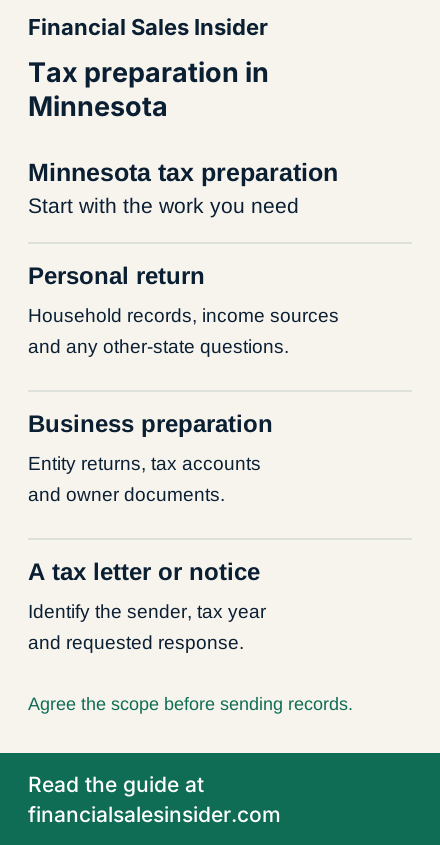
FSI preparation diagram with branding and guide link. The accompanying text explains the records and scope.
On this page
Choose the preparation route that fits the work
| Work needed | Start with |
|---|---|
| A household return | Income statements, the previous return, household changes and relevant state records. |
| Self-employment or a side business | The business activity, existing filing treatment and whether the records are reconciled. |
| A separately taxed business | The entity's prior returns, accounts and documents needed by its owners. |
| A move or work in another state | Residence dates, actual work locations and the related income and withholding statements. |
| A tax letter | The sender, tax year, requested action and response date. Keep this separate from ordinary preparation. |
The personal preparation checklist covers the household handoff. The Minnesota business preparation guide explains how to separate state business-return work, tax accounts and owner documents.
For a letter from the IRS, the notice and letter guide provides a starting point for identifying the task. A Minnesota agency letter is a different matter; use the sender's official contact and response instructions rather than assuming the federal process applies.
Gather Minnesota records with the household documents
Keep a copy of the previous return and current income statements together. Identify missing or corrected documents, dependents and household changes, and any questions carried forward from earlier filing work.
Minnesota's official preparation checklist includes records such as Certificates of Rent Paid, education expenses and property-tax statements where relevant. These documents do not establish eligibility for a credit by themselves. Tell the preparer which records apply to you and ask which current-year forms and conditions need review.
If you also own a business, keep its books and entity papers separately labeled. A pile of receipts does not explain whether the accounts are complete or which taxpayer's return each document affects. Agree who resolves bookkeeping questions before preparation begins.
Compare experience, credentials and the actual engagement
The Minnesota Department of Revenue's choosing-a-preparer guidance explains that the department does not require tax preparers to be licensed. It also recommends asking about professional designations, training, relevant experience, fees and year-round contact.
A claimed CPA or enrolled-agent credential therefore needs its own verification. So does experience with the return or issue you actually have. The CPA and enrolled agent guide explains the credential distinction without treating it as proof that a particular professional accepts your assignment.
Ask how the fee is calculated, what preparation and review are included, and which additional work is separately charged. Establish how you will receive copies and the submission result. If you want planning or later representation, confirm that scope rather than assuming it accompanies every prepared return.
Revenue also cautions against unusually large refund promises, refund-percentage fees and signing a blank return. Check the official guidance directly if you have concerns about a proposed engagement.
Check volunteer sites and practical access
Minnesota's free-preparation locator provides current site details for VITA and AARP Tax-Aide programs. The state page explains the available search options and records to bring. Confirm the particular program's eligibility, return limitations, appointment instructions and season before visiting.
Language, access and return scope matter as much as distance. University of Minnesota Extension's preparation resources point readers to the state locator and language options. Extension explains that it does not itself provide the preparation service.
Do not assume every volunteer site can prepare a separate company return, a complex self-employment return or every other-state situation. Describe the work before booking, and use the program's current instructions rather than an old brochure or last year's threshold.
Local preparation guides
- Minneapolis: compare personal and business scope, office location and metropolitan volunteer help.
- Rochester: check provider identity, return types and basic volunteer preparation.
- Duluth: organize Minnesota-Wisconsin work facts alongside personal or business preparation.
- St. Cloud: compare remote support and preparation scope, with a separate student-resource route.
- Alexandria: distinguish local program limits from paid preparation and ongoing business support.
- Brainerd: confirm the actual office and the personal, farm, business or estate assignment.
- Mankato: coordinate household organizers, closely held business records and any separate taxpayer work.
- Winona: compare return scope and distinguish a service request from the tax-organizer handoff.
- St. Paul: confirm the office and preparation, application or later-response scope.
- White Bear Lake: compare preparation and business records support with office, drop-off or remote arrangements.
- Bloomington: distinguish appointment and mailing locations alongside personal, international or entity work.
- Bemidji: confirm the records destination, monthly accounts and separately scoped financial services.
- Fergus Falls: distinguish original preparation, review of a filed return and business-record cleanup.
- Grand Rapids: compare Minnesota preparation and document handoffs, with additional services agreed separately.
- Moorhead: organize Minnesota-North Dakota employment, other income and withholding facts.
- Plymouth: compare annual returns, specialized individual needs and separate planning or forecasting work.
- Maple Grove: identify the tax company and distinguish return, recurring-account and adviser assignments.
- Blaine: confirm the particular preparation or follow-up service and its published timing.
- St. Michael: identify current or past-due years, business records and the actual nearby-office arrangement.
- Cambridge and Isanti: distinguish preparation by a professional or volunteer from help preparing your own return.
- New Ulm: compare household assistance with separately accepted business, fiduciary or organization work.
- Albert Lea: distinguish a staffed program document handoff from an in-person or virtual appointment.
- Lakeville: identify the current practice and who holds earlier returns before agreeing new preparation.
- Detroit Lakes: compare preparation routes and record worksheets, with historical program arrangements checked for the current season.
- Hibbing: distinguish annual preparation, unfinished business accounts and a separate tax-letter response.
- Willmar: agree an understandable return-review arrangement and confirm advertised language support and current intake.
- Hutchinson: separate annual returns from recurring accounts and financial reports requested by another recipient.
- Eden Prairie: distinguish annual preparation from business formation, accounting setup and separately requested applications.
- Woodbury: separate annual household or business returns from monthly accounts and any chosen financial advice.
- Burnsville: identify the named tax provider when preparation is offered at a financial-planning office.
- Eagan: agree who reviews in-house records, makes corrections and supplies final figures for preparation.
- Northfield: confirm which returns are accepted or referred and distinguish nearby office and mailing arrangements.
- Edina: compare actual return scope, readable document delivery and the completed-return review arrangement.
- Cloquet: confirm the current intake arrangement before choosing a preparation service or making a trip.
- Hermantown: distinguish annual return preparation from separately requested planning and business accounting.
- Virginia: identify the current preparation provider and separate filing work from other organization services.
- Stillwater: compare return scope and the document intake, preparation and review visits.
- Owatonna: select the organizer and supporting record set that match the household, farm, rental or business return.
- Anoka: compare preparation from ready financial statements with monthly accounting, controller support and planning.
- Shakopee: agree who maintains asset and disposal records and supplies the final figures for preparation.
- Coon Rapids: distinguish documents received for a return from separately commissioned business year-end reporting.
- Minnetonka: ask explicitly who accepts the income-return work and any separate foreign-account report.
- Richfield: confirm personal preparation, any application or renewal assistance and the language for discussion.
- Roseville: describe consulting or other independent-work records alongside household and retirement information.
- Buffalo: identify the return and supporting farm, business or recurring work included in a preparation quote.
- Apple Valley: explain another state, foreign income or an earlier filing before agreeing additional preparation work.
- Cottage Grove: agree who receives dropped-off records, resolves questions and arranges review of the finished return.
- Inver Grove Heights: distinguish current preparation, review of an earlier filing and an actual agency letter.
- New Brighton: identify customer or project reports separately from the final figures needed for annual preparation.
- Elk River: compare the actual return with both accepted services and explicitly excluded work.
- St. Louis Park: distinguish available activity records from financial summaries when agreeing the preparation work.
Before authorizing filing
Review the completed returns and resolve unanswered questions. Confirm what has been submitted, what still needs action and how any rejection or later correspondence will be handled. Keep the final copies, relevant records and remaining payment or document instructions together.
Reviewed on 17 November 2026. Site listings and service descriptions do not guarantee eligibility, appointments, credentials or FSI participation.