
Personal tax preparation: choose the right help and know what gets filed
Personal tax preparation should end with an accurate return you understand, a clear account of what was submitted and copies you can use later. Choosing between software, free assistance and a paid tax professional starts with the returns and support you need.
A straightforward annual return and a household with self-employment, investments, several states or missing prior-year filings may need different help. Describe those facts before comparing prices. A higher fee, a professional title or a promise of a larger refund does not establish that the service fits.
Choose a preparation route that fits your return
| Route | Check before starting |
|---|---|
| Prepare your own return | Whether the software supports your forms, states and tax year, what assistance costs and how corrections are handled |
| Free preparation assistance | Current eligibility, appointment arrangements and whether the particular site can handle your return |
| Paid individual tax preparation services | The named preparer, relevant experience, included returns, secure exchange, review process and support after filing |
The IRS publishes Free File options, with different eligibility and capabilities. Check current filing-season availability and the supported tax year before choosing this route. Start through the official IRS page, review the provider conditions and confirm any state-filing charge. Free federal preparation does not automatically mean every connected service is free.
VITA and Tax Counseling for the Elderly provide basic preparation assistance to qualifying individuals. Services depend on the site and the expertise available. Check suitability before bringing a complicated return or assuming a business filing is covered.
With paid help, distinguish credentials from the service agreement. The CPA, enrolled agent and tax preparer comparison explains professional status and representation limits. Ask whether the individual regularly handles your circumstances, rather than assuming a credential answers that question.
Define the years, states and household facts first
Prepare a short outline of the filing work. Include the tax year, any earlier unfiled or amended returns, where you lived and worked, and significant household changes. Mention marriage, separation, dependants, a move, a death or income from another country when relevant. The preparer can identify the additional questions and records needed.
State returns need explicit scope. Someone who moved or worked across state lines should explain the dates and income sources, rather than assuming one home address settles every filing question. Ask which state or local returns the engagement includes and which require separate review.
Business activity also needs a boundary. Freelance or sole-proprietor income may form part of the personal filing assignment; ownership in another business can require information from a separate return. The business preparation guide explains how to agree that handoff. Do not assume the personal preparer has received every business document simply because the same firm handles both jobs.
Build a records pack and identify what is missing
Agree the document list with the preparer. A useful starting pack separates information by year and person, and marks corrected or replacement forms clearly.
| Record group | Examples to discuss |
|---|---|
| Prior filing | Complete previous returns, relevant correspondence and any outstanding corrections |
| Income | Employment statements, investment statements, retirement distributions, business or rental records and other income information |
| Deductions and credits | Records relevant to the expenses, contributions, dependants or benefits you are asking the preparer to assess |
| Payments | Withholding, estimated payments, extension payments and records of amounts already paid |
| Changed circumstances | Residence/work dates, household changes, purchases or disposals and other facts affecting the return |
| Filing details | Identification and any requested filing-security information, supplied through the agreed secure method |
This is an organising tool, not an exhaustive list of deductible expenses or required forms. A receipt does not establish eligibility for a tax benefit. Explain what happened and let the preparer identify the applicable treatment and evidence.
If a form is missing or appears wrong, list the issue separately. Ask what must be obtained or corrected before filing and who will follow up. Sending an incomplete pack without identifying the gap can leave each person assuming the other has resolved it.
Agree what the preparation fee includes
A comparable proposal names the federal, state and local work, tax years, responsible preparer and review arrangements. Ask whether the quote assumes complete records or includes help organising them. Identify separate charges for additional schedules, amended returns, bookkeeping or later correspondence.
Consider a hypothetical household that changed states and has one partner with freelance income. A quote for one federal return does not answer whether both states and the business schedule are included. A useful comparison asks each provider to price the same facts and describe what remains outside scope.
Ask how questions are handled during preparation and after filing. Identify a contact who will still be available if a form is corrected later or a notice arrives. Availability does not itself mean amendments or representation are included.
Share documents through an agreed secure process
Begin an initial enquiry with a description of the work. Before transmitting returns, identity records, bank information or dependent details, obtain the firm's secure transfer instructions and confirm the recipient.
Keep an inventory of what you supplied and any outstanding questions. If another adviser is sending information, confirm who requests it, what permission is needed and who checks receipt. Financial Sales Insider's public enquiry descriptions are not a place to upload confidential tax records.
Review the return before authorising filing
The IRS's preparer-selection guidance explains that taxpayers remain accountable for their return. Paid preparers must include their identifying PTIN and sign where required. A PTIN is not a guarantee of specialist expertise.
Review the actual return and ask about unfamiliar figures before signing the applicable authorisation. Check the names, filing facts, income, payments and bank details against your records. Do not sign a blank return. Have the preparer explain unresolved items and the effect of any proposed correction.
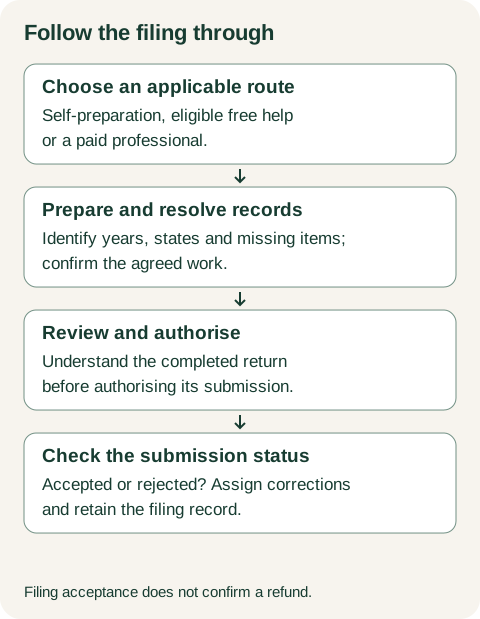
Preparation, authorisation, submission and acceptance are separate steps. Ask who sends the return, who monitors its status and how you will learn about a rejection. Acceptance of an electronic filing is not a promise that every reported item has been substantively approved or that a refund has been released.
Confirm completion and keep the after-filing record
Request a complete copy of the filed returns, applicable submission or acceptance records and a summary of any payment instructions. Check which returns are complete and whether any remain outstanding. Retain the underlying supporting documents as well as the final PDF.
If an extension is needed, agree who requests it and what evidence will be retained. The IRS distinguishes an extension to file from time to pay. Confirm the actual dates and payment obligations for your year and situation; a preparation appointment does not settle them.
For a rejected filing, record the reason, the person responsible for correction and how resubmission will be checked. If a later notice arrives, keep the complete letter and contact the agreed preparer or an appropriate representative. The IRS notice guide separates common notice tasks from routine filing.
Questions about personal tax preparation
Do I need paid help for every personal return?
No. Compare your actual forms and support needs with self-preparation and current free-assistance options. Eligibility, supported forms and confidence handling the records matter more than an assumption that every household needs the same service.
Does preparation include planning for next year?
Only if that work is agreed. Filing concerns the return; forward planning considers decisions and projected circumstances. Ask for the specific analysis and deliverables rather than interpreting a brief filing conversation as a complete planning engagement.
Is the job complete when I sign the return?
Signing or authorising filing does not establish that submission has occurred. Confirm the submission arrangement, status follow-up, copies and any remaining payments or returns. The useful completion record names what was filed and what still needs action.