
Minnesota business tax preparation: returns, accounts and owner coordination
Minnesota business tax preparation should start with a work list: the entity's returns, information needed by its owners and any separate tax-account filings. Identify who prepares and reviews each item. Registering a business or obtaining a tax ID does not show that these filing responsibilities have been completed.
Use the business's existing federal tax treatment and prior returns as the starting point. A trading name or “LLC” in the legal name is not enough to identify the return-preparation assignment.
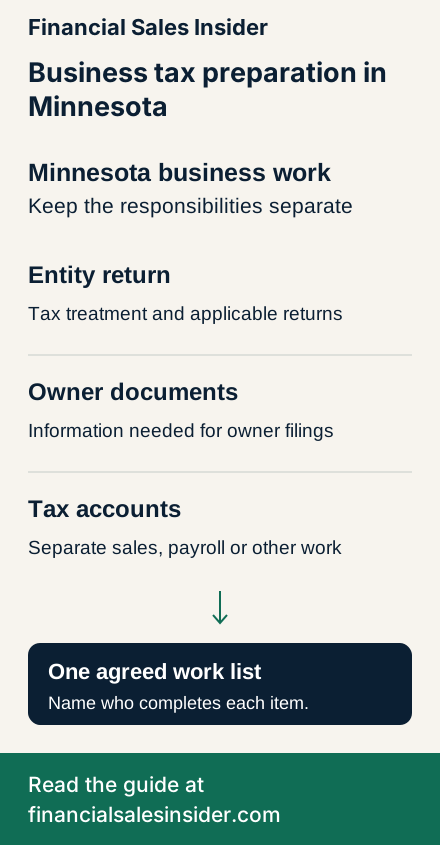
FSI preparation diagram with branding and guide link. The accompanying text explains the records and scope.
On this page
Identify the Minnesota return work
The Minnesota Department of Revenue's partnership filing guidance explains the state return requirements for a partnership with taxable Minnesota gross income and the relevant federal filing obligation. It identifies Form M3 as the partnership return.
The same guidance distinguishes S corporations with Minnesota income, which use Form M8. It also explains that a single-member LLC's Minnesota income-tax form depends on its federal tax treatment. Do not assume all LLCs file the same return or that every partnership has identical filing circumstances.
Give the preparer the prior federal and state returns, any election or classification records and a clear account of changes during the year. Ask which state requirements apply to the entity's actual income and activity. This is an engagement-scoping step, not a recommendation to change entity structure.
Keep registration and recurring tax accounts separate
Revenue's tax-ID requirements describe circumstances requiring a Minnesota Tax ID, including applicable business-return filings, taxable sales and employee withholding. These are different responsibilities. A single identification number does not mean one annual income-tax engagement covers every account.
Prepare an account list showing which taxes the business is registered for, who handles each filing and any unresolved notices. Identify sales or payroll work separately from income-tax preparation. If the business changed its organization or activity, ask the professional to review the effect rather than assuming old arrangements remain appropriate.
| Workstream | Confirm who handles |
|---|---|
| Entity income-tax returns | Federal and applicable Minnesota preparation, review and submission. |
| Owner information | Documents needed for owners' separately scoped filing work. |
| Bookkeeping | Reconciliations, missing transactions and final figures for preparation. |
| Sales or payroll accounts | The applicable recurring filings, payments and any corrections. |
| Notices or prior-year issues | A separate response assignment and its deadlines. |
The national business preparation checklist provides the broader records handoff. This Minnesota guide adds the state return and account distinctions; it does not replace the rules for a particular entity.
Compare preparation with broader business support
Minnesota service pages show why proposals need a scope comparison. Ellingson & Ellingson's business-tax page distinguishes entity-level return preparation from strategic review and year-round advisory support. A business should establish which deliverables it is buying rather than assume every preparation engagement includes continuing planning.
MPS Tax describes business and farm preparation alongside bookkeeping, payroll reporting and representation. These categories may relate to the same business, but they are not interchangeable assignments.
Minnehaha Business Services' published service page explicitly separates business returns from bookkeeping and lists formation and payroll services separately. Its price list is labeled 2022, so it should not be used as a current Minnesota price benchmark. The useful comparison is the separation of work, not an old advertised fee.
These examples describe provider-published scope. They are not an FSI recommendation, independently verified credential record or confirmation of present availability.
Prepare one entity-and-owner handoff
Identify the legal entity, tax year, prior filing treatment and the person responsible for answering records questions. Label owner information separately from entity accounts so it is clear whose work each document affects.
Explain whether the books are final. Identify unreconciled accounts, missing documents and corrections before asking the preparer to rely on totals. Agree a cutoff and a clear way to deliver replacement records without leaving two conflicting versions in the file.
If the business operates or has owners in other states, disclose those facts early. Ask which state-return and owner questions the engagement includes. Do not assume one Minnesota filing resolves every owner's separate obligations or makes a particular election beneficial.
Review the deliverables and unfinished work
Before authorizing submission, review the returns and ask about unresolved items. Confirm how you will receive final copies and the submission result, and who handles a rejected filing. Keep payment instructions, owner documents and separate account filings on a remaining-action list.
Ask what ongoing support or later notice work is included. The CPA and enrolled agent comparison helps explain credentials; relevant business-return experience and the exact engagement still need direct confirmation.
Return to the Minnesota preparation guide for household preparation and local resources.
Reviewed on 17 November 2026. This guide defines preparation questions and records, not an entity election, tax-saving result or individual filing determination.