
CPA, enrolled agent or tax preparer: choosing business tax help
"Tax preparer" describes a role, not one professional credential. A CPA or an enrolled agent can also prepare tax returns. For a business owner, the useful comparison is the person's current status, relevant experience and the work they will actually deliver.
If you own a profitable business, choosing between a CPA and an enrolled agent starts with the work you need done. A credential matters, but it does not tell you whether someone has handled your ownership structure, industry or next transaction.
The right question is whether the professional can coordinate the business and owner issues in your engagement. Neither title promises a smaller tax bill.
On this page
- What the credentials establish
- Where other paid preparers fit
- Compare the engagement against your business situation
- Check credentials separately from suitability
- Compare scope before comparing fees
- Put the business proposal in writing
- Questions to take to the first conversation
- Questions about preparers and business credentials
- Related resources
- Sources
What the credentials establish
Certified public accountants are licensed by state boards of accountancy. Enrolled agents are licensed by the IRS. The IRS identifies CPAs and enrolled agents, along with attorneys, as having unlimited representation rights before the IRS. Those rights include audits, collection matters and appeals. They do not mean that every practitioner specializes in every tax issue. [1]
| Question | What to establish |
|---|---|
| Is the credential current? | Check the relevant state board for a CPA or the IRS status process for an EA. |
| Does the person advise owners like you? | Ask about the actual entity, industry and ownership decisions they handle. |
| Who will do the work? | Identify the adviser, return preparer and reviewer rather than relying on the firm's name. |
| What happens if a notice arrives? | Confirm whether representation is included, separately engaged or referred elsewhere. The IRS notice workflow explains how to identify the actual issue before agreeing that assignment. |
An enrolled agent's tax focus can be relevant to an owner needing tax preparation, planning or IRS representation. A CPA may offer tax alongside broader accounting services. Ask which services the particular practitioner actually provides. The IRS itself notes that CPAs offer different services and some specialize in tax preparation and planning. [1]
Where other paid preparers fit
The IRS distinguishes credentials from a paid preparer's PTIN. A PTIN is the identifying number required for paid federal return preparation; holding one is not the same as being a CPA, EA or attorney. Its credential guidance also explains the different representation limits. [1]
| Status | What it tells you | IRS representation distinction |
|---|---|---|
| CPA | State accountancy licensure; services and tax specialisms vary. | Unlimited representation rights before the IRS, including audits, collection matters and appeals. |
| Enrolled agent | IRS licensure; check current status separately. | Unlimited representation rights before the IRS, including audits, collection matters and appeals. |
| Annual Filing Season Program participant | Participation in an IRS voluntary annual education programme, not CPA or EA licensure. | Limited rights for qualifying returns the participant prepared and signed, before revenue agents, customer service representatives and similar IRS employees, including the Taxpayer Advocate Service. Those rights do not extend to appeals or collection matters. |
| PTIN holder without another qualifying credential or status | A paid-preparation identifier, rather than proof of a professional credential or specialist competence. | A PTIN alone does not confer authority to represent clients before the IRS. |
The IRS describes additional conditions on the limited rights of Annual Filing Season Program participants, including the relevant annual records of completion. Check the actual status and return involved instead of assuming participation covers any future matter. Attorneys also have unlimited IRS representation rights; the tax attorney versus CPA guide separates that from the court-admission question. [1]
This is not a skill or price ranking. A credential does not establish that a practitioner regularly handles your entity, industry or transaction, while a PTIN alone does not answer the credential or representation questions.
For the filing process itself, the personal preparation guide covers household records and completion, while the business preparation guide separates entity work and owner handoffs. These workflows do not change the credential checks above.
Compare the engagement against your business situation
Recurring owner and entity work
If you receive income from several entities, ask who reconciles the entity work with your personal return and planning. A good initial discussion should identify ownership interests, states involved, compensation arrangements, existing advisers and incomplete records.
Ask how projections are updated when results change. A promise of year-round support is difficult to evaluate without agreed meetings, deliverables and response arrangements. Request a description of what you receive between filing seasons.
A transaction or specialist issue
Selling a company, admitting a partner or changing ownership can require a team. Ask the CPA or EA which parts they handle and when they involve tax counsel, a valuation specialist or another adviser. Do not assume one credential covers every legal, accounting and implementation task.
Describe the transaction before choosing the professional. An adviser whose practice centers on routine individual returns may have a different service fit from one regularly coordinating closely held business transactions, regardless of title.
Check credentials separately from suitability
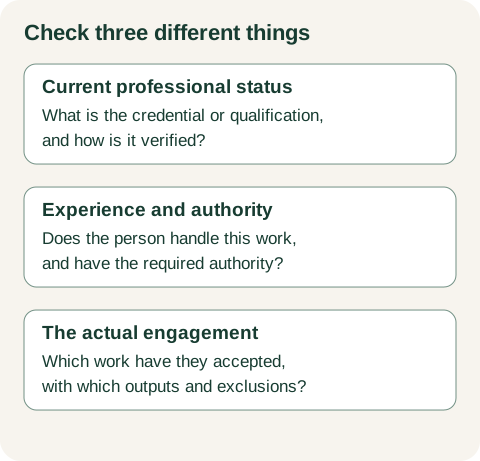
For a California CPA, use the California Board of Accountancy's lookup and read the status and any restrictions. For an out-of-state CPA serving a California business, ask about authorization to practice in California. The CBA explains that an absent lookup result alone does not establish that an out-of-state CPA lacks authorization. [2]
For an enrolled agent, follow the IRS's current status-verification instructions. [3] Then ask for relevant experience. A valid credential establishes something different from a recommendation, a review score or proof of specialist expertise.
The IRS preparer directory is another research tool, but its coverage has limits. Its FAQ explains that it does not include every valid PTIN holder. An unsuccessful directory search needs follow-up rather than an automatic rejection. [4]
Compare scope before comparing fees
Give each candidate the same outline: entities, owners, states, current records, upcoming decisions and the services you want. Ask whether the quote includes the entity returns, personal return, projections, implementation and notice responses.
For example, one proposal might cover annual filing and one meeting while another includes recurring projections and coordination with your bookkeeper. Comparing their headline prices alone would compare different work. This is an illustrative comparison, not a claim about typical fees or either credential's pricing.
Put the business proposal in writing
Use the same short brief for every candidate. List entities and owners, states and tax years, the condition of the accounts, current advisers and the decision you want help with. Ask for secure document instructions before sending returns or identity records.
| Proposal item | What to have confirmed |
|---|---|
| Preparation | The entity and personal returns, years and states included, with the responsible preparer and reviewer. |
| Records work | Whether the quote assumes completed accounts, and who handles reconciliation or cleanup. |
| Planning | The projections, meetings or written analysis delivered between filing seasons. |
| Coordination | Who requests information from the bookkeeper, other preparer or specialist and resolves missing items. |
| After filing | Whether notices or amendments are included, separately engaged or referred elsewhere. |
| Changes | How additional work is identified, approved and charged. |
A proposal that names only a return may be appropriate for a preparation-only assignment. It should not be read as an agreement to supply recurring planning, bookkeeping or representation. Conversely, do not buy a broader package without identifying the outputs you need. See the planning-fee comparison for a fuller engagement checklist.
Questions to take to the first conversation
- Which parts of my situation are within your regular practice?
- Who will advise me, and who reviews the work?
- How will business and personal tax decisions be coordinated?
- What work needs a separate specialist or engagement?
- What are the deliverables, exclusions and communication arrangements?
Choose the combination of current credentials, relevant experience and clearly agreed work. If you need help defining that requirement, start with your business situation and the decision you need to make, rather than asking for a CPA or EA without explaining the work.
Questions about preparers and business credentials
Can my CPA or EA also be my tax preparer?
Yes. Preparation describes the work, while CPA and EA describe credentials. Confirm that the professional offers the preparation you need and identify who will prepare and review it. [1]
Does paying for preparation include IRS representation?
Do not assume so. Representation rights describe what a status permits; your engagement describes the work someone has agreed to do. Check both, including who would handle an audit, appeal or collection matter. [1]
Should I reject someone who does not appear in the IRS directory?
Not on that fact alone. The directory does not include every valid PTIN holder. Follow up on the person's stated credential or status and their suitability for your assignment. [4]
Related resources
- Verify CPA license California
- Business tax planning fees
- Business owner tax planning documents checklist
- California tax planning for established business owners
Sources
[1] Internal Revenue Service, Understanding tax return preparer credentials and qualifications.
[2] California Board of Accountancy, License Lookup.
[3] Internal Revenue Service, Verify the status of an enrolled agent.
[4] Internal Revenue Service, Directory of Federal Tax Return Preparers FAQ.