
Gambling tax preparation in Nevada: winnings, losses and records
For gambling tax preparation in Nevada, bring the tax year and the full record of activity to the preparation discussion. A W-2G form is important, but it is not a complete record of all winnings, losses or withholding. Casual gambling, professional activity and nonresident returns can also require different analysis.
Nevada does not impose an individual state income tax, but that does not remove federal gambling-income obligations or settle another state's requirements. The Nevada income-tax explanation and IRS gambling guidance address different parts of that distinction.
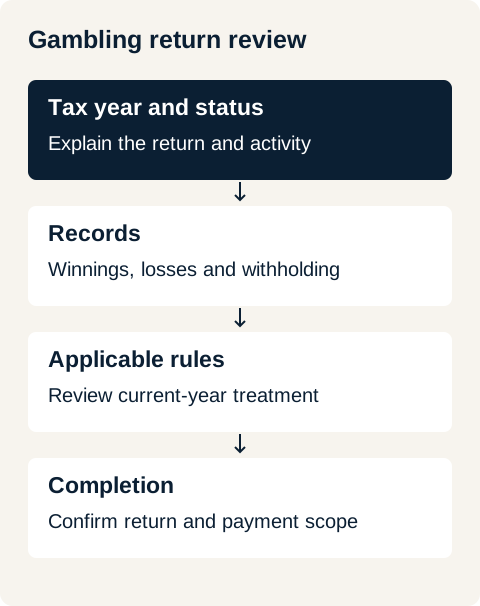
On this page
Separate the tax year, records and return type
Tell the preparer whether you need an original return, a correction to an earlier return or planning for the current year. Rules for a 2026 tax year should not be applied automatically to an earlier return simply because both are being discussed in 2026.
Describe whether the activity is occasional or connected to an asserted trade or business. Do not decide professional status from the size of one payout or an online account label. Ask the preparer what facts and records are needed for that determination.
If you are not a U.S. resident for tax purposes or have obligations to another state, say so at the beginning. This guide does not determine treaty treatment, residency or a particular filing position.
Bring more than W-2G forms to the preparation meeting
The IRS says gambling winnings are taxable even when no Form W-2G is issued, and it requires adequate records to support losses. Build a record set that lets the preparer understand the activity rather than supplying only forms received after a large win.
| Record | What it helps establish |
|---|---|
| W-2G forms and withholding information | Reported payouts and tax already withheld |
| A dated diary or equivalent detailed records | The activity, dates, locations and amounts being reviewed |
| Tickets, receipts and other supporting evidence | Support for the amounts recorded |
| Relevant casino or platform statements | Additional information to reconcile with your own records |
| Prior returns and related correspondence | Earlier treatment, unresolved questions or corrections |
A statement total should not be assumed to replace all supporting records. Give the preparer the available information and identify gaps or inconsistencies. Keep records even where activity produced no information form.
Ask for a current-year loss-deduction review
The IRS's final Publication 505 for 2026 states that, beginning in 2026, the gambling-loss deduction on Schedule A is limited to the lesser of 90% of gambling losses or gambling winnings. That is not a rule allowing 90% of winnings to be deducted.
For example, 90% of $10,000 of losses is $9,000. That arithmetic is only one part of the stated limit; it does not establish a taxpayer's deduction, itemization position or final tax bill. Have the relevant year's rules, records and other limitations checked.
An older article saying losses can always offset winnings dollar for dollar should not settle a 2026 return. Ask which current authority supports the treatment being proposed. Professional and nonresident situations need their own review rather than an assumption that a short Schedule A explanation answers every case.
Check withholding and estimated payments
Tax withheld from one payout does not establish that the year's entire liability has been covered. Supply withholding information together with other income and payment records. Ask the preparer whether estimated payments or a withholding review are needed for your circumstances.
Publication 505 explains federal withholding and estimated-tax rules. Do not apply a general percentage to a payout and treat it as a complete calculation without reviewing the whole return.
Confirm casual, professional or nonresident scope
Clayton Financial and Tax's professional-gambler page is an example of a Nevada firm's published specialist offer. A statement that a firm handles gamblers is a starting point for checking your required work, not an FSI endorsement, confirmed appointment or verified outcome.
Ask the person who would handle the return about the applicable tax year, record reconciliation, taxpayer status and any correction or representation work. Check their actual role through the preparer-credential guide.
The personal preparation guide covers the remaining household record set. If a letter has already arrived, use the IRS notice guide as a separate response task.
Questions about gambling tax preparation in Nevada
Are winnings without a W-2G ignored?
No. The IRS explains that gambling winnings must be reported even if no W-2G is issued. Provide the full activity records to the preparer.
Does breaking even mean there can be no tax consequence?
Do not assume that. Reporting, deductibility, tax year and taxpayer status matter. Have winnings and losses reviewed separately under the applicable rules.
Does this page describe a separate Nevada gambling income tax?
No. It helps Nevada-facing readers choose preparation and organize federal gambling records. For other state and local preparation resources, see Nevada tax help.