
Business tax preparation: define the returns, records and responsibilities
Business tax preparation works best when the engagement names every return, the records it depends on and the person responsible for each handoff. A business return, the owner's personal filing, bookkeeping and payroll are connected tasks with potentially different scopes.
Before comparing business tax preparation services, establish the business's actual tax classification, reporting period, ownership and jurisdictions. Then compare proposals for the same work. Neither the business's trading name nor a broad description such as full service tells you what will be filed.
Confirm what the business is filing
The IRS explains that business structure affects the income tax return. Give a prospective preparer prior returns, relevant entity and election records, ownership information and details of changes. Ask them to confirm the applicable treatment instead of selecting a return from a marketing label.
An LLC can have different federal tax classifications, depending on its owners and elections. The initials alone do not establish a separate entity income-tax return. Employment and other tax treatment can also differ. This guide does not recommend changing an election or legal structure.
| Scope question | Information to establish |
|---|---|
| Which business? | Legal entity, tax classification, identifying details and relevant elections |
| Which period? | Tax year or other reporting period, and any start, closure or ownership change |
| Which people? | Owners and other parties who need information from the business filing |
| Which jurisdictions? | States and other locations where operations, employees, property or sales may create questions |
| Which filings? | Named income, information, payroll or other work included or excluded from the engagement |
This is a scoping record, not a determination that every activity creates a filing obligation. Give the facts to the professional and identify who evaluates the relevant jurisdictions.
Separate bookkeeping cleanup from return preparation
Ask whether the preparation quote assumes reconciled accounts and who resolves discrepancies. Provide the current profit-and-loss report, balance sheet and supporting records in the format the preparer requests. Explain provisional figures, unusual transfers and any incomplete periods.
The IRS's recordkeeping guidance explains the role of underlying records in supporting reported income and expenses. A bookkeeping export is a starting point; it does not settle every classification or replace transaction evidence.
Useful issues to flag include unreconciled bank or card accounts, inventory adjustments, loans, assets bought or sold, owner payments, contractor information and payroll corrections. These are examples to discuss, not a universal document list or a conclusion about deductibility.
Agree who supplies each missing item and how questions are tracked. If cleanup is a separate project, ask how it affects the return timetable and price before treating preparation as underway.
Coordinate business and personal returns explicitly
Identify which information must pass between the business preparer and each owner's personal preparer, where applicable. Agree the expected delivery date, recipient and secure exchange. Ask what happens if the business information changes after it has been shared.
For a hypothetical owner with interests in two businesses, completing one entity's return does not establish that the owner's personal return is ready. The practical question is which documents remain outstanding and who joins the information together.
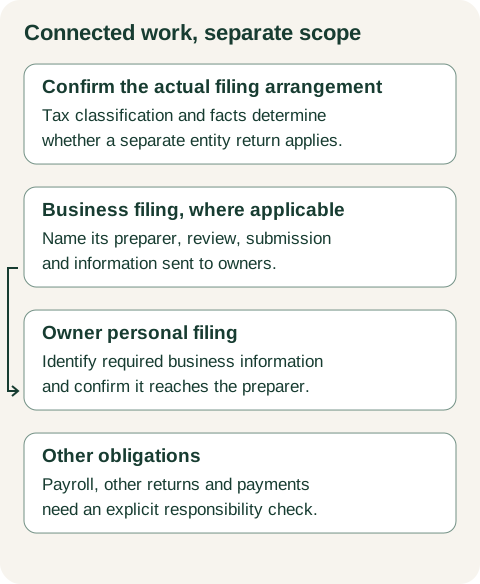
Some business activity is reported within an owner's return rather than a separate entity income-tax return. Confirm the actual arrangement. The personal preparation guide covers household filing records and review without assuming that one preparation fee includes every connected business task.
Compare proposals using a responsibility record
A written scope should make it possible to tell who prepares, reviews, authorises and submits the work. Ask how the firm will communicate missing information and how additions are approved. The business also needs a named person who supplies records and responds to questions.
| Work stage | Responsibility to agree | Evidence to retain |
|---|---|---|
| Records | Who reconciles accounts and supplies supporting documents | Records list, unresolved items and agreed handoff |
| Preparation | Named returns, periods and jurisdictions | Scope and drafts supplied for review |
| Review | Who checks the return and answers questions | Reviewed version and resolved changes |
| Authorisation | Who is entitled to approve and sign for the actual taxpayer | Applicable signed authorisation |
| Submission | Who sends each return and monitors status | Submission and available acceptance or rejection records |
| Payments | Who calculates, authorises and initiates each payment | Instructions and payment confirmations |
| Follow-up | Who handles corrections or later correspondence | Completion summary and agreed support scope |
These are engagement questions, not a substitute for the actual return's signature and filing rules. Ask the preparer to explain the requirements for your entity and filing method.
Give extensions and payments separate owners
If records will not be ready, ask about the extension procedure for the particular return and jurisdiction. Confirm who prepares the request, what estimate is needed and how timely submission will be evidenced. Do not assume the firm files an extension merely because it has received your documents.
For returns covered by Form 7004, the IRS instructions distinguish the filing extension from payment and require the applicable return to be identified. This is not a blanket extension for every business, payroll, state or owner obligation.
Keep an explicit list of payments and who initiates them. A calculation, a draft payment voucher and a completed transfer are different states. Confirm the account, tax period and proof of payment through the appropriate secure process.
Check current instructions and any applicable relief for the actual year. A general business guide cannot supply one deadline for every entity, fiscal period, state and circumstance.
Review the return against the agreed work
Before authorising filing, compare the return with the entity, period and records in scope. Ask the preparer to explain significant adjustments and how business information will reach the owners. Resolve unexplained differences rather than assuming they are standard tax entries.
Check the treatment of outstanding questions: an item may have been resolved, excluded from the assignment or left waiting for evidence. Those outcomes need different follow-up. A clean-looking final document should not conceal an unassigned task.
If the proposed work includes forward planning, identify its separate output. The planning-versus-preparation guide distinguishes filing from projections and decisions. A preparation engagement does not automatically include entity restructuring, payroll changes or transaction advice.
Keep a completion pack that another adviser can use
At the end, request complete filed returns, relevant supporting schedules, filing-status evidence and a list of outstanding actions. Record which information was delivered to owners or other advisers and which payments remain your responsibility.
Confirm who investigates a rejected submission, what information is needed and how a corrected filing will be tracked. Signing a draft or sending it to the firm is not proof of accepted electronic filing. Acceptance also does not settle every substantive tax issue.
Agree how long the provider remains available for preparation questions and whether amendments or notice responses need a separate engagement. If correspondence arrives, retain the complete notice and match it to the relevant entity and period before choosing a response. The IRS notice guide provides a federal starting point; a state notice follows that agency's procedure.
Questions about business preparation services
Does an LLC always file its own income-tax return?
No. The LLC label does not establish its federal classification. Give the preparer ownership and election records and have them confirm the correct return arrangement. Do not infer the answer from another LLC's filing.
Is payroll included in business tax preparation?
Only if the scope says so. Identify the specific payroll work, periods and provider. An income-tax preparation proposal should not be interpreted as responsibility for every employment-tax filing, deposit or correction.
How should I compare preparation fees?
Give each provider the same entities, periods, states, record condition and requested outputs. Compare exclusions, cleanup, owner coordination and follow-up alongside the fee. The planning-fee guide applies the same scope-first method to advisory proposals without inventing a standard market price.