
Nevada sales and use tax filing: records and return preparation
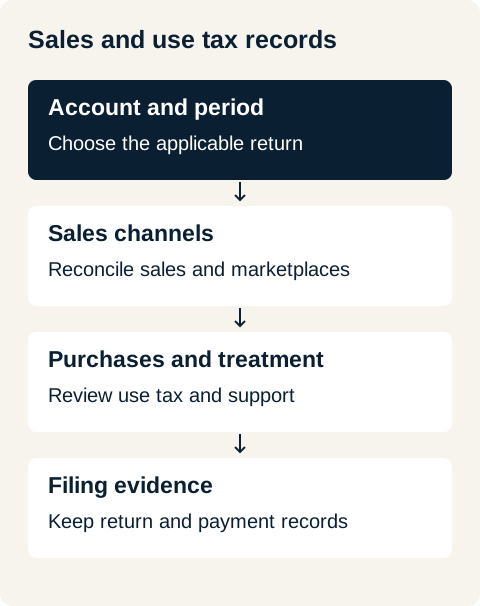
Nevada sales and use tax preparation requires more than taking a percentage of bank deposits. Start with the tax account and reporting period, then reconcile sales channels, returns, marketplace information and relevant purchases. Identify who decides the tax treatment and who submits and pays the return.
The Nevada Department of Taxation's sales and use tax page provides the forms, instructions and location-based rate resources. Use the applicable current instructions for the transaction and period rather than treating one county's rate or one example as a statewide answer.
On this page
Choose the sales or consumer-use return that fits the account
The Department distinguishes sales/use reporting from a consumer-use return. Its guidance describes consumer use tax reporting for relevant purchases where sales tax was not paid, including circumstances involving people or businesses that do not hold a sales permit.
Before preparing a return, confirm:
- The legal taxpayer and actual tax account.
- The period and filing frequency assigned to that account.
- The business activity and transactions being reviewed.
- Whether the task involves sales collection, consumer use, an amendment or an account question.
A business's federal tax return or bookkeeping report is not the state sales/use return. Ask the preparer to name the state work included. The Nevada business preparation guide explains how to separate these responsibilities.
Reconcile sales channels before calculating the return
Collect the records behind the reported figures, especially when sales pass through several systems:
| Record source | Preparation question |
|---|---|
| Point-of-sale reports | Do gross sales, returns and tax collected agree with the period's records? |
| Online store reports | Which transactions and destinations are included? |
| Marketplace statements | What did the facilitator collect and remit, and what remains the seller's responsibility? |
| Bank deposits | Which amounts reflect fees, refunds, transfers or timing differences? |
| Exemption or resale records | What supports the proposed treatment of those transactions? |
Marketplace collection should be evidenced, not assumed. Use the Department's marketplace guidance linked from its sales/use page and have the relevant responsibilities reviewed. Do not count the same transaction twice or assume that marketplace collection resolves every direct-sale or account obligation.
Match location, period and supporting records
Nevada publishes county and location rate resources and historical effective dates. A current rate is not automatically the correct rate for an earlier period. Likewise, an office address does not necessarily settle how a particular transaction should be treated.
Ask the preparer to document the relevant location and period, the applicable transaction treatment and any questions needing further review. Keep the records supporting exempt, resale or otherwise differently treated amounts.
Avoid a blanket assumption that all services are taxable or that every sale follows the same rule. Product, transaction, sourcing and registration questions need the applicable official guidance or professional review.
Keep use-tax purchases visible
Give the preparer purchase records as well as sales reports. Identify purchases on which sales tax was not charged or where the charged amount needs review. Include invoices and the facts about where and how the purchase was used.
Do not assume that being a consumer rather than a retailer removes every use-tax question. Conversely, a missing sales-tax charge is a reason for review, not enough information for this guide to determine a specific liability.
Agree on filing evidence and corrections
Keep the calculation, return copy, submission confirmation and payment evidence together, identified by account and period. The Department's returns and payments guidance explains electronic return copies and correction routes.
For an amendment, preserve the original figures, corrected figures and explanation. Confirm the applicable route and do not assume that requesting a credit means it is already available to use.
The Department's electronic-submission FAQ sets 7 December 2026 as the start of the new requirement and explains waivers and exceptions. Check the rules for the submission date. That date had not arrived at this guide's 13 November 2026 review.
If a notice has already been issued, read its requested action and deadline separately from the return-correction task. The Nevada business-notice guide covers that distinction.
Questions about Nevada sales and use tax filing
Can I prepare the return from deposits alone?
Deposits may differ from sales because of fees, refunds and timing. Use the underlying sales records and reconcile them to the books and bank activity.
Does a marketplace statement mean I have nothing to file?
Not necessarily. Confirm the facilitator's collection and remittance, your direct sales and your account's actual filing responsibilities.
Where do I find the right rate?
Use the Department's sales/use resources for the relevant location and period. The Nevada tax-help hub links the other business-filing guides.