
Nevada Commerce Tax filing: revenue review and return scope
Nevada Commerce Tax preparation starts with the business entity's Nevada gross revenue for the correct Commerce Tax year. It is not a household income test or a tax on business profit. Federal return figures may need reconciliation before they can support the Nevada review.
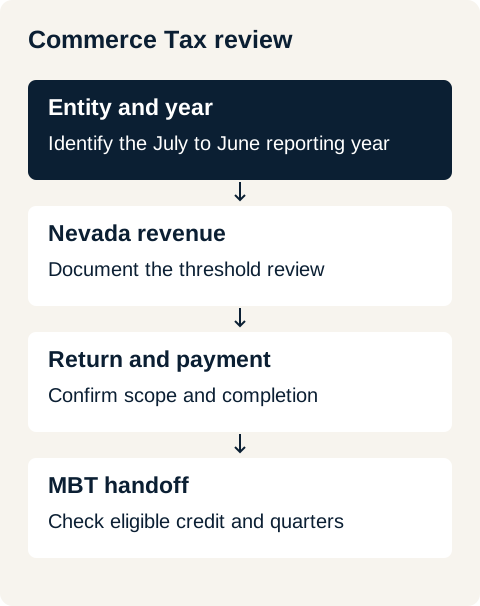
Identify the entity, reporting period, Nevada revenue and responsible filer before deciding what needs to be submitted. Keep the revenue analysis even when the conclusion is that a routine return is not required.
On this page
- Check the Nevada revenue threshold for the correct period
- Prepare a revenue bridge rather than copying federal sales
- Resolve industry classification and filing responsibility
- Keep filing, payment and corrections evidenced
- Coordinate the Commerce Tax credit with MBT
- Questions about Nevada Commerce Tax filing
Check the Nevada revenue threshold for the correct period
The Department's current Commerce Tax FAQ says entities with Nevada gross revenue over $4 million during the taxable year must file. It also explains that, from the 2018-2019 tax year onward, businesses with Nevada gross revenue of $4 million or less are generally no longer required to file a routine Commerce Tax return.
Older articles describing a mandatory simplified return below the threshold reflect earlier rules. Do not use those instructions as the basis for a current filing decision. Account closure, final returns, exemptions and unusual circumstances require their own review.
The Commerce Tax year runs 1 July through 30 June, regardless of the business's federal tax year. The Department's Commerce Tax page gives a due date 45 days after that year ends, with the stated weekend and holiday adjustment. Check the year and current instructions rather than copying an old article's calendar date.
Prepare a revenue bridge rather than copying federal sales
Give the preparer enough information to explain how the books connect to the Nevada figures:
| Preparation question | Supporting work |
|---|---|
| Which entity is being reviewed? | Legal name, account information and entity-specific books |
| Do the books use the Commerce Tax year? | A July to June report or a documented reconciliation from the business's usual year |
| Which revenue belongs in Nevada? | Transaction and location information supporting the applicable sourcing analysis |
| Are exclusions or deductions relevant? | The records and rule supporting each proposed treatment |
| Is the threshold conclusion supported? | A retained calculation, not a recollection of approximate annual sales |
Do not subtract ordinary expenses from revenue and call the result the threshold measure. Ask the preparer to explain the applicable revenue rules, exclusions and deductions separately.
Resolve industry classification and filing responsibility
The tax treatment includes industry classification. Confirm that the activity and classification used on the return match the actual business and the current instructions. An old registration description may not explain a later change in operations.
For businesses with several entities, identify each entity's responsibility. The Department's FAQ does not allow a federal consolidated-return assumption to be carried into Commerce Tax filing.
An out-of-state incorporation does not answer whether Nevada obligations exist. Give the adviser the operating and Nevada-revenue facts so the applicable connection and filing questions can be reviewed. This guide does not determine a particular business's nexus or classification.
Keep filing, payment and corrections evidenced
Agree who prepares the revenue calculation, reviews it, submits the return and authorizes payment. Retain the final return, submission confirmation and payment evidence for the correct account and year.
Use the Department's returns and payments guidance for current filing and amendment routes. Its electronic-submission FAQ specifies a new requirement beginning 7 December 2026, subject to stated waivers and exceptions. That start date was still upcoming when this guide was reviewed on 13 November 2026.
If reviewing an earlier year or closing an account, state that explicitly. Do not submit a second original return merely because the first calculation needs correction; identify the applicable amendment or final-return process.
Coordinate the Commerce Tax credit with MBT
The Department describes an MBT credit equal to 50% of Commerce Tax paid, subject to the eligible following quarters and applicable entity or affiliated-group rules. It is not an automatic refund or a credit against every tax account.
Keep the Commerce Tax payment evidence and a record of credit use. Where a payroll provider files MBT, establish who sends it the available credit and checks that the amount was used in an eligible quarter. The Nevada MBT guide covers the quarterly payroll-side handoff.
Questions about Nevada Commerce Tax filing
Is $4 million the business's profit threshold?
No. The Department's test concerns Nevada gross revenue for the applicable Commerce Tax year, with the relevant rules applied.
Does an LLC automatically avoid Commerce Tax?
No. The entity's name or federal classification does not resolve the Nevada revenue and filing review. Provide the actual facts and check the current rules.
Where does this fit in my overall business preparation?
It is a separate state assignment. The Nevada business preparation guide distinguishes federal returns, payroll, sales/use and Commerce Tax. The Nevada hub groups the supporting resources.