
Business tax preparation in Ohio: agree the returns and responsibilities
Ohio business tax preparation should begin with a list of entities, owners, tax years and filing responsibilities. A quote for the company return does not establish that owner returns, Ohio pass-through tax, municipal work or payroll filings are included. Define the work before comparing fees.
This guide helps business owners scope preparation, whether the business is new, established or part of a more complex group. It does not determine which returns you owe or establish that Financial Sales Insider provides the professional tax work.
Identify the taxpayer behind each return
List each legal entity and its federal tax classification. Include ownership changes, any tax elections and the prior returns. An LLC can be treated differently for federal income-tax purposes depending on its members and elections; the letters after its name do not identify the return. [1]
For example, an owner asking about a sole-proprietor Schedule C needs a different filing scope from partners waiting for a partnership return and K-1s. Someone with both an operating company and a separate property entity should explain both, including which existing preparer handles each.
The Ohio individual preparation guide covers the personal-filing side. Where entity work supplies information for the owner, agree who coordinates the two engagements.
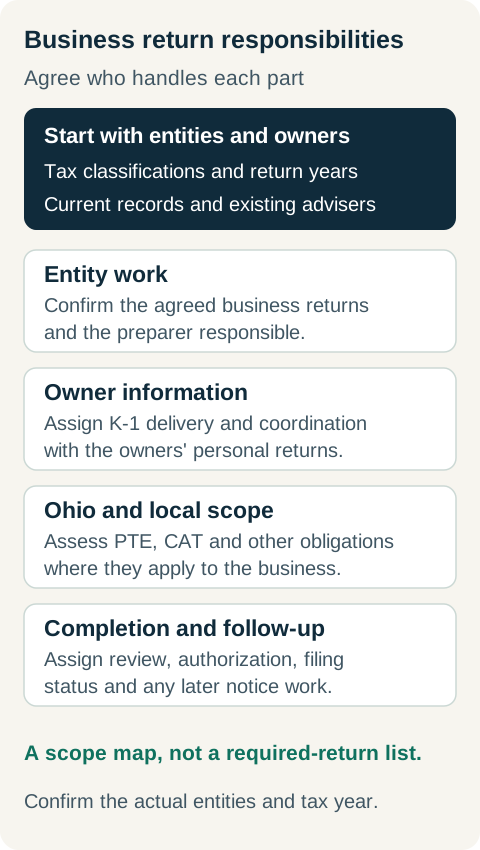
The diagram shows a responsibility chain, not a list of returns every business must file: establish the entities and classifications, prepare the agreed entity work, coordinate owner information, and check separately scoped Ohio or local obligations.
Put the filing scope into a responsibility list
| Work to assess | What the agreement should identify |
|---|---|
| Federal entity returns | The actual entities, classifications, years and responsible preparer. |
| Owner returns and K-1s | Who prepares owner information, who receives it and how unresolved items are handled. |
| Ohio pass-through work | Which Ohio return or election is being assessed and who coordinates entity and owner treatment. |
| Commercial Activity Tax | Applicability, account status, Ohio receipts and any group filing responsibilities. |
| Payroll, sales tax and municipal work | Which obligations the firm handles and which remain with another provider. |
| Corrections and notices | Whether prior periods, amended returns or responses require a separate engagement. |
This list is a comparison tool. It does not mean every business has every obligation. A preparer should explain the facts behind the proposed work, rather than describe an undefined “all taxes” package.
Understand the Ohio pass-through question
Ohio's IT 4738 is an entity-level election for qualifying pass-through entities. It is different from the IT 1140 withholding and IT 4708 composite arrangements, under which the entity files and pays on behalf of owners or investors. A disregarded entity cannot make the IT 4738 election. [2]
Ask the adviser which arrangement is being considered, whose income is included, and how it connects with owner returns and other-state work. Ohio explains that the IT 4738 choice applies for one tax year, binds the owners and cannot be changed for that year. It also restricts filing IT 1140 or IT 4708 for the same year after electing IT 4738. [2]
Have the responsible adviser record the facts and choice for that year. This guide does not recommend an election or promise savings.
Do not confuse a CAT payment exclusion with closing the account
Ohio's Commercial Activity Tax uses taxable gross receipts, not an owner's personal income or business profit. Its rules also address Ohio sourcing, nexus, excluded businesses and combined or consolidated groups. A company-revenue figure alone does not settle the filing position. [3]
Ohio states that the annual exclusion increased to $6 million for tax years 2025 onward. However, its guidance also says an active CAT account requires returns even below the taxable-receipts amount. If an account should be canceled, that needs to be handled properly; simply stopping returns can lead to notices or bills. [3]
Give the preparer account details and prior filings, not just the current sales total. Ask whether the engagement includes checking registration status and any necessary account changes. The exclusion should not become a blanket “no filing required” conclusion.
Resolve records and owner-information dependencies early
Agree which reports must be ready before preparation begins: reconciled accounts, asset records, payroll, owner payments, ownership details and prior notices. Identify missing information and ask whether bookkeeping cleanup is included or separately charged.
For a hypothetical partnership with an unresolved ownership change, the important question is who resolves the underlying records and approves the treatment before owner information is finalized. Quoting a filing fee alone does not allocate that work.
Set an information timetable between the business, preparer and owners. Ask how owners will be told about missing K-1 information, corrections or a filing extension. Use a secure transfer process for detailed accounts, identifiers and payroll records.
Separate filing extensions, payments and completed work
Confirm who calculates payments and who submits them. An extension to file is not a general extension to pay. For IT 4738 specifically, Ohio explains that the filing extension does not move the original payment due date. Use the instructions for the actual return and year. [2]
Before completion, agree who reviews the returns, obtains authorization, checks submission status and supplies copies. Ask who handles a rejection or subsequent notice. Verify professional credentials and relevant experience, while recognizing that a CPA or EA credential alone does not establish expertise with every entity or jurisdiction. [4]
Questions before accepting a preparation proposal
Does the business fee include my personal return?
Only the agreed scope answers that. Identify every owner whose return needs coordination, any K-1 dependency and work retained by another adviser. Entity preparation and personal filing can be coordinated without being the same engagement.
Will the preparer also advise on future decisions?
Ask explicitly. The planning-versus-preparation guide explains the distinction. A return engagement should not silently become a promise of projections, entity restructuring or implementation.
How should I compare quotes?
Give each firm the same entity, year and records summary. Compare included returns, cleanup, owner coordination, Ohio and municipal scope, review and exclusions. For a separate planning proposal, the planning-fee guide offers a comparison framework rather than a preparation price average.
Use the Ohio tax-help resources for the broader route through filing, planning and local guides.
Sources
Checked October 31, 2026. Filing obligations, elections and deadlines depend on the actual taxpayer, return and year.
[1] IRS: Federal classification of a domestic LLC.
[2] Ohio Department of Taxation: IT 4738 electing pass-through entity income tax return.
[4] IRS: Understanding tax return preparer credentials and qualifications.