
Tax preparation in Ohio for individuals and self-employed people
Ohio individual tax preparation starts with the returns you need, not just finding someone to enter your W-2. Ask a prospective preparer to confirm the tax year, income sources and federal, Ohio, school district and municipal work included. A personal return with freelance income needs a different scope from a business entity's return.
You can use this guide for an ordinary filing question or a more complex household. High personal income is not a requirement for understanding your filing options. Financial Sales Insider publishes these resources to help you compare the work; this page does not establish an available preparer or a professional engagement.
Match the preparation service to your income
Describe what changed during the year before asking for a price. Wages, pension payments, brokerage sales, rental property and self-employment can involve different records and schedules.
| Your situation | What to confirm with the preparer |
|---|---|
| Wages or retirement income | Which household members and income statements are covered, and whether a move changes the filing scope. |
| Investments or rental property | Whether the quote includes transaction reporting, rental expenses and existing depreciation records. |
| Freelance or sole-proprietor income | Whether Schedule C, self-employment tax and estimated-payment records are included. |
| Ownership in a partnership or S corporation | Who prepares the entity return and supplies the K-1 needed for your personal return. |
For a sole proprietor, the IRS describes Schedule C as the place to report business profit or loss and Schedule SE as the calculation of self-employment tax. Estimated payments are another question to assess, rather than assuming a year-end filing resolves everything. [1]
An LLC's legal name does not settle its federal tax classification. The number of members and any election matter. Explain the existing arrangement instead of requesting an unspecified “LLC return.” [2]
Check Ohio, school district and city work separately
Use the full addresses where you lived, the dates of any move and the relevant tax year. Give the preparer your work locations too. A postal city or five-digit ZIP alone is not a reliable way to settle every tax boundary.
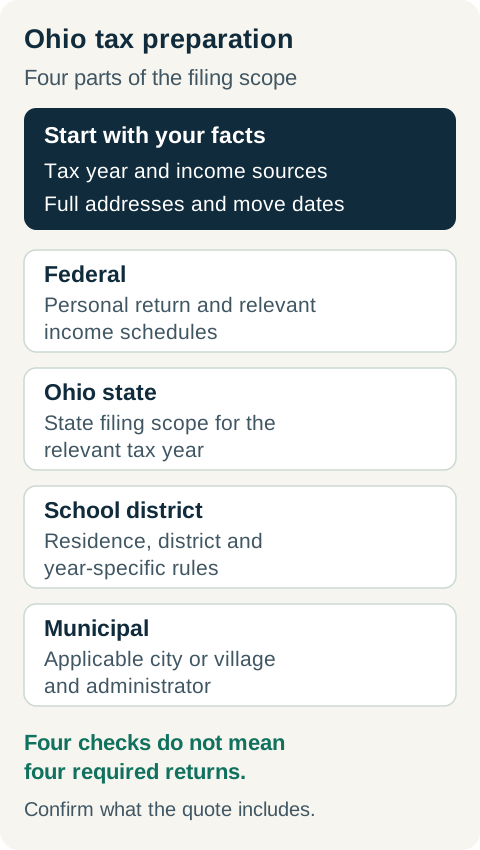
The diagram separates four scope checks: federal filing, Ohio state filing, school district income tax and applicable municipal filing. It does not say every person needs four returns.
School district tax depends on the actual district
Ohio's school district guidance distinguishes residence-based school district income tax from city tax. A school district liability can exist even when there is no Ohio state income-tax liability. [3]
Check the district, tax type and applicable year rather than treating retirement income or self-employment income identically in every district. Ohio distinguishes traditional and earned-income tax bases. Its Finder also warns that a five-digit ZIP search can produce more than one school district. [3][4]
If you moved between districts, identify every address and residence period. Ohio provides a consolidated SD 100 for tax years 2023 and later; its guidance describes separate district returns for 2022 and earlier. An old year's instructions should not be applied automatically to a current filing. [3]
Municipal filing is its own scope question
Ask which city or village returns the preparer will assess and which administrator handles them. Ohio's municipal links direct individual tax questions to the municipality or its administering agency. A promise to prepare an “Ohio return” should therefore identify whether municipal work is included. [5]
The Ohio location guides can help frame a local discussion. A guide about a city does not prove that a particular firm has an office there or can accept your work.
Prepare records that explain the year
Start with income statements, the prior return and a short account of changes. For self-employment, include income and expense records, relevant asset information and payments already made. Identify missing or unreconciled items so the preparer can explain any cleanup needed. [1]
For example, someone with wages and a new freelance activity should describe both sources and ask how they will be reported together. Someone receiving a partnership K-1 needs to establish who supplies it and what happens if it is delayed. These are illustrative filing situations, not claims about FSI clients.
Begin an enquiry with a non-sensitive summary. Agree a secure transfer process before sharing returns, Social Security numbers, bank details or identity documents.
Compare qualifications, scope and the fee
Paid federal preparers need a PTIN. CPAs and enrolled agents have unlimited representation rights before the IRS, but credentials do not establish experience with every return or industry. Ask who prepares and reviews your work and whether they regularly handle your circumstances. [6]
Request a quote that identifies the year, returns and schedules, jurisdictions, cleanup and follow-up. Ask whether an amended return, prior-year filing or later notice is a separate engagement. An advertised starting price is not an Ohio-wide average or a quote for your facts.
Before filing, agree how you will review the completed returns, authorize submission, receive copies and learn the filing status of each included return. Identify who follows up if a submission is rejected. Keep those responsibilities separate from any promise about a refund amount or timing.
If you want future decisions modelled as well, use the planning-versus-preparation guide to clarify that additional work.
Questions before choosing a preparer
Does self-employed income always require a separate company return?
No. A sole proprietor generally reports business activity on Schedule C with the individual return. An LLC's federal classification depends on its members and elections; a corporation or partnership involves different entity work. Confirm the actual classification before agreeing the scope. [1][2]
Does one preparation fee include every Ohio-related return?
Do not assume so. Request a written list of the federal, state, school district and municipal work included, along with any exclusions. Use your actual addresses and tax year to identify the questions that need checking.
Are there official free filing options?
Check the IRS's free e-filing options for current availability, eligibility and supported returns. As checked on October 31, 2026, IRS Free File is closed and directs users to check back in January 2027. Free federal software does not automatically include free state or municipal filing. [7]
The IRS also explains VITA and TCE free basic preparation for qualifying taxpayers. Confirm the site's eligibility, availability and supported work before relying on it for a business, rental or otherwise complex return. [8]
Sources
Sources checked October 31, 2026. This guide explains preparation scope and does not determine your filing obligations or recommend a tax election.
[1] IRS: Self-employed individuals tax center.
[2] IRS: Federal classification of a domestic LLC.
[3] Ohio Department of Taxation: School district income tax, including year-specific SD 100 guidance.
[4] Ohio Department of Taxation: Finder school district features and ZIP limitations.
[5] Ohio Department of Taxation: Municipal individual income-tax sites.
[6] IRS: Understanding tax return preparer credentials and qualifications.
[7] IRS: E-file, do your taxes for free. Availability checked October 31, 2026.
[8] IRS: Free tax return preparation for qualifying taxpayers.