
Ohio tax help for individuals and business owners
The right starting point for Ohio tax help depends on the work you need: filing a personal return, preparing business returns, reviewing future decisions or responding to a notice. Use these resources to describe the task and compare the professional scope offered by CPAs and enrolled agents.
Choose the resource for your task
| What you need | Where to start |
|---|---|
| Help with wages, retirement, investments or self-employment on a personal return | Ohio individual and self-employed preparation. |
| Business entity returns and coordination with owners | Ohio business tax preparation. |
| Help understanding an IRS, Ohio or municipal letter | Ohio tax notice help. |
| Analysis before a purchase, ownership change or another business decision | Tax planning versus preparation, followed by a relevant local guide below. |
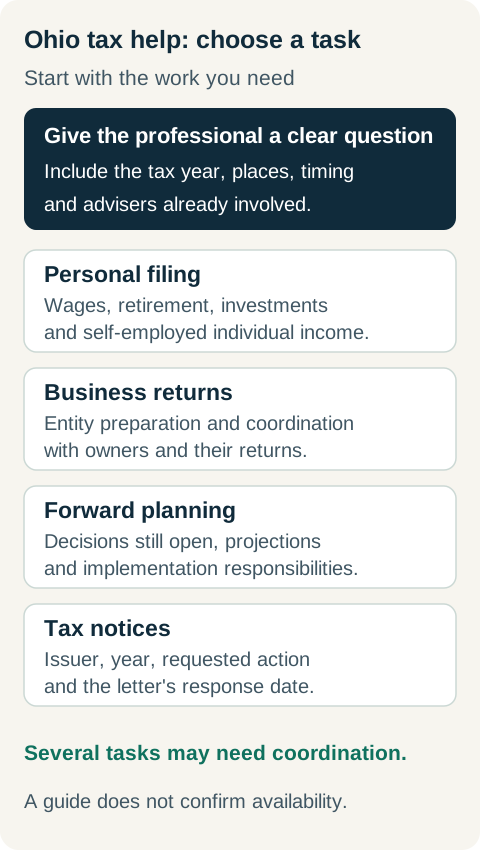
The diagram shows four different starting tasks. They can overlap: a business owner may need entity preparation, a coordinated personal return and planning. Identify which work is already assigned before asking a new adviser to take responsibility.
For basic filing assistance, the Ohio individual preparation guide also explains how to check current federal options and a volunteer site's supported work. Confirm any separate Ohio, municipal or school district work rather than assuming a federal service includes it.
Include the right Ohio and local questions
A federal return is not a complete description of every Ohio filing question. Tell the preparer your full home and work addresses, move dates, business locations and tax year. Check state, school district and municipal scope separately.
Ohio's school district guidance ties that tax to residence and distinguishes traditional and earned-income tax bases. Its Finder warns that five-digit ZIPs can cross district boundaries. A mailing city or ZIP alone should not decide the filing scope. [1][2]
For business owners, legal structure and tax classification are different questions. Ohio's elective pass-through tax arrangements also need their own entity-and-owner review. Ask which returns, elections, payments and jurisdictions the professional proposes to assess rather than assuming an “Ohio business return” covers everything. [3][4]
If your circumstances cross a state line
Separate where you live, where you work and where the entities operate. Wage reciprocity should not be treated as a universal answer for business income, owner compensation or municipal taxes. Ohio's employer guidance includes specific reciprocal-state rules and a relevant exception for certain nonresident pass-through owners. [5]
The Cincinnati guide develops a Kentucky-related owner question. The Oakwood guide considers income taxed elsewhere, while Youngstown addresses a residence-change situation. These are particular scenarios, not fifty-state determinations for every reader.
If property creates the question
Explain whether you need rental-income reporting, depreciation records, a proposed sale or exchange, or a property-tax assessment reviewed. These are different assignments. Rental losses also involve rules beyond simply owning property; IRS rental and passive-activity resources provide background, with their relevant tax-year editions identified. [6][7]
Describe the property, entity, location and decision before asking for a specialist. Property value or an investor label does not establish the owner's personal income or eligibility for a deduction.
Choose an Ohio location guide
Each guide develops a local owner decision, records question or engagement choice. Use the explanation that fits your circumstances rather than assuming every guide covers every service.
- Bellefontaine business tax planning and equipment sales
- Business tax planning and JEDD account coordination for Canton owners
- Compare business tax planning help in Centerville
- Business tax planning help for Cincinnati owners
- Business tax planning help for Cleveland owners
- Business tax planning help for Columbus owners
- Choose business tax planning help in Cuyahoga Falls
- Business tax planning help for Dayton owners with mixed results
- Business tax planning help for Dublin owners
- Tax planning and municipal filing help for Grandview Heights owners
- Compare owner pay and benefit tax planning for a Kettering business
- Choose business tax planning services in Middletown
- Compare business tax planning for Oakwood owners with income taxed elsewhere
- Business tax planning for Parma owners expanding payroll
- Tax planning for Sidney owners stepping back while keeping business income
- Business tax planning for Springfield owners after the RITA handoff
- Strongsville business tax planning and employee plan support
- Toledo business tax planning and employment transitions
- Troy business tax planning and lodging examples
- Choose business tax planning help in Vandalia
- Business tax planning for Youngstown owners changing residence
A location guide does not establish an available local firm, a nearby office or a provider's participation in FSI. Confirm professional experience, credentials, accepted work and current capacity directly. CPA and EA credentials and representation rights are useful starting checks, but do not establish expertise with every situation. [8]
Prepare a useful inquiry and compare the work
Begin with a concise, non-sensitive description: the issue, tax year, relevant places, timing and professionals already involved. Business owners should include their ownership role and entities. Use an agreed secure process for returns, identifiers and detailed financial records.
A request starts a discussion about fit. It does not confirm an appointment, a professional engagement or a tax result.
Compare the proposed deliverables, exclusions and responsibilities. For planning, the business tax planning fees guide helps compare scope; the planning documents guide explains how to prepare relevant records. Neither is a quote for preparation or evidence that all services are bundled.
Tax professionals and tax firms
Listing a firm, receiving referrals and commissioning marketing are different arrangements. The national client-growth guide and lead-provider comparison explain questions for evaluating acquisition approaches. They do not establish an active paid FSI offer, available Ohio leads or a promised result.
Sources
Checked October 31, 2026. This overview does not determine a reader's filing obligations. Jurisdiction, tax year and individual facts matter.
[1] Ohio Department of Taxation: School district income tax.
[2] Ohio Department of Taxation: Finder school district features.
[3] IRS: Federal classification of a domestic LLC.
[4] Ohio Department of Taxation: IT 4738 electing pass-through entity income tax return.
[5] Ohio Department of Taxation: Employer withholding filing requirements, including reciprocity.
[8] IRS: Understanding tax return preparer credentials and qualifications.