
Tax preparation in Cleveland, Ohio
Tax preparation in Cleveland can mean personal filing, self-employed reporting or a separate company return. Compare those jobs first, including the municipal work accepted. An ownership-change review may be valuable for a business facing that decision, but it is not a condition for getting ordinary preparation help.
Use this guide to compare personal and business preparation, then any additional local or planning work. The Ohio tax-help overview provides the wider state and location routes.
On this page
- Personal tax preparation
- Compare official basic help and private preparation
- Business tax preparation
- Planning beyond the completed return
- Choose a continuing tax engagement before adding transaction work
- When ownership changes require a separate Cleveland review
- Match the team to the decision that changes your tax work
- Ask for a separate CCA workstream
- Test the proposal with a partner-buyout question
- Define the deliverables before comparing fees
- Choose the business tax help that fits your needs
- Sources
Personal tax preparation
For a personal return, describe wages, retirement statements, investment activity and any self-employed or rental records. Include where you lived and worked during the year, the dates of changes and payments already made. Ask which federal, Ohio and applicable local returns the preparer will assess and prepare; a quote for an Ohio return needs a separate municipal-scope answer.
The taxpayer matters in Cleveland's CCA discussion. The local section below distinguishes corporations and partnerships from individual Schedule C, E or F activity. Do not choose an undefined business package merely because your personal return includes income-producing activity. Equally, ask who supplies the final company information if you own an interest in a separately filing entity. [3]
A wage-only household and an owner waiting for that information can need different amounts of preparation work. Give the prospective firm the actual records summary and identify missing items before comparing fees. Ask who prepares and reviews your return, how you approve submission and receive copies, and who follows up on a rejection. Clarify whether prior-year filings, amendments or a later notice are separately priced. The Ohio individual preparation guide gives further household and self-employed detail.
Compare official basic help and private preparation
For a straightforward personal filing, check the IRS's VITA and TCE basic-preparation options. Confirm the site's supported returns, own eligibility conditions, season and appointment arrangements. The IRS does not set one programme-wide VITA income ceiling; individual sites may set limits. A programme link does not establish an available local appointment.
The IRS Free File page, checked November 3, 2026, says the service is closed and to check back in January 2027. Check the next season's terms when published. Free federal software does not automatically include the state or municipal work you need. If the programme or software cannot cover the return, compare a private preparer's actual scope and fee.
Business tax preparation
A Cleveland company should identify each entity, classification, tax year and existing adviser before requesting a preparation quote. Provide reconciled books, prior returns, ownership records, asset information, payroll and payment confirmations. If the records do not reconcile, ask for the cleanup scope and resulting reports before relying on a filing price.
Request a written division between entity returns, owner information and individual returns. The local CCA work also needs an identified taxpayer and administrator. Ask which business net-profit filings, employer-withholding tasks and owner filings the engagement accepts and which remain with another provider. A municipal administration election is a separate fact to verify, with the taxpayer exclusions discussed below retained. [2][3][4][5]
An ordinary preparation engagement can continue while a proposed partner buyout receives a separate assessment. Name who resolves the ownership and basis questions, approves the conclusions and supplies usable information to the return preparer. Do not treat a section 754 discussion as a standard deliverable for every company or a conclusion about an individual purchaser.
Finally, agree who reviews and authorizes each return, submits it, checks the result and resolves a rejection. Allocate payments, delivery of owner information and final copies, with later corrections and transaction analysis separately scoped. The Ohio business preparation guide explains the wider entity-to-owner workflow.
Planning beyond the completed return
Choosing business tax planning in Cleveland starts with your present workload, not with an assumption that you are buying or selling a company. You may need a business return prepared, continuing company-and-owner advice, or a specialist assessment before ownership changes. A CPA or enrolled agent's proposal should distinguish those assignments.
Choose a continuing tax engagement before adding transaction work
For an established business staying under the same ownership, compare who prepares the entity return, reviews the books supplied by your accountant and addresses the owner's related reporting. Ask whether the municipal return is included and whether the professional will explain differences from the federal figures. Return preparation and reconciliation should not disappear behind a promise of strategic advice.
If you want advice during the year, give the candidate a decision that is still open and ask what written analysis you will receive. Establish how actual profit changes reach the projection and what continuing support means for your business. A quarterly conversation without updated inputs is different from a revised calculation.
A partner purchase adds another assignment: the buyer, seller and continuing business may need different advice. Before appointing a transaction specialist, ask the current preparer what work is already accepted and what will be excluded. Compare the complete fee across both engagements, including who carries the approved treatment into returns. A specialist appointment should fill an identified gap rather than duplicate an existing service.
When ownership changes require a separate Cleveland review
An ownership change can leave you with several tax questions that belong to different people. The business may need a transaction analysis, the purchasing owner may need a separate calculation, and the continuing entity may have municipal reporting work that differs from its federal return.
When comparing business tax planning help in Cleveland, ask who will connect those pieces. A useful proposal should identify the decision, the taxpayers affected, the calculations you will receive and the person responsible for implementation. A broad promise to handle business taxes does not describe that division of work.
Match the team to the decision that changes your tax work
Start with what you are considering: buying a partner's interest, adding a purchasing entity, acquiring operating assets or expanding into another municipality. These are different assignments. Tell the prospective adviser what is still negotiable and which documents have already been signed.
Ask for experience with the transaction and ownership structure, including municipal work. The IRS explains that CPAs, enrolled agents and attorneys have unlimited representation rights before the IRS, while their skills and specialties differ. Those rights do not establish experience with your particular purchase or Cleveland reporting. [1]
Name the existing participants: the business preparer, each owner's adviser, attorney and bookkeeper. Ask who leads the analysis and who reviews assumptions supplied by another professional. You may need an additional specialist rather than a complete change of firm.
Ask for a separate CCA workstream
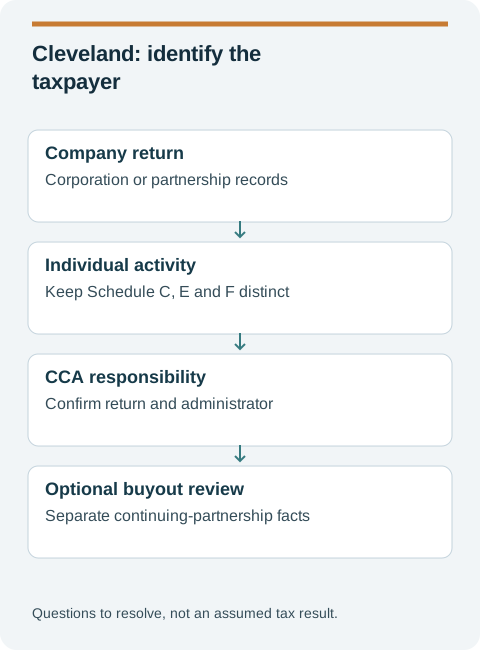
Cleveland identifies the Central Collection Agency, or CCA, as its municipal income-tax collection agency. Municipal work deserves an explicit place in the engagement alongside federal and Ohio work. [2]
CCA's business FAQ distinguishes corporations and partnerships filing its net-profit form from individuals reporting Schedule C, E or F activity on its individual form. Its individual category includes sole proprietorships and single-member LLCs reported that way federally. An LLC label alone therefore does not tell you which return or taxpayer your proposal must cover. [3]
Request a short responsibility map showing the legal entity, federal classification, municipal filing position, administrator and person preparing each return. Keep employer withholding and the owner's personal work separately identified.
An eligible entity may have elected Ohio state administration of municipal net-profit taxes. That election must be checked, not assumed; it continues until valid termination. This regime excludes natural persons and entities subject to Ohio Revised Code Chapter 5745. It is not a way to transfer every personal or payroll obligation to the state. [4][5]
Test the proposal with a partner-buyout question
Consider a hypothetical established partnership in which one partner proposes to sell an interest to another owner. Before asking how much tax the purchase will save, ask which taxpayer would receive any adjustment and how federal and municipal treatment would be reconciled.
CCA addresses a specific partner-sale situation involving an Internal Revenue Code section 754 adjustment. It says the continuing partnership cannot claim that adjustment on its municipal net-profit return in the described fact pattern. Its answer distinguishes that partnership from a purchasing partner, including the corporate and partnership purchasers it discusses. [3]
That distinction is a useful test of an adviser's explanation. It is not a recommendation to make an election or a conclusion about your transaction. Ask the team to identify the seller, purchaser and continuing entity on separate schedules, explain the applicable treatment and state what additional facts could change it.
The requested work product is a bridge from the federal analysis to municipal reporting, showing adjustments and their owner or entity. One combined savings number cannot show whether the amount belongs to the buyer, the operating business or another taxpayer. Ask to see unresolved assumptions before deciding that a quoted benefit justifies the transaction costs.
Define the deliverables before comparing fees
Compare proposals against the same assignment. Useful items to specify include:
- The transaction alternatives being assessed and documents required before analysis begins.
- The business entities, owners, tax years and municipalities included.
- Written federal and municipal calculations, with assumptions and limitations.
- Coordination with counsel and responsibility for approved elections, filings and closing-related actions.
- An updated projection after the final terms are known, including who revisits expected payments.
Bring the ownership agreement, proposed purchase documents, recent business and owner returns, K-1s, prior municipal filings, payment records and operating-location information. Ask which additional records are needed rather than sending confidential files through an initial inquiry.
Use our explanation of tax planning versus tax preparation to check which parts of your existing engagement already cover this work. Then ask the prospective firm to identify additions and exclusions in writing. An attractive fee is difficult to compare when one proposal includes analysis and another includes implementation and filing.
Can one CPA handle the whole engagement?
Possibly, but ask how the firm covers each part rather than assuming one credential answers every question. A lead professional can coordinate specialists. You should know who reviews municipal adjustments, who handles the purchasing owner's return and who follows through after closing.
Can a remote adviser handle Cleveland tax work?
Compare the actual expertise and working arrangement. Ask how the adviser obtains local records, confirms filing positions and coordinates with your existing team. An office address is less informative than a clear account of the work the firm can perform and the limits it identifies.
What if my current preparer already knows the business?
Ask them first whether the ownership-change analysis is included or can be added. If another specialist is needed, agree who supplies records, reviews the recommendations and incorporates the final treatment into returns. Avoid leaving two firms each expecting the other to complete that step.
Choose the business tax help that fits your needs
Compare the accepted returns, records, fees and responsibilities before appointing a preparer. Check the responsible professional's current status and relevant experience using the IRS explanation of preparer credentials. A credential category does not establish experience with every local or owner situation. The guide to tax planning versus tax preparation explains the additional planning assignment.
Share confidential documents only through an agreed secure process. Identify the existing advisers and the ownership question before transferring the records they need.
Sources
[1] IRS: Understanding tax return preparer credentials and qualifications.
[2] City of Cleveland: Division of Taxation, CCA.
[3] CCA: Business FAQs, filing requirements and IRC section 754 adjustments.
[4] Ohio Revised Code section 718.80: Municipal net-profit administration election.
[5] Ohio Revised Code section 718.81: Definitions and taxpayer exclusions.