
IRS and Ohio tax notice help: choose the right next step
Start tax notice help by identifying who sent the letter, the tax year, its notice number, what it asks you to do and the response date. An IRS correction, an Ohio school district inquiry and a municipal tax bill follow different procedures. Do not choose a debt-settlement service before understanding the actual issue.
This guide helps individuals and businesses organize the question and compare professional help. It does not establish representation by Financial Sales Insider or promise an available firm, reduced balance or paused enforcement.
Read the request before deciding how to respond
The IRS sends notices for several reasons, including a balance due, a changed refund, a question about a return, identity verification or processing delays. Its guidance says to locate the CP or LTR number, review the letter and retain it. [1]
Create a short record before contacting anyone:
| Record | Why it matters |
|---|---|
| Issuing authority and notice number | Establishes which procedure and contact route to check. |
| Tax year and taxpayer | Separates your personal return from an entity or another period. |
| Requested action | A request for documents is different from a payment instruction. |
| Response date | Determines when the stated action needs attention. |
| Relevant return, payments and earlier correspondence | Helps explain agreement, disagreement or an apparent mismatch. |
Keep the original notice and evidence of any response. If authenticity is uncertain, follow the issuing authority's official verification guidance. The IRS notice resource provides a notice search and instructions for suspicious letters. [1]
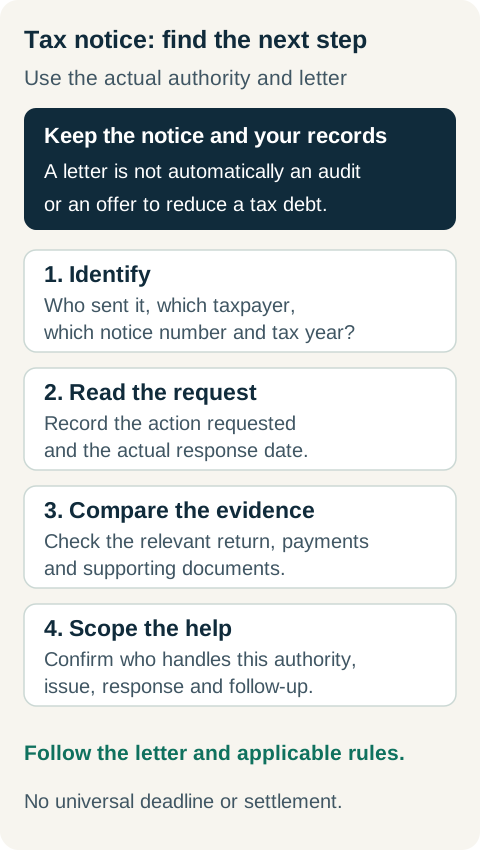
The diagram's sequence is: identify the issuer and year, record the action and date, compare the evidence, and decide whether you need professional help for that authority and issue. It does not replace the notice's instructions.
Agreement does not answer every response question
For an IRS notice you agree with, take the action requested. The IRS says you do not need to reply unless it specifically asks you to. If you disagree, follow the notice's dispute instructions and supply the relevant supporting documents by the due date to protect appeal rights. [1]
Agreement may still require payment, verification or another action. A professional should identify the issue before proposing work.
Check Ohio and municipal letters with their own authority
For an Ohio school district failure-to-file notice, verify the district, year and addresses used. Ohio's notice explanation describes supplying residence dates and supporting evidence when the notice's assumptions do not match where you lived. It directs readers to the response date on the notice and the official response process. [2]
Use the current instructions for the year concerned. The notice article is dated August 2024 and includes older separate-district filing wording. Ohio's current school district guidance distinguishes separate SD 100 returns for 2022 and earlier from a consolidated form for 2023 and later. Do not assume an old explanation settles how to file the year in your letter. [2][3]
A city or village notice is another scope question. Ohio's municipal resource directs individual tax questions to the municipality or its administering agency. [4] Local examples such as the Grandview Heights account-correction guide can help frame a records discussion, but do not establish the procedure for every municipality or IRS case.
Choose representation for the actual work
Ask whether the proposed engagement covers interpreting the letter, preparing a response, correcting a return, an examination, collection discussions or an appeal. Identify the authority and years, who will communicate with it, and whether authorization is needed.
CPAs, enrolled agents and attorneys have unlimited representation rights before the IRS. Relevant expertise and an accepted engagement still matter. A PTIN or a past return-preparation engagement does not by itself establish the same representation scope. If court proceedings are involved, ask separately who is qualified and engaged to handle that work. [5]
Ask who reviews your records, what you receive in writing, how deadlines are tracked and which developments require a revised fee. Separate obtaining records and filing missing returns from negotiating a payment arrangement. Send detailed notices and financial records through an agreed secure process rather than a public enquiry message.
Distinguish a payment arrangement from a reduced settlement
The IRS advises filing on time even if you cannot pay in full. Its payment-plan guidance explains agreements to pay over time and notes that interest and penalties can continue. A plan is not the same thing as cancelling the balance. [6]
An offer in compromise is a different process. The IRS considers circumstances such as income, expenses and asset equity and sets compliance requirements. These include required returns, estimated payments, bankruptcy status and, for employers, specified tax deposits. The IRS generally will not accept an offer where payment in full is possible through a plan or asset equity. [7]
Treat a promised reduction or standard settlement percentage cautiously. Owing tax does not establish eligibility, and another taxpayer's outcome does not determine yours. Ask the professional to explain the options, assumptions and costs before authorizing work.
Questions to ask before engaging help
Should my original preparer handle the notice?
Ask what their engagement includes and whether they have experience with the specific authority and issue. A correction to a prepared return and an unrelated collection matter can need different work. Confirm any additional fee and responsibility before assuming support is included.
Can I use the same response deadline for every letter?
No. Record the date and instructions in the actual notice, identify any uncertainty promptly and confirm the applicable procedure. This guide does not create a universal response period or extend a deadline.
Is there official help if I cannot resolve the issue?
The IRS notice resource links to official assistance, including the Taxpayer Advocate Service and Low Income Taxpayer Clinics. Check the relevant eligibility and scope; those links do not establish acceptance of your case. [1]
For a different task, the Ohio tax-help overview separates preparation, planning and local resources. Missing annual returns may require preparation as well as a notice-response engagement.
Sources
Checked October 31, 2026. Procedures and eligibility depend on the authority, issue, year and facts.
[1] IRS: Understanding your IRS notice or letter.
[4] Ohio Department of Taxation: Municipal individual income-tax sites.
[5] IRS: Understanding tax return preparer credentials and qualifications.
[6] IRS: Payment plans and installment agreements. Relevant FAQ sections updated March 3, 2026.