
Florida tax help for individuals and businesses
Start with the work you need completed: a personal return, business filings, a future decision or a tax letter. Florida's lack of personal income tax does not remove federal filing, other-state questions or business obligations. Those jobs can involve different records, agencies and professionals.
| What needs attention? | Start with |
|---|---|
| A personal or family return | Individual preparation: identify the year, income and relevant states |
| Business returns or state obligations | Business preparation: identify the taxpayer, classification and assigned filings |
| A decision before it is implemented | Planning: define the change and analysis you need |
| A letter or bill | Notice help: identify the issuer, period, requested action and date |
Individual tax preparation
The Florida Department of Revenue confirms in its new-resident tax information that Florida has no personal income tax. Give a preparer the actual facts about where you lived, worked and received income. A Florida mailing address does not decide your federal filing requirements or responsibilities connected with another state.
Identify the tax year and whether you need an original return, an earlier unfiled return or an amendment. Explain wages, retirement, investments, rental activity, self-employment and business interests where relevant. Mark missing or corrected forms, payments already made and information still expected from a business preparer.
For basic assistance, the IRS VITA/TCE guidance and locator provide a starting point. Check the selected operator's eligibility, supported return, tax year and current location arrangements. Branches' Miami Tax Pros program describes a Miami-Dade VITA coalition; Heart of Florida United Way describes basic assistance in Orange, Osceola and Seminole counties. These are regional routes with their own conditions, not confirmation of an appointment anywhere in Florida.
If considering IRS Free File, check current filing-season availability and supported years before starting. For paid preparation, agree which federal and other-state work the quote includes, how incomplete records are handled and who answers questions after filing. Review the return before the applicable authorization, then identify who checks acceptance or rejection and supplies complete copies and payment instructions. The personal preparation guide develops that workflow.
Business tax preparation
List the entities, actual tax classifications, owners, reporting periods and places of activity. Establish which returns belong to the business and which information must reach each owner's personal preparer. Ask whether the fee assumes reconciled books or includes cleanup, and who resolves missing records before preparation.
A Florida business can have federal tax work, Florida Department of Revenue responsibilities and a Division of Corporations annual report. Agree the applicable work separately, with a person responsible for review, submission, payment instructions and completion evidence. An annual report does not replace an income-tax return; completed bookkeeping does not establish that either was filed.
The business preparation workflow explains how to assign the general filing work. The Florida business sections below develop the classification, registration, reporting and calendar questions that determine the state part of that assignment.
Planning beyond the return
Preparation and forward planning answer different questions. For a household approaching retirement, changing work or reviewing several income sources, define the decision and the years affected. A useful planning discussion identifies assumptions, cash needs and the comparison you want explained. The retirement tax-planning guide shows how to compare scenarios without assuming one withdrawal or conversion strategy suits everyone.
For a business owner, the separate work may concern ownership, compensation or an upcoming transaction. Confirm which analysis and implementation responsibilities are included. Filing a return does not, by itself, mean those decisions have been reviewed.
An IRS letter or a Florida tax notice
Read the whole document before choosing a response. Identify the agency, taxpayer, tax period, notice heading or reference, requested action and actual date. Keep the relevant returns, filing records, payment evidence and prior correspondence together. Use an agreed secure process for sharing them with a professional.
For federal correspondence, the IRS notice guide separates verification, proposed changes, balances and other procedures. A Florida Department of Revenue letter needs its own state route. The Department's collection guidance distinguishes a missing-return delinquency notice from an amount-due bill and explains whom to contact if you disagree or have already filed or paid. Match the actual tax and period rather than assuming every letter calls for an amended return or the same reply.
For a state problem that remains unresolved through normal DOR processes, the Florida Taxpayers' Rights Advocate explains its limited role. That office is separate from the federal IRS Taxpayer Advocate Service and does not replace normal administrative or judicial appeal procedures.
Florida business filing responsibilities
The following sections distinguish income tax, business registration, sales tax and entity reports. Apply each rule to the actual taxpayer, activity and reporting period. Keep responsibility for federal preparation and owner information identifiable alongside these state duties.
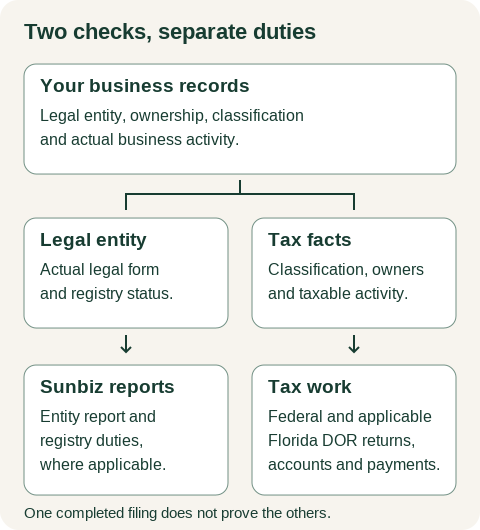
Florida tax help for small businesses starts with what the state does and does not tax. Florida does not impose personal income tax on natural persons, but federal and other-state obligations can still apply. Taxable C corporations generally pay Florida corporate income tax at 5.5% on the Florida tax base after the $50,000 exemption. The calculation starts with federal taxable income and includes applicable Florida adjustments and apportionment; it is not a tax on all business revenue. [1][2]
Businesses making taxable sales generally collect Florida's 6% state sales tax plus any applicable county surtax, subject to transaction-specific exceptions. Corporations and LLCs also have a separate annual-report obligation with the Division of Corporations. Income-tax returns, sales-tax returns and annual reports are different filings. [4][9][10]
Before starting activity that requires Florida tax registration, register with the Department of Revenue for the applicable taxes, online or using paper Form DR-1. Not every business needs every tax registration. [6]
An LLC's legal form alone does not determine its Florida corporate income-tax filing. DOR distinguishes an LLC taxed as a corporation from one taxed as a partnership or disregarded for tax purposes. For example, an LLC classified as a partnership must file Florida Form F-1065 if one or more owners is a corporation; a disregarded single-member LLC does not file a separate Florida corporate income-tax return. Where its owner is a corporation, the income is reported on that owner's return. Check the classification and owners before deciding which return applies. [2]
Where Florida tax help for small businesses starts
Budget for the state filing fee and the first annual report separately before you form the business.
The Florida LLC fee statute lists $100 for original articles of organization and $25 for the registered-agent designation: $125 for those required state formation components. Optional documents and other services are separate. Under the ordinary annual-report rule, an LLC whose articles become effective in November 2026 first reports in 2027. Check the applicable annual-report fee before budgeting that later filing. [9][19]
The profit-corporation fee statute lists $35 for articles of incorporation and $35 for designation and acceptance by the registered agent: $70 for those state formation components. A certificate of status costs $8.75; a certified copy of a document costs $52.50. Those are different optional documents, not interchangeable names for the same charge. [20]
Use the current official LLC fee schedule or corporation fee schedule to check the complete charge for the filing and documents you need. Do not assume a formation payment includes the next annual report. [7][8]
Annual report deadlines and late fees
Mark the annual-report window every year, since missing it can bring fees and consequences beyond an overdue form.
A Florida LLC files its first annual report between January 1 and May 1 of the year following the calendar year in which its articles became effective, and then within that window each year thereafter. For example, under this ordinary rule, an LLC whose articles became effective in August 2026 files its first annual report in the 2027 window. [9]
A Florida corporation has the same ordinary January 1 to May 1 window, beginning in the year after its articles of incorporation became effective. Its next annual report is a separate yearly filing. [10]
Check Sunbiz annual-report instructions and the applicable entity fee schedule for current filing charges, late charges and submission instructions. Keep the formation cost, annual-report charge and any optional documents as separate budget items. [5][7][8]
For corporations, section 607.1420 identifies failure to deliver the annual report by 5 p.m. Eastern Time on the third Friday in September as a ground for administrative dissolution. It provides for dissolution for that failure on the fourth Friday in September. This corporation-specific rule does not extend the ordinary May 1 annual-report deadline. [21]
An LLC or foreign LLC that fails to file an annual report complying with section 605.0212 may not maintain or defend an action in a Florida court until it files the report and pays all fees and penalties due under that chapter. If a report lacks required information, a correction delivered within 30 days after the effective date of the department's notice is treated as timely. [9]
S corporation election rules for owners
Check the shareholder rules and the filing deadline before you elect, and pay shareholder-employees reasonable compensation for their work.
Generally, Form 2553 is filed no more than two months and 15 days after the beginning of the tax year the federal S election is to take effect, or during the preceding tax year. The IRS instructions also address short first tax years and late-election relief, so identify the effective tax year rather than applying one calendar date to every business. [11]
The corporation must meet the 100-shareholder limit and the other eligibility and consent requirements. For the shareholder-count test, specified spouses and family members can be treated as one shareholder under the IRS rules. More than 100 individual people therefore does not automatically mean the limit is exceeded. The shareholder-count rules do not remove the required consents described in the Form 2553 instructions. [11]
An S corporation must pay reasonable compensation to a shareholder-employee for services before making non-wage distributions to that shareholder-employee. The IRS can reclassify non-wage payments as wages subject to employment taxes. [12]
The resulting payroll-tax calculation depends on taxable wages, the applicable Social Security wage base and Medicare rules. A reclassified distribution amount alone is not enough to establish the total; use the applicable year's IRS Publication 15 when calculating the payroll consequences. [13]
Sales tax registration before the first sale
Register covered locations before taxable activity begins, and keep the required documentation for resale transactions.
A Florida business conducting activity that requires sales-tax registration must apply before engaging in that business, with a separate certificate for each place of business. A person conducting covered activity without registering is also subject to a $100 registration fee. DOR may waive that fee when the failure was due to reasonable cause and not willful negligence, willful neglect or fraud. For example, two shops conducting covered activity need separate certificates. [14]
A resale must comply with the statutory documentation rules. A dealer making a noncompliant sale for resale is liable for the tax. Section 212.07 permits documentation using the purchaser's resale certificate or specified DOR authorization methods; calling a sale business-to-business is not enough to establish an exemption. [15]
Collecting and remitting sales tax
File and pay electronically and on time to keep the collection allowance, and remit the sales tax you collect.
A business that paid $5,000 or more in sales and use tax during Florida's prior fiscal year, July 1 through June 30, must file and pay electronically during the next calendar year, beginning with the January return filed in February. Under that rule, payments of $5,000 or more from July 1, 2025 through June 30, 2026 trigger electronic filing and payment during 2027. Failure to file electronically carries a $10 penalty, and failure to pay electronically carries a separate $10 penalty, in addition to other penalties that may apply. [16]
Florida businesses that file and pay sales and use tax electronically and on time can take a collection allowance of 2.5% of the first $1,200 of tax due, up to $30 per reporting location per return. For example, a location owing $800 qualifies for a $20 allowance when those filing and payment conditions are met. [16]
Collected sales tax must be remitted to the state. The theft offense in section 212.15(2) requires failure to remit collected tax with intent to unlawfully deprive or defraud the state. Within that offense, the amount bands are under $1,000, $1,000 to under $20,000, $20,000 to under $100,000, and $100,000 or more. The first band ordinarily carries a second-degree misdemeanor, but a second conviction raises it to a first-degree misdemeanor and a third or subsequent conviction to a third-degree felony. The other bands carry third-, second- and first-degree felonies respectively. Thus $25,000 falls in the second-degree felony band only within an offense meeting the statutory elements; the amount alone does not establish those elements. The statute also permits aggregation when determining the offense grade. [17]
Key Florida dates for small businesses
Build the calendar around the business's reporting period, tax year and entity. Check the applicable year's official instructions and electronic-payment calendar before submitting.
- Sales and use tax: returns and payments are ordinarily due on the first day and late after the 20th day of the month following each reporting period. Monthly and quarterly filers have different reporting periods. Electronic payment must generally be initiated, with a confirmation number, by 5 p.m. Eastern Time on the business day before the 20th; use DOR's current electronic-payment calendar for the applicable date. [16]
- Florida Form F-1120: the ordinary due date is the later of the applicable post-year-end date or the 15th day after the related federal return's unextended due date. The post-year-end date is the first day of the fifth month, except that a June 30 year end uses the first day of the fourth month. Apply the relevant weekend and holiday rules and check any applicable extension or relief. [2][3]
- Annual reports: the ordinary window is January 1 to May 1, first applying in the year after the articles became effective. Keep the corporation-specific September dissolution rule separate from the May filing deadline and from LLC rules. [9][10][21]
- Tangible personal property: when a return is required, file Form DR-405 with the county property appraiser by April 1. Filing waivers and approved extensions can affect the obligation or timing; check the DOR guidance and your property appraiser's instructions. [18]
Florida location guides
- Boca Raton, FL tax preparation
- Clearwater, FL tax preparation
- Deerfield Beach, FL tax preparation
- Deltona, FL tax preparation
- Fort Lauderdale, FL tax preparation
- Gainesville, FL tax preparation
- Hialeah, FL tax preparation
- Homestead, FL tax preparation
- Jacksonville, FL tax preparation
- Kissimmee, FL tax preparation
- Lakeland, FL tax preparation
- Miami, FL tax preparation
- Orlando, FL tax preparation
- Palm Bay, FL tax preparation
- Palm Coast, FL tax preparation
- Pompano Beach, FL tax preparation
- Port St. Lucie, FL tax preparation
- St. Petersburg, FL tax preparation
- Tallahassee, FL tax preparation
- Tampa, FL tax preparation
- West Palm Beach, FL tax preparation
Source notes
Business filing examples use the statutory and tax-year contexts stated in the source list, with their original review dates. Preparation and notice links were checked November 3, 2026. Current program opening, supported work and case acceptance require checking with the selected operator.
Sources
- https://www.flsenate.gov/Laws/Constitution flsenate.gov (checked October 27, 2026)
- https://floridarevenue.com/taxes/taxesfees/Pages/corporate.aspx Florida Department of Revenue (checked October 27, 2026)
- https://floridarevenue.com/Forms_library/current/f1120n.pdf Florida Department of Revenue (checked October 27, 2026)
- https://floridarevenue.com/taxes/taxesfees/Pages/sales_tax.aspx Florida Department of Revenue (checked October 27, 2026)
- https://dos.fl.gov/sunbiz/manage-business/efile/annual-report/ Florida Department of State, Division of Corporations (checked October 27, 2026)
- https://floridarevenue.com/Forms_library/current/dr1n.pdf Florida Department of Revenue (checked October 27, 2026)
- https://dos.fl.gov/sunbiz/forms/fees/llc-fees/ Florida Department of State, Division of Corporations (checked October 27, 2026)
- https://dos.fl.gov/sunbiz/forms/fees/corporate-fees/ Florida Department of State, Division of Corporations (checked October 27, 2026)
- https://www.flsenate.gov/Laws/Statutes/2026/605.0212 Florida Senate (checked October 27, 2026)
- https://www.flsenate.gov/Laws/Statutes/2026/607.1622 Florida Senate (checked October 27, 2026)
- https://www.irs.gov/instructions/i2553 Internal Revenue Service (checked October 27, 2026)
- https://www.irs.gov/businesses/small-businesses-self-employed/s-corporation-compensation-and-medical-insurance-issues Internal Revenue Service (checked October 27, 2026)
- https://www.irs.gov/publications/p15 Internal Revenue Service (checked October 27, 2026)
- https://www.flsenate.gov/Laws/Statutes/2026/212.18 Florida Senate (checked October 27, 2026)
- https://www.flsenate.gov/Laws/Statutes/2026/212.07 Florida Senate (checked October 27, 2026)
- https://floridarevenue.com/taxes/taxesfees/Pages/sales_tax.aspx Florida Department of Revenue (checked October 27, 2026)
- https://www.flsenate.gov/Laws/Statutes/2026/212.15 Florida Senate (checked October 27, 2026)
- https://floridarevenue.com/property/Pages/Taxpayers_TangiblePersonalProperty.aspx Florida Department of Revenue (checked October 27, 2026)
- https://www.flsenate.gov/Laws/Statutes/2026/605.0213 Florida Senate (checked November 1, 2026)
- https://www.flsenate.gov/Laws/Statutes/2026/607.0122 Florida Senate (checked November 1, 2026)
- https://www.flsenate.gov/Laws/Statutes/2026/607.1420 Florida Senate (checked November 1, 2026)