
Retirement tax planning: compare future income before making decisions
Retirement tax planning considers how income, retirement accounts, benefits and payments may interact in the years ahead. It starts with your actual records and the decisions still open, rather than a universal rule about which account to use first.
An annual return reports what happened. A forward review compares defined alternatives and records the assumptions, tax consequences and cash needs before you act. The useful output is an explanation you can assess and implement with the appropriate people, not a headline promise of tax-free retirement.
Build one picture of retirement income and cash needs
Start with the most recent returns and an outline of expected changes. Identify the year you expect employment or business income to change, anticipated pension or benefit payments, available accounts and any significant spending or move.
Separate a known amount from an estimate. Label a pension quotation, a projected distribution and an actual payment differently. If retirement timing or spending is uncertain, describe a range that can be tested instead of giving a single figure false precision.
| Input | What to establish for the review |
|---|---|
| Earnings and business income | Current amounts, expected changes and the relevant years |
| Pensions and benefits | Expected start dates, statements and any withholding arrangements |
| Retirement accounts | Account type, ownership, beneficiary status and relevant records of already-taxed amounts |
| Other income | Investments, rental activity or other sources that need coordination |
| Tax payments | Withholding and estimated-payment records, plus responsibility for future changes |
| Household and location | Filing circumstances, other household income and states involved |
| Spending needs | Expected cash requirements and material one-off commitments |
This is a discussion pack, not an instruction to disclose account passwords or place financial statements in a public enquiry. Request secure transfer instructions from the professional handling the work.
Separate filing, personal planning and employer plan design
Preparation concerns the relevant annual return and reporting documents. The personal tax preparation guide explains that workflow. A planning engagement should state which future years and decisions it examines, and how updated facts change the analysis.
Establishing or changing a retirement plan for a business is a different assignment. Workforce, funding, actuarial and ongoing administration questions belong in the cash balance and employer-plan guide. A business deduction discussion is not a complete personal retirement-income plan.
For an owner approaching retirement, both assignments may be relevant. Name the provider for each and agree how they exchange information. Neither a personal tax projection nor a plan-design proposal automatically completes the other job.
Ask specific questions about the income and accounts involved
Distributions and required minimum distributions
Identify the actual account types, owners and any inherited accounts. The IRS's required minimum distribution guidance explains that withdrawal requirements and tax treatment differ across accounts and circumstances. Already-taxed amounts and qualifying tax-free treatment matter; a gross withdrawal is not always the same as taxable income.
Have the adviser confirm which requirements apply, the relevant year and who calculates and arranges any necessary distribution. Do not apply one age, beneficiary rule or account total to every holding. If several providers are involved, make the allocation of responsibility explicit.
Roth conversions and rollovers
A conversion and a regular contribution are different transactions. The IRS's IRA conversion guidance explains that converting untaxed traditional IRA amounts to Roth can create taxable income. A conversion should not be assumed to be a tax-free transfer or to improve every person's outcome.
Before authorising a transaction, ask what is being compared, the assumed tax treatment and how any resulting payment will be funded. Confirm the applicable transfer and reporting procedure with the adviser and custodian. Do not rely on the word rollover to establish that every distribution is eligible or every method has the same consequences.
Social Security, pensions and other income
The IRS explains that Social Security taxation depends on other income and filing facts. Do not assume every benefit is wholly taxable or wholly tax-free. Bring the actual benefit and pension statements into the same review as withdrawals and other income.
Ask which other costs, benefits or jurisdiction questions are within the analysis and which require separate advice. A tax-only projection should say what it excludes rather than appearing to model an entire retirement decision.
Compare alternatives using the same assumptions
Consider a hypothetical person deciding whether to reduce work next year or continue for another year. A useful comparison holds the shared facts constant, then identifies what changes: earnings, pension timing, account withdrawals, payments and cash available for spending.
The comparison should show the relevant years and taxes considered, the records relied on and assumptions that remain uncertain. Ask for a baseline alongside the alternatives. Without it, an attractive result may reflect changed assumptions rather than the proposed decision.
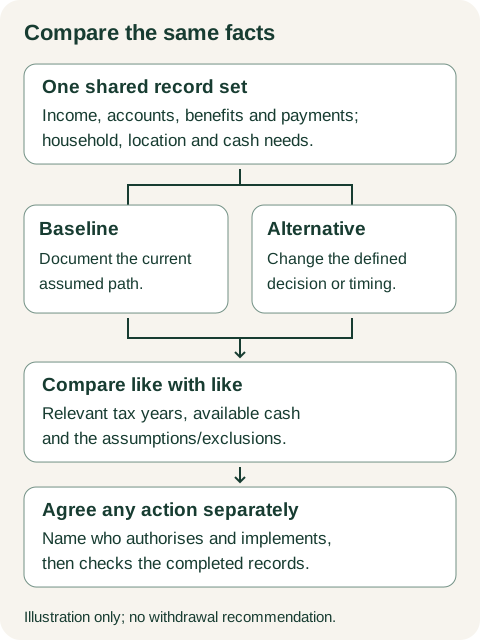
No figure in this example represents a client outcome or a recommended withdrawal strategy. An estimate is useful when its boundaries are visible. It cannot guarantee future legislation, investment returns, personal spending or a particular saving.
Agree who advises, authorises and implements
Ask the tax professional to specify the analysis they will deliver and the decisions they are qualified and engaged to address. Identify where a custodian, plan administrator, legal adviser or appropriately qualified financial adviser supplies separate input.
Before implementation, record the action, responsible person, timing and evidence of completion. A discussion about a conversion is not an instruction to a custodian; an instruction is not proof of the completed transaction. Confirm who checks the final records and incorporates them into the return.
Ask separately about withholding and estimated payments. The person preparing a projection may not be the person changing a pension withholding election or initiating a tax payment. Name the owner of that step and how the change will be confirmed.
Request a planning record you can revisit
A useful written output identifies the decisions compared, assumptions, tax years, scope and limitations. It also records approved actions, unresolved questions and the events that should trigger another look.
Those events might include a change in work, household circumstances, account ownership, residence or expected spending. Agree whether an update is included or needs a new engagement. A scheduled annual meeting is not a substitute for reporting a material change when it occurs.
Keep the planning record with the relevant returns and transaction confirmations. When facts change, the next discussion can start from the prior assumptions instead of reconstructing why a decision was made.
Questions about retirement tax planning
Is retirement tax planning the same as preparing my return?
No. Preparation reports the relevant year's facts; planning compares prospective decisions and assumptions. One professional may provide both, but the engagement should identify the separate outputs and responsibilities.
Should everyone make Roth conversions before retirement?
There is no universal recommendation. Taxable amounts, timing, other income, cash needs and the assumptions in the comparison matter. Ask for the alternatives and their limits before deciding, rather than treating a general article as a transaction instruction.
Can I use a single rule for all required distributions?
No. Account type, ownership, inherited status and applicable rules need checking. Establish which requirements apply to each relevant account and who makes sure the necessary action is completed.