
Tax preparation in Plano for individuals and businesses
Compare Plano tax preparation for the household and company returns needed now. If a services business changes its offer, name or ownership, keep its specialist review connected to the actual filing records rather than treating every change as a new taxpayer.
Personal tax preparation in Plano
For a personal return, identify the year, employment, self-employment, investments, rentals and business interests. Tell the preparer about household changes, a move and missing entity information. If company compensation or another planning decision affects your records, establish who supplies the final reviewed figures. A household filing quote should state whether it also includes a new projection or only preparation using supported information.
Use an agreed secure process for records. Confirm the fee, reviewer and signing process; review the return before authorization and retain your copy. Ask who submits it and checks acceptance or a rejection, with payment instructions distinguished from the preparation fee.
For a straightforward return, the personal tax preparation guide explains official and basic-help options and their eligibility limits. Compare a local appointment with metro or remote service by the work actually accepted, not by a city name on a webpage. Confirm current service area and capacity directly.
Business tax preparation in Plano
Business tax preparation in Plano should name each entity, period and included federal or applicable state reporting. Ask who reconciles books, payroll and any changes in contracts, name or ownership. An unresolved service-taxability question needs an accepted specialist review; a rebrand does not itself settle tax identity. Identify who gives final instructions to the preparer and who handles Texas information reports rather than assuming no payment means no reporting work.
List the reviewer, authorized signer, submitter and acceptance contact for each included return. Confirm the fee, exclusions and who resolves a rejection. The business tax preparation guide provides the wider filing comparison.
An open IRS letter needs its own code, taxpayer, period and actual response date identified. Confirm who has accepted that response work separately from filing. The IRS notice guide explains federal triage; a state letter follows the issuing agency’s instructions.
Services-company operating changes
A services business can change significantly while its annual return process stays the same. New technology, different contracts, an acquisition or a rebrand can introduce questions that routine preparation has not been asked to evaluate. Choose Plano business tax help around the change and the person who will own that review.
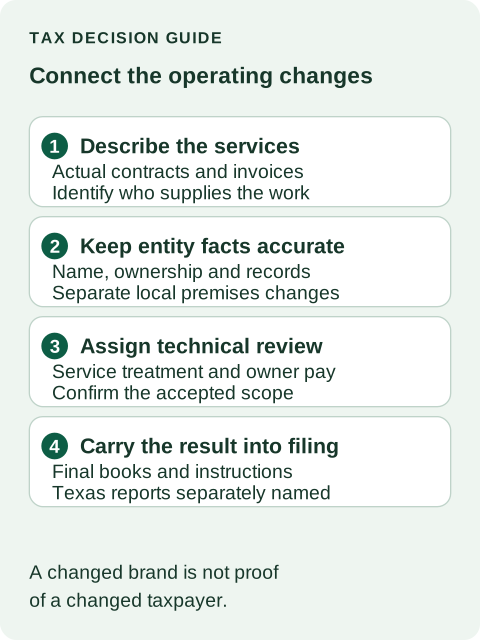
Describe what customers actually buy
Give the prospective CPA or enrolled agent your service descriptions, sample contracts and invoices. Explain whether customers buy advice, access to software, processing of information or a combination of activities. Add who performs the work and which entities contract and collect payment.
Texas Comptroller guidance says using a computer alone does not make a professional service taxable data processing. It separately describes data-processing activities and software-as-a-service examples. The contract and actual service need review; a broad label such as consulting or technology is not a complete tax analysis.
Ask whether the firm handles this work, what facts it needs and whether a specialist will be involved. Do not apply a taxability conclusion from another company's website to your own bundle of services.
software and service taxability
Keep a Plano rebrand aligned with the legal-entity records
Plano's certificate-of-occupancy guide dated March 2, 2026, lists business-name and ownership changes among events requiring an updated CO for applicable premises. It also identifies exceptions, including home occupations and no-impact home-based businesses. Confirm the actual address, activity and change with Building Inspections.
For an established owner rebranding after an acquisition or reorganizing the service offer, keep a clear record of the legal entity, trade name, contracts and premises. Ask your tax professional to check that the records used for returns and planning identify the correct taxpayer. A new brand does not by itself answer whether ownership, assets or the tax entity have changed.
City occupancy requirements and tax classification have different purposes. Use the local check to keep the operating record accurate, not as evidence that a particular reorganization is tax-free or that a new business name creates a new taxpayer.
Connect the company review with your personal plan
Ask whether the proposed engagement includes your personal return and projection as well as the operating entity's filings. If there are several owners or a separate property company, specify which people and entities are clients and how the necessary information will be exchanged.
For an S corporation, ask how the adviser evaluates owner duties and compensation before discussing distributions. IRS guidance requires reasonable compensation for shareholder-employee services before the relevant non-wage distributions. A desired saving or a standard salary percentage is not a substitute for that fact-specific review.
If another adviser manages investments or a retirement plan, establish how their work connects with the tax analysis. Do not assume one firm provides legal, valuation or investment advice merely because it coordinates tax planning.
Ask for a process that reaches implementation
A planning proposal should name the decision, required records, assumptions, written deliverables and action owner. Ask who revisits the analysis if revenue, payroll, contract terms or the transaction date changes.
Preparation is a separate deliverable: identify returns, entities, jurisdictions and report years. If bookkeeping cleanup is required, agree who will complete it and whether projections remain provisional until the records reconcile.
For 2026 Texas franchise reporting, the No Tax Due Report is discontinued, while applicable PIR or OIR information-report duties generally remain subject to exceptions. Ask who owns that reporting for each relevant entity rather than treating no payment as confirmation that nothing is due.
Verify credentials and the specific expertise
Use Texas State Board of Public Accountancy tools to check CPA and firm status where applicable. Follow current IRS instructions for enrolled-agent verification. Then ask the supervising professional about experience with your actual service and contract structure.
A local office, a specialist title or a review score does not establish that a particular taxability or acquisition question is covered. Ask how technical uncertainty is reviewed and how a specialist's work is incorporated into the return and implementation steps. Confirm communication arrangements and availability directly.
Questions for a Plano tax-adviser discussion
Does using software make all my consulting revenue taxable?
Not automatically. The Comptroller distinguishes computer use from taxable data-processing activity. Have the actual service, contracts and transaction reviewed before adopting a conclusion.
Does changing the business name change the taxpayer?
A brand change alone does not answer that question. Explain the legal ownership, entity and transaction facts to your professional, and confirm any applicable Plano premises record update separately.
Can one proposal cover both taxability and personal planning?
Potentially. Ask whether both are expressly included, who supervises each part and what work is referred or excluded. A broad business-tax label does not establish the scope.
Keep the final handoff clear
Keep a concise handoff showing the actual service, legal entity, adopted tax conclusions and responsible preparers. Separate completed actions from proposals still open, and communicate changed facts before relying on the earlier analysis.
Sources and scope
City of Plano: Guide to Obtaining a Certificate of Occupancy, March 2, 2026; Texas Comptroller: data-processing services and 2026 franchise reporting guidance; Texas State Board of Public Accountancy: license lookup; IRS: S corporation compensation and credential guidance. Research checked October 30, 2026. This is an engagement-selection guide, not a taxability determination.
- City of Plano: Guide to Obtaining a Certificate of Occupancy, March 2, 2026. Confirm the actual premises and applicable exceptions with the City.
- Texas Comptroller: Taxable Services, data-processing and professional-service distinctions.
- Texas Comptroller: 2026 Franchise Tax Report Forms, report-year duties and exceptions.
- IRS: S Corporation Compensation and Medical Insurance Issues, actual services and reasonable-compensation context.
- Texas State Board of Public Accountancy: License Lookup.
- IRS: Verify the Status of an Enrolled Agent.