
Tax preparation in Katy for individuals and businesses
Compare Katy preparation through actual returns, classification records and unresolved work. An intended S election that cannot be confirmed can need a separate relief review. Another return does not itself establish validly obtained status.
Personal tax preparation in Katy
Identify household years, income and ownership interests, with actual company and shareholder filings. If status is unresolved, supply correspondence and reviewed information relevant to your return. Ask whether earlier affected periods are included or rely on another specialist. A projected election benefit establishes neither eligibility nor an IRS outcome. Agree secure records exchange, who reviews and signs the prepared return and who submits it. Review the completed figures before authorization, retain a full copy and establish who checks acceptance or a rejection. Tax payment instructions are separate from the preparation fee. The personal preparation guide covers the wider comparison.
Business tax preparation in Katy
Provide formation and ownership history, intended dates, signed documents, submission evidence and earlier returns. Separate intent from what was filed or confirmed. The preparer needs a supported status conclusion, not an assumed label in the books.
Ask who checks validity, timing, reporting consistency and the relief route, signs a request and monitors it. Historical relief, correction work and current filing can be separate scopes. Name how outcomes reach company and shareholder preparers and what remains open.
List the reviewer, authorized signer, submitter and acceptance contact for each included return, with the fee and exclusions. Use the business preparation guide for the full filing comparison.
If an IRS letter is open, identify its code, taxpayer, period and actual response date separately from the preparation schedule. Ask who has accepted the response work. The IRS notice guide covers federal triage; a state notice follows the issuing agency’s instructions.
Comparing Katy tax-service scope
Saved October 30 descriptions include Gadea's tax and advisory work, SVCPA's return and planning catalogue and Trinity's regional owner services. Ask about actual late-election experience. Listing S returns does not establish relief work; no status, FSI relationship, capacity or successful request is verified.
A missing S election needs validity and relief review
An intended S election that was not filed on time needs a relief review, not an assumption that preparing an S return makes the election valid. The owner's records must show the intended treatment, eligibility, filing history and reason for the failure.
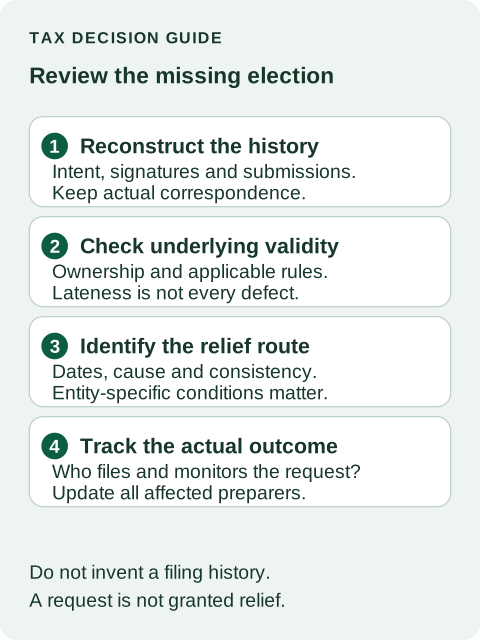
Reconstruct what was intended and what was filed
Consider a hypothetical established business whose owner believed an S election had been made. A new preparer cannot locate the filed election or confirmation. Before repeating the assumed classification, the owner needs to know whether the evidence supports the intended effective date and whether the applicable relief route is available.
Gather the signed documents, delivery and submission evidence, IRS correspondence, company returns and shareholder returns for the relevant periods. A copy of an unsigned draft, a payroll setup or a bookkeeping label is not the same as a reviewed account of what happened.
The IRS says its late-election procedure generally addresses an otherwise eligible election that failed solely because it was not filed timely, with returns consistently reporting the intended treatment. [1] The reviewer must first establish whether that describes the actual problem.
Test validity separately from lateness
The IRS emphasizes that relief under Revenue Procedure 2013-30 concerns elections that would otherwise be valid. It identifies shareholder signatures and eligibility problems that cannot simply be treated as lateness. [1]
Its S-corporation overview lists requirements involving the corporation, allowable shareholders, shareholder count, stock classes and excluded types of corporation. [2] Ask the adviser to check the relevant ownership and rights during the actual period, rather than assume that a business wanting S status has always qualified.
If the issue is an invalid shareholder, inconsistent classification or another defect, the owner needs that issue named. A reasonable-cause narrative for late filing does not automatically cure every eligibility failure. The practitioner should identify the applicable route and any specialist work before promising a result.
Check the conditions for the proposed relief route
The IRS's general rules include intended S classification, eligibility, reasonable cause for late filing, consistent company and shareholder income reporting and a request within the stated three-years-and-75-days period. Its page describes a limited exception to that period with additional conditions. [1]
For the hypothetical owner, build a dated chronology and identify the actual intended effective date. Have the reviewer explain the applicable timing rule rather than select a convenient new date or treat the general period as an automatic extension of the original election deadline.
| Condition to evaluate | Evidence to provide |
|---|---|
| Intended effective treatment | Contemporaneous instructions, signed documents and actual business reporting. |
| Reason for the failure | Factual account of what prevented timely filing, with supporting records. |
| Consistent returns | Relevant company and shareholder filings and any differences needing review. |
| Valid underlying election | Ownership, rights, signatures and other applicable requirements. |
| Available procedure | Actual date calculation, entity type and any additional relief conditions. |
Where a late corporate-classification election is also needed for the same effective date, the IRS describes additional requirements. It also distinguishes the limited timing exception for certain corporations from an LLC seeking classification relief. [1] Do not assume every entity has the same procedural route.
Require a truthful explanation and a defined filing assignment
A satisfactory work product should state the supported facts, applicable procedure, conditions met and any unresolved item. The owner should be able to distinguish a valid relief request from a suggestion to file a form and hope it is accepted.
The reasonable-cause account should describe what actually occurred. Do not invent a mailing, signature, professional instruction or earlier intention to fit a procedure. Ask who prepares and checks the statement, who signs the required documents and who monitors the response.
The IRS page describes private-letter-ruling requests where the revenue-procedure route does not apply. [1] If relevant, obtain qualified advice on the current procedure, scope and actual costs before proceeding. This guide does not recommend a ruling request or quote a fee.
Reconcile the outcome with preparation and owner reporting
The engagement should identify what happens while the status is unresolved and how the final conclusion reaches the company and personal preparers. A proposed relief request does not establish that the IRS has granted it or that every past return has been reviewed.
If the records reveal inconsistent filings, have the adviser explain the actual implications and any separate corrective work. Do not assume that merely attaching a late election to the next return resolves all affected years.
IRS recordkeeping guidance identifies return support and business monitoring as purposes of records. [3] Preserve submission evidence, correspondence and the final reviewed position with the relevant returns so the question does not reappear at the next adviser change.
business tax supporting records
Keep Katy business approvals separate from federal status
The City of Katy recommends a preliminary building and fire compliance walk-through before signing a lease. Its business checklist distinguishes no-construction and planned-construction paths and states that it is not exhaustive. Confirm the actual address's jurisdiction and current City requirements. [4]
For an existing business changing advisers or expanding premises, keep those approvals on their own track. An S-election effective date does not establish occupancy approval, and a City business description does not prove federal tax classification. A Katy postal address should not be treated as proof that every location follows the City of Katy process.
Choose a CPA or EA for the relief review
Verify claimed CPA and relevant firm standing through the Texas board, or enrolled-agent status through the IRS. [5][6] Both are among professionals with unlimited IRS representation rights, subject to its rules. [7]
Ask about actual late-election cases, classification defects and company/shareholder coordination. Who decides which route applies and reviews the evidence? Who responds if the IRS requests more information? When does the candidate involve legal or other specialist advice?
Compare the written scope, named reviewer, fee basis and exclusions. A service menu listing S returns or entity planning does not establish that historical eligibility and relief work are included.
Texas business tax professional selection
Questions Katy owners ask about a missing election
Does an S return prove the election was valid and timely?
Do not assume that. Establish the actual election, eligibility and submission history. The IRS's relief rules separately address validity, lateness and consistent reporting. [1][2]
Does reasonable cause fix every problem?
No. The general relief route has other conditions, including an otherwise valid election and relevant reporting and timing requirements. An eligibility defect needs its own applicable analysis. [1]
Can every business use the same timing exception?
No. The IRS describes a limited exception with specific conditions and distinctions between corporations and LLC classification situations. Have the reviewer identify the actual entity, date and available procedure. [1]
Sources
[1] Internal Revenue Service: Late Election Relief, current overview of Revenue Procedure 2013-30 conditions, timing and procedural limits checked October 30, 2026.
[2] Internal Revenue Service: S Corporations, eligibility and election requirements.
[3] Internal Revenue Service: Recordkeeping.
[4] City of Katy: Starting a Business, City-specific walk-through and construction-path checklist. Confirm current address and project requirements.
[5] Texas State Board of Public Accountancy: License Lookup.
[6] Internal Revenue Service: Verify the Status of an Enrolled Agent.
[7] Internal Revenue Service: Understanding Tax Return Preparer Credentials and Qualifications.
This guide helps select professional work. It does not establish election validity, reasonable cause, qualification for relief or an IRS outcome.
Preparation guidance checked November 4, 2026 using the IRS preparer-selection guidance, business-structure guidance and notice guidance. Provider comparisons use the saved October 30 descriptions. Retained specialist sources keep the publication years and limits stated above; no individual tax result or provider appointment is determined here.