
Tax preparation in Duncanville for individuals and businesses
Choose Duncanville tax preparation by the returns, contract records and accepted accounting work. A household return and a contractor's company return require different information. If a project crosses a tax-year boundary, identify whether the quote includes method analysis or preparation using an already supported conclusion.
Personal tax preparation in Duncanville
For personal preparation, describe income sources, household changes, tax years and jurisdictions. Mention business interests and self-employment alongside employment, investments or retirement where relevant. Ask who supplies final company information and how an unfinished contract review affects the expected personal filing timetable. A job's customer receipts should not simply be treated as the owner's reportable income.
Confirm which missing-year or amendment work is included in the fee. Identify the reviewer, paid preparer, submitter and acceptance follow-up. Review the completed return before filing authorization and keep the full return and filing-status evidence. Agree tax payments separately from preparation charges. The personal preparation guide covers ordinary household work as well.
Contractor preparation and the method-review boundary
Give the preparer each entity's actual classification, owners, period and jurisdictions, with prior returns, reconciled books and job schedules. For contracts crossing year-end, supply the actual agreement, contract type, entry date, reporting year, revisions, estimated costs and completion evidence. A progress report can support the review without deciding the tax method.
Ask who checks the applicable category, effective-date conditions and method history before a return is prepared. The specialist review below explains the distinction between a contract-day date and the tax year in which it was entered. If a change procedure or completed-contract look-back needs review, name that assignment rather than assume a bookkeeping entry completes it.
Agree who delivers final schedules and owner information and who updates changed job assumptions. Put the reviewer, authorized signer, submitter and acceptance or rejection follow-up beside every included return. Permit administration is a separate project responsibility. The business preparation guide gives the broader entity filing comparison.
If an IRS letter is open, identify its code, taxpayer, period and actual response date separately from the preparation schedule. Ask who has accepted the response work. The IRS notice guide covers federal triage; a state notice follows the issuing agency’s instructions.
Comparing Duncanville tax-service scope
Saved October 30 descriptions contrast Zoro's individual, business and resolution catalogue, Professional Tax Pros' separate personal and business advisory services and Diverse's preparation, bookkeeping and payroll offer. Ask which candidate actually accepts construction-method analysis. Advertised guarantees, fees and representation claims are not adopted. These historical descriptions establish no FSI participation, verified credentials or current appointment.
Construction-contract methods beyond return preparation
A construction job can receive customer cash in one year and finish in another. That does not mean the tax preparer may choose whichever year produces the preferred result. The actual contract and applicable accounting method come before a dependable owner forecast.
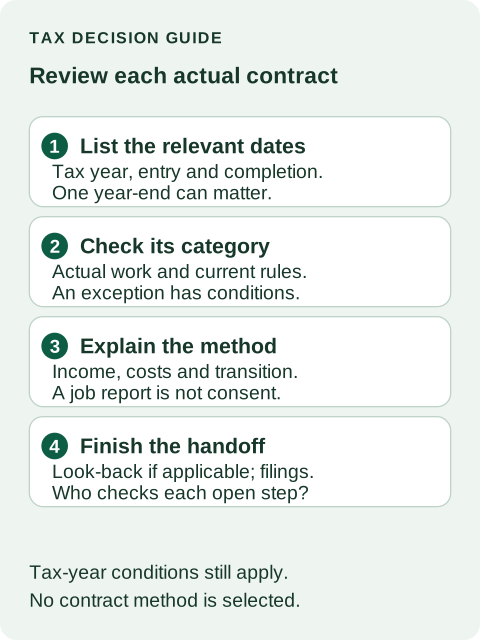
Identify which contracts cross a tax-year boundary
Consider a hypothetical established contractor with several jobs in progress. A residential project and a nonresidential project cross the company's year-end. The owner expects the same cash-based tax treatment for both because the same bookkeeping software tracks their receipts and costs.
The IRS's 2026 guidance describes a long-term contract by reference to specified construction or other work not completed within the tax year in which the contract is entered into. It says the percentage-of-completion method generally applies, with exceptions for qualifying construction contracts. [1]
Prepare a contract-by-contract list showing the actual work, agreement date, tax year, start, expected completion and current status. A contract does not need to run for many calendar years to raise this question. Conversely, a large price alone does not establish the applicable category or method.
Check current exceptions before applying an old method
The 2026 guidance explains that the 2025 legislation extended the home-construction exception to residential construction contracts and changed the related method framework. It gives an effective-date rule tied to contracts entered into in tax years beginning after July 4, 2025. [1]
For the hypothetical owner, the fiscal year and contract entry date therefore matter alongside the actual type of work. A broad statement that a contract signed after a particular day is automatically eligible skips the tax-year condition. A method used for an earlier residential contract may also need reconsideration for a later contract under changed rules.
The guidance describes other conditions and method rules for exempt contracts, including taxpayer and accounting considerations. [1] Exempt from the general percentage-of-completion requirement does not mean exempt from tax or free to choose any reporting method without analysis.
Ask the reviewer to identify the applicable contract category, exception if any, permissible method and reason for the conclusion. If a method change is proposed, have the adviser establish the required procedure before staff change the books or return treatment.
Distinguish a method review from a job-progress report
A job report can help management track cost, billing and expected margin without deciding the federal tax method. The tax review needs to explain how the contract's income and costs enter the relevant return periods under the supported method.
| Information supplied | Question the tax review should resolve |
|---|---|
| Customer receipts and invoices | Why do these amounts differ from, or agree with, the income recognized for tax? |
| Actual and estimated contract costs | Which method uses them, and how are changed estimates reviewed? |
| Contract type and dates | Which current rule, effective date or exception applies to this contract? |
| Existing return treatment | Is continuing that method appropriate, or is a formal change needed? |
The completed work should connect the method decision to an understandable period-by-period result. It should identify uncertainty and required evidence instead of presenting the accounting software's profit as a self-evident tax answer.
Completion can also raise a look-back question. The IRS describes Form 8697 as computing interest due or refundable for certain completed long-term contracts accounted for under the specified methods. Its discussion compares contract income based on estimated and actual price and costs, with exceptions and additional conditions. Ask whether the current rules apply to your completed contract and who checks that step; do not assume that finishing the job ends every reporting responsibility. [2]
This is not a percentage-of-completion calculation or a conclusion that either hypothetical contract qualifies for an exception. The owner is choosing the professional work needed to establish those conclusions.
Compare a return-only service with contract-method advice
Ask each candidate what they would receive from your office and what they would return. A preparation service may use an existing supported method and completed schedules. A method review investigates whether that treatment fits the actual contracts and current rules.
A proposal should name the technical reviewer, contracts and years covered, required analysis and responsibility for any implementation. The IRS guidance explains that accounting-method changes generally require consent through the applicable procedures, with specific automatic-change guidance. [1] Do not assume that correcting an entry in the ledger completes that process.
If you need continuing review, define which new contract or changed fact triggers it. Avoid buying a broad advisory label without knowing whether anyone checks the contract categories and current reporting conditions.
Carry the supported timing into the owner plan
The result should show the income and cost assumptions used for each relevant tax period and how they connect to the company's and owner's reporting. Separate tax recognition from the cash actually available to fund payroll, suppliers and owner needs.
Have the reviewer explain what changes if a contract's scope, completion expectation or estimate changes. Identify who supplies the new information, who reviews the affected treatment and who updates any personal payment recommendation. The owner should be able to see why an update occurred, rather than receive an unexplained new tax total.
IRS recordkeeping guidance identifies business monitoring, expenses and return preparation as purposes of records. [3] Preserve the executed contract, revisions, job evidence, reviewed method conclusion and final reporting schedules so a later preparer can follow the treatment.
construction business tax records
Keep Duncanville permit responsibility accurate
Duncanville's contractor guidance says contractors must register with the City and warns that the person obtaining a homeowner permit becomes the responsible party of record. It directs applicants to obtain project-specific guidance and says its list is not exhaustive. [4]
For actual work, confirm the correct permit applicant and inspection responsibilities with the City. Those operational responsibilities should match the real contract. They do not establish the federal long-term-contract method, and a tax classification does not authorize building work.
Verify the practitioner and the construction assignment
Check claimed CPA and relevant firm status through the Texas board, or enrolled-agent status through the IRS. [5][6] Both are among professionals with unlimited IRS representation rights, subject to its rules. [7]
Then ask for actual experience with construction contract methods, effective-date changes and implementation procedures. Who reviews an uncertain contract? Who coordinates with the bookkeeper and the personal preparer? If specialist advice is required, is that work included or referred?
Compare written scope, fee basis and exclusions. A general planning promise, payroll menu or cash-flow service does not establish that contract-method advice is part of the engagement.
Texas business tax professional selection
Questions Duncanville owners ask about contract accounting
Can a contract crossing one year-end be a long-term contract?
Yes, the IRS definition concerns completion outside the tax year in which the specified contract is entered into, not a requirement that it run for several years. The actual work and applicable rules still need review. [1]
Does an exception mean the contract income is tax free?
No. An exception from the general method requirement concerns how the applicable contract is accounted for. Permissible methods, other conditions and any change procedure still need to be established. [1]
Can the bookkeeper simply switch to a different tax method?
Do not assume that. Have the tax reviewer identify whether a change is needed and the applicable consent and filing procedure before implementing it. A revised job report is not by itself a completed method change. [1]
Sources
[1] Internal Revenue Service: Internal Revenue Bulletin 2026-39, selected construction-contract background, effective-date and accounting-method procedure provisions checked October 30, 2026. No conclusion about an individual contract's eligibility or method is made.
[2] Internal Revenue Service: Instructions for Form 8697, December 2025 instructions, selected purpose, general-rule and estimated-versus-actual look-back provisions. Apply current law and exceptions with the 2026 guidance above.
[3] Internal Revenue Service: Recordkeeping.
[4] City of Duncanville: Permit and Inspection Services, actual contractor and permit-holder responsibility guidance. Confirm current project requirements.
[5] Texas State Board of Public Accountancy: License Lookup.
[6] Internal Revenue Service: Verify the Status of an Enrolled Agent.
[7] Internal Revenue Service: Understanding Tax Return Preparer Credentials and Qualifications.
This guide helps compare professional work. It does not classify a contract, authorize a method change or calculate tax income.
Preparation guidance checked November 4, 2026 using the IRS preparer-selection guidance, business-structure guidance and notice guidance. Provider comparisons use the saved October 30 descriptions. Retained specialist sources keep the publication years and limits stated above; no individual tax result or provider appointment is determined here.