
Tax preparation in College Station for individuals and businesses
Compare College Station tax preparation by the actual household and business returns needed. A valuation, a proposed sale and a completed transaction create different information needs. Establish the filing assignment first, then commission any separate basis or transaction analysis before relying on a proceeds estimate.
Personal tax preparation in College Station
A personal preparation brief should identify the years, income sources, household changes and states involved. Mention ownership interests, investments, rental activity and any completed sale. If a valuation exists, say what it values and why it was commissioned; a headline company value does not establish personal income or the basis to report. Ask which final statements and transaction records the preparer needs, and what remains outside the quoted fee.
Confirm who reviews and signs the return, who submits it and how acceptance or a rejection is followed through. Read the completed return before authorizing filing, keep a full copy and distinguish tax payments from service charges. A person without a business can still compare ordinary household preparation using the personal preparation guide.
Business preparation and valuation-to-return handoffs
Describe each entity's actual tax classification, owners, reporting period and filing jurisdictions. Supply prior returns, reconciled accounts and acquisition or basis records. An LLC's legal name and a valuation report do not tell a new preparer which returns or owner schedules apply. Identify any bookkeeping reconstruction before agreeing the completion timetable.
For a completed transfer, give the preparer the final agreement and reviewed tax analysis, with draft valuations distinguishable from final transaction facts. Ask who supplies the owner's reporting information and resolves changes to price, payment terms or asset details. If the sale is still proposed, a return-preparation quote should not be assumed to include the separate liquidity and transaction review below.
Agree the named reviewer, authorized signer, submitter and filing-status follow-up for each return. Separate a valuation engagement from preparation and from legal transaction work, even when one firm offers several services. The business preparation guide explains the wider entity-and-owner workflow.
If an IRS letter is open, identify its code, taxpayer, period and actual response date separately from the preparation schedule. Ask who has accepted the response work. The IRS notice guide covers federal triage; a state notice follows the issuing agency’s instructions.
Valuation, tax basis and sale-liquidity review beyond filing
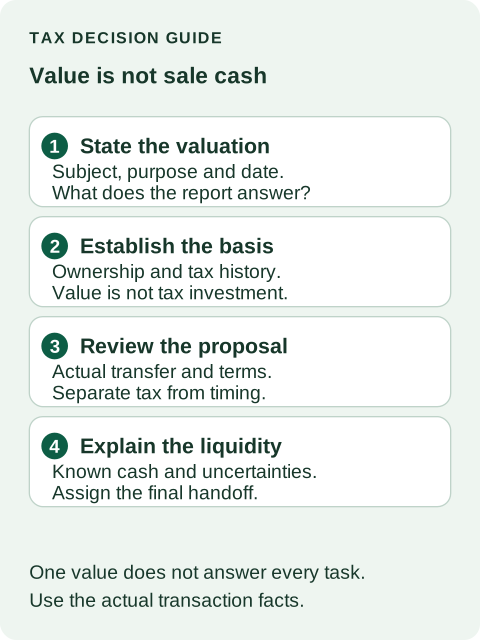
A business valuation can help an owner discuss price or financing. It does not, by itself, establish the owner's tax basis or the money retained after a transaction. When comparing College Station tax professionals, identify which of those questions the proposed service will actually answer.
Start with what the valuation will be used for
Consider a hypothetical owner who receives an indicative valuation while exploring the sale of an interest in an operating business. The owner wants to know whether the possible proceeds would meet a personal liquidity objective. A report about the business's value answers only part of that question.
The valuation assignment needs its purpose and subject identified. Is it describing the whole enterprise, a particular ownership interest or specified assets? What date, assumptions and restrictions does the report use? Those are editorial questions for understanding the work being purchased; this guide does not prescribe a valuation standard or decide whether a report is suitable for a lender, buyer, court or taxing authority.
The tax assignment starts from the actual ownership and proposed transaction, not only the headline value. Agreeing a business price is different from explaining its tax consequences for the seller. A negotiation estimate should not silently become a supported tax conclusion.
Value and tax basis describe different things
IRS Publication 551 describes basis generally as the amount of a capital investment in property for tax purposes. It also explains that basis is usually cost, with other rules applying in various circumstances. A current valuation is therefore not a substitute for establishing the applicable basis from the actual acquisition and subsequent history. [1]
For the hypothetical owner, that means the adviser needs to identify what is being transferred and obtain the relevant ownership and tax records. The basis of an ownership interest and the basis of assets held inside an entity should not be treated as one unexplained number. This guide does not calculate either amount or determine the rules applicable to the proposed transfer.
IRS recordkeeping guidance explains that records of business assets support depreciation and gain or loss on sale. Maintaining those records makes the tax review possible; it does not mean that a market-value estimate proves an asset's tax history. [2]
A sale of business assets is not one undifferentiated item
The IRS's sale-of-business guidance explains that a sale of a business is generally treated as a sale of individual assets rather than one asset. Different assets can have different treatment. That distinction matters if the proposal being valued and negotiated is an asset transaction. It should not be applied without analysis to every sale of an ownership interest. [3]
If the proposal changes from an interest transfer to an asset transaction, the adviser should revisit the tax analysis using the revised facts. The owner should not simply substitute a new price in an old calculation. Equally, this page does not recommend one transaction form: legal exposure, financing, commercial terms and the other parties' positions need appropriate advice.
The useful question for the candidate is whether the engagement includes the proposed transaction analysis or only the valuation. Both are legitimate services. Their outputs should be named so that the owner can see which question remains unanswered.
Build the liquidity comparison from an actual proposal
A practical owner comparison starts with proposed consideration and distinguishes the assumptions needed to reach expected cash. Transaction costs, payment timing, debt arrangements and the actual tax analysis may affect that comparison. This is an editorial decision framework, not a universal proceeds formula or individualized tax computation.
For example, a valuation may assume a price without specifying the final payment terms. The owner cannot use that number alone as proof that cash will be available at a particular time. A candidate who offers transaction advice should identify what is known from the proposal, what is estimated and what must be resolved with the attorney, buyer or other advisers.
The review should leave the owner able to explain why the valuation, proposed consideration, tax calculation and expected liquidity are separate figures. That is more useful than an unexplained “after-tax value” copied into a presentation. If a material input changes, identify which professional updates the affected calculation before the owner relies on it.
Compare College Station service descriptions carefully
The saved October 30 CollegeStationCPAs service page separately describes accounting, projections, valuation and tax preparation. Talbert supplies regional legal and transition context; Hopkins is broader professional-selection guidance. A wide catalogue does not establish that valuation includes transaction tax work. These are historical descriptions, not verified credentials, FSI listings or current appointments.
A valuation-only assignment may be right when the immediate question is negotiation or another specifically agreed purpose. A tax review is a separate need when the owner must understand the consequences of an actual proposed transfer. A combined engagement can be useful when responsibilities, qualifications and deliverables are clear. Separate specialists can also work when they exchange the relevant assumptions and conclusions.
Verify Texas CPA status through the state board and enrolled-agent status through the IRS's current process. Those checks do not establish valuation credentials, legal services, transaction expertise or firm availability. Discuss the actual assignment with the professional who would be responsible for it. [4][5]
Questions about valuations and business tax advice
Is a business valuation the same as tax basis?
No. IRS Publication 551 describes basis as a capital investment in property for tax purposes and explains that cost is the usual starting point, subject to applicable rules. A valuation does not replace the ownership, acquisition and tax history needed for the particular basis calculation. [1]
Does selling a business always produce one type of gain?
No. The IRS explains that a sale of business assets generally involves the sale of individual assets, with potentially different treatment. The adviser first needs to establish the actual transaction; an ownership-interest transfer should not automatically be treated as that asset-sale example. [3]
Should the same professional do the valuation and tax review?
Either a combined or separate arrangement can work. Compare the purpose, qualifications, accepted analysis and exchange of assumptions. One firm name does not prove that the valuation includes transaction tax work, and separate advisers need a defined handover.
For the next stage, use the Texas business-sale tax guide, supporting-records guide and business-owner hub to define the next assignment.
Sources
- IRS Publication 551 (December 2025), Basis of Assets. Selected general basis and cost context, not an individual interest or asset calculation.
- IRS, What kind of records should I keep?. Business asset records.
- IRS, Sale of a business. Asset-by-asset distinction and transaction scope.
- Texas State Board of Public Accountancy, License Lookup. Relevant professional status.
- IRS, Verify the status of an enrolled agent. Current verification process.
Preparation guidance checked November 4, 2026 using the IRS preparer-selection guidance, business-structure guidance and notice guidance. Provider comparisons use the saved October 30 descriptions. Retained specialist sources keep the publication years and limits stated above; no individual tax result or provider appointment is determined here.