
Tax preparation in Baytown for individuals and businesses
Choose Baytown tax preparation for the returns and records involved. A personal filing, a company's income-tax return and a Texas manufacturing-equipment exemption review answer different questions. Confirm which work the professional accepts before treating a purchase decision as part of annual preparation.
Personal tax preparation in Baytown
Describe the tax years, household changes, income sources and relevant states. Include wages, retirement, investments, rental activity or self-employment where applicable. Identify annual filing, an unfiled year or an amendment. Personal preparation does not require owning an industrial business or buying equipment.
If business information will feed the return, identify who supplies it and what remains provisional. Ask which records the fee assumes are ready, who resolves missing or corrected statements and who reviews the return. Agree a secure exchange method and practical meeting arrangements before transferring detailed records. The personal preparation guide provides the full household checklist.
Review the completed return before authorization and confirm the paid preparer's signature. Name who submits each included return and who checks acceptance or corrects a rejection. Obtain complete copies and filing-status evidence, with tax-payment instructions agreed separately from the service fee.
Business preparation after an equipment purchase
List the actual entities, tax classifications, owners, periods and jurisdictions. Supply prior returns, relevant elections and the condition of the accounts. Agree who performs reconciliation, payroll or bookkeeping corrections and which company and owner returns the quote includes. The business preparation guide gives the full workflow.
For an equipment purchase, provide the actual purchaser, invoice, item description, use and asset history requested by the preparer. Distinguish any Texas exemption analysis from the federal asset treatment. The manufacturing review below explains why a vendor's equipment label and the fact that an item is used at a factory do not settle the exemption. Ask who accepts that specialist work before relying on it in the purchase budget or records.
Name the reviewer, authorized signer, submitter and acceptance or rejection follow-up for each return. If a state-tax specialist and federal preparer are different people, agree who sends the final purchase conclusion and who reviews a later change in use. Keep the final invoice and implemented facts with the reporting record rather than only the original quote.
An IRS notice and a Texas sales-tax inquiry need their own taxpayer, period, issue and actual date. Confirm who accepts the response. The IRS notice guide provides federal triage; it does not replace Comptroller instructions.
Manufacturing-equipment review beyond the return
An equipment purchase can require a separate Texas sales-and-use-tax review before the owner discusses federal income-tax treatment. A Baytown manufacturing business should not assume that every machine, support item or industrial purchase qualifies for the same exemption.
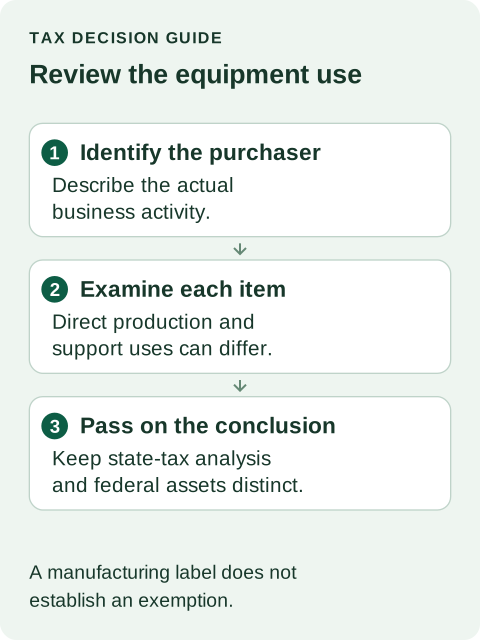
The activity and use matter more than the equipment label
Consider a hypothetical manufacturer planning a purchase that includes production equipment and supporting items. The vendor's quote calls everything “manufacturing equipment.” Before relying on an exemption, the owner needs the actual purchaser, activity and use of each relevant item reviewed.
The Texas Comptroller describes manufacturing exemptions for taxpayers manufacturing, fabricating or processing tangible personal property for sale. Its guidance identifies eligible activities and says certain non-manufacturers, including contractors and persons repairing property belonging to others, do not qualify for these manufacturing exemptions. A business's industrial description alone is therefore insufficient. [1]
This page does not classify a particular business as a manufacturer or decide an exemption. A qualified reviewer should use the actual operations and applicable current authority, including relevant rules and special categories. The buyer's description should explain what the equipment does rather than merely reproduce the vendor's label.
Direct production and manufacturing support can differ
The Comptroller explains that equipment causing a physical or chemical change in the product can qualify under the stated conditions. It also says equipment used for manufacturing support, but not directly in manufacturing, generally does not qualify and lists excluded items. These distinctions prevent treating every item at a factory as the same purchase. [1]
For the hypothetical owner, separate the proposed production machine from office equipment or intraplant transportation equipment, such as the forklifts listed in the guidance. The appropriate professional must review the actual item and use; this contrast is not a conclusion that any machine in the proposal qualifies.
A useful review identifies what is included, excluded or still unresolved and explains the supporting facts. If the purchase bundles components, installation or other work, ask what additional analysis is needed rather than assume that one description settles every charge. No allocation, service-taxability or installation conclusion is supplied here.
Support the proposed exemption before relying on it
The Comptroller describes use of a properly completed exemption certificate by a qualifying manufacturer purchasing qualifying items. Its listed information includes a description of the item and why the purchase is exempt. The qualifying conditions matter; the existence of a form is not a substitute for the underlying review. [1]
The owner should know which conclusion the tax professional has reached and what the vendor is being told. Where information remains missing, identify the gap before relying on an exemption in the purchase budget. This guide does not instruct the owner to sign a certificate or establish a particular filing procedure.
The supporting record can connect the purchaser, equipment specification, intended use, applicable analysis and final invoice. That is an editorial control for making the conclusion understandable. It does not guarantee that a taxing authority will accept the treatment or remove the need to confirm current requirements.
Changes in use need to reach the adviser
The Comptroller also discusses divergent use of exempt equipment for purposes other than manufacturing items for sale. Its guidance addresses tax and recordkeeping for that situation. An exemption review should therefore not disappear after the purchase if the actual use differs from the reviewed purpose. [1]
This page applies no divergent-use percentage, period or calculation. Ask the professional what facts need monitoring under the actual arrangement and who reviews a material change. A decision to use equipment elsewhere can have a different implication from the original production proposal.
For example, a later operating change may mean that the actual equipment use is no longer the one described to the adviser. The useful process is to communicate that change and obtain the applicable review, rather than assume that the first invoice permanently settles all future treatment.
Keep the state-tax and federal assignments explicit
Texas sales-and-use-tax analysis and federal asset treatment answer different questions. The equipment's sales-tax position does not itself select a depreciation method or prove a federal deduction. IRS asset-record guidance explains the records needed to support depreciation and gain or loss, including acquisition and use information. [2]
An owner may use a focused state-tax specialist while the existing preparer handles the federal return. A combined engagement can also work when the accepted work and information exchange are clear. Identify what each professional must receive from the final purchase and any subsequent change.
The service pages captured October 30, 2026 show different starting points. Davis & Associates describes preparation and year-round planning. B Credeur separates individual/business preparation, planning and estate/trust work. RJCPAs presents a shorter preparation, planning and tax-problem menu. These are historical descriptions, not FSI listings or current credential, office or capacity checks. None proves manufacturing-exemption expertise. Ask the candidate to explain a comparable equipment review, its evidence and its output without private client information.
Verify Texas CPA and relevant firm status through the state board, or EA status through the current IRS process. The relevant state-tax specialty and capacity need direct confirmation separately. [3][4]
planning and preparation scope
Manufacturing-purchase questions
Is every item used in a manufacturing business exempt?
No. The Comptroller identifies qualifying activities and equipment uses, as well as exclusions and manufacturing-support distinctions. The actual purchaser, item and operation need review before relying on an exemption. [1]
Does a vendor's description establish the manufacturing exemption?
Not by itself. Explain the actual activity and equipment use to the professional. The Comptroller's conditions concern those facts, not merely an industrial label. This guide makes no individual equipment determination. [1]
Does exempt sales-tax treatment prove an immediate federal deduction?
No such conclusion follows. The state purchase-tax review and federal asset analysis are separate assignments. IRS asset-record guidance explains the supporting information for depreciation and disposal calculations; the professional must determine the actual federal treatment. [2]
Sources
[1] Texas Comptroller, Manufacturing Exemptions, publication 94-124. Current hosted guidance labeled March 2021, checked October 30, 2026. Selected eligibility, use, exclusions, certificate and divergent-use context; applicable current rules require professional confirmation. No numerical formula or special research exemption applied.
[2] IRS, What kind of records should I keep?.
[3] Texas State Board of Public Accountancy, License Lookup.
[4] IRS, Verify the status of an enrolled agent.
Preparation guidance checked November 4, 2026 using the IRS preparer-selection guidance, business-structure guidance and notice guidance. Provider comparisons use the saved October 30 descriptions. Retained specialist sources keep the publication years and limits stated above; no individual tax result or provider appointment is determined here.