
Pennsylvania tax help for individuals and businesses
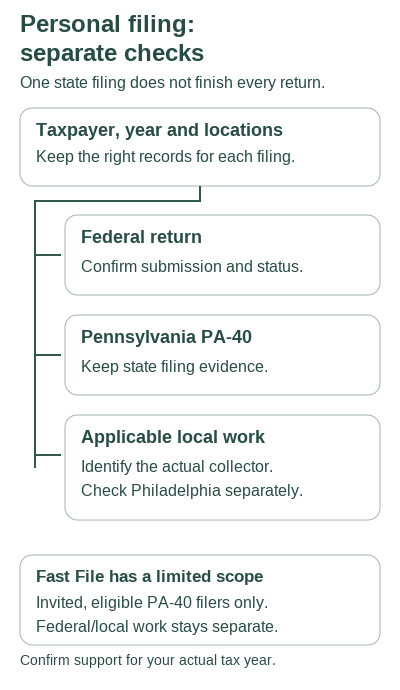
A federal return, a Pennsylvania filing and local tax work may need different records and completion checks. Start with the taxpayer, year and work outstanding, then identify the responsible agency or collector. Preparation, future planning and responding to a tax notice are separate assignments, even when the same professional helps with more than one.
| Your immediate task | Where to begin |
|---|---|
| Personal or family returns | Individual preparation: federal, Pennsylvania and applicable local work |
| Business filings and owner information | Business preparation: entities, books and handoffs |
| A future household or business decision | Planning: assumptions and the work to compare |
| A letter, assessment or bill | Notice help: the issuer, type, instructions and date |
Individual tax preparation
Tell the preparer which years need attention and whether you need an original return, an earlier unfiled return or a correction. Explain income, household changes, residence and work locations, including moves during the year. Identify payments, corrected forms and information expected from a business preparer.
Pennsylvania DOR's personal income-tax page points to state filing through myPATH. Confirm the tax years, forms and work supported by the option you choose. A completed PA-40 does not, by itself, establish completion of IRS Form 1040 or any applicable local return.
The department's Fast File guidance describes a streamlined option for selected eligible taxpayers who receive its letter. It covers the Pennsylvania PA-40, with federal and local filing handled separately. Do not treat an invitation, a myPATH account or a prefilled wage record as proof that every required return has been prepared and filed.
When comparing basic assistance, self-service software or paid preparation, check current opening arrangements, eligibility and supported return types and years. For paid help, agree the federal, state and local scope, review process and support after filing. Name who obtains authorization, submits each return, checks acceptance or rejection, resolves missing items and supplies copies and payment instructions. The personal preparation guide develops the general workflow.
Business preparation and owner information
List each entity, actual tax classification, owner and reporting period. Provide prior returns and election records, identify books needing cleanup and agree who supplies missing information. Separate entity preparation from owner-return work, payroll, local withholding and any other assigned filings.
Local work needs actual location records. Pennsylvania DCED's local withholding guidance directs employers to address-based EIT, political subdivision code and collector information. It also treats Philadelphia separately. Give the professional the relevant home and work addresses and dates; a postal city or county name alone does not identify the whole assignment. A local withholding payment is not proof that all state, federal or owner work is complete.
Agree the preparer, reviewer and responsible person for each submission and payment, plus the owner-information handoff. Keep filing status and payment evidence tied to the correct taxpayer and period. The business preparation guide explains that general process. The location library below develops distinct local business-planning and professional-selection questions; it is not a checklist of obligations for every business.
Personal planning and business decisions
If your household needs to compare retirement, changing income or a move before acting, describe the decision, years and cash assumptions. Ask which alternatives will be assessed and when changing facts require another review. The retirement tax-planning guide provides a household framework rather than an employer-plan design service or a universal withdrawal recommendation.
For a business, the question may instead concern ownership, property, staffing, expansion or closing an operation. Use the relevant city guide to define that planning work. Confirm whether a preparation quote includes the analysis and implementation you need, or whether those are separate engagements.
Identify who sent the tax letter
Record the issuer, taxpayer, period, notice type or reference, date issued and required action. Keep the complete notice with the relevant return, filing evidence, payments and previous correspondence. Tell the professional about an approaching response or appeal date before agreeing a routine preparation assignment.
Use the federal notice guide for an IRS letter. Pennsylvania DOR's Understanding Your Notice distinguishes assessments, billing, information requests, offsets and adjustments. The notice type affects the next step. Read the whole document and follow its instructions, response route and actual deadline; there is no single reply period or automatic amendment suitable for every letter.
A local collector's letter needs its own taxpayer, period and procedure checked. Do not assume a DOR or myPATH response has answered a local matter, or that payment to one agency resolves another agency's account. Agree who reviews the evidence and handles each response, and retain what was sent and the resulting acknowledgement.
City guides
Browse city guides for established business owners comparing tax-planning scope, CPA or enrolled agent expertise and implementation responsibilities. Start with the guide relevant to your business, then use its questions to describe the work you need.
These are educational resources. A city guide does not establish that a participating firm is available there, has a local office or can accept your engagement.
- Beaver Falls: Compare tax advisers for a Beaver Falls Opportunity Fund decision, separating the actual gain, existing elections, investment commitment and tax cash needs.
- Bethlehem: Compare Bethlehem business tax planning around activity receipts, local classifications, operating margins and company and owner cash decisions.
- Butler: Compare Butler tax-planning proposals on new-business exemption conditions, unresolved eligibility assumptions, applications and business-owner cash planning.
- Coatesville: Compare Coatesville business tax planning for property improvements by continuing taxes, added assessment, parcel conditions and company and owner funding.
- Connellsville: Compare Connellsville tax advisers on current payment-proof review, a conditional final receivable, remaining company obligations and owner cash planning.
- Easton: Compare Easton PA/NJ business tax planning by owner income type, reciprocity limits, conditional credits and coordinated company and owner cash projections.
- Greensburg: Compare keeping your accountant with additional tax or legal support, company and owner work, fees and implementation responsibilities.
- Harrisburg: Compare Harrisburg tax advisers on professional-firm cost recoveries, related-company charges, written analysis, owner cash planning and implementation.
- Johnstown: Compare Johnstown assessment-review and tax-planning engagements on written records, current procedure, specialist scope and continuing owner cash decisions.
- Lancaster: Compare Lancaster tax advisers on CRIZ reporting, payment records, business and owner planning, and responsibility for the work your operation needs.
- Monessen: Compare professional scope before a Monessen residential property purchase: title, current rehabilitation terms, intended use and continuing obligations.
- Philadelphia: Compare Philadelphia business tax advisers on BIRT/NPT scope, owner planning, written deliverables and implementation responsibilities.
- Pittsburgh: Compare Pittsburgh business tax advisers on work-location records, payroll expense tax, owner projections and responsibility for implementation.
- Reading: Compare Reading tax-planning proposals for a business with multiple locations, receipts-attribution evidence and coordinated owner cash planning.
- Scranton: Compare a Scranton adviser change by current planning, legacy local-tax accounts, records handover and responsibility for company and owner projections.
- Shamokin: Compare a Shamokin wind-down engagement by closing tax review, continuing responsibility and usable records after routine accounting services end.
- Sunbury: Compare Sunbury KIZ credit planning by company tax use, permitted owner allocation, remaining award and approved sale cash, with clear adviser responsibilities.
- Wilkes Barre: Compare actual Wilkes-Barre-area planning offers and directory disclosures, then define the business and owner work, team and responsibilities you need.
- Williamsport: Compare Williamsport tax advisers on actual-fact research, City tax determinations, limited reliance, conditional owner planning and implementation.
- York: Compare York tax-planning engagements for an additional operation, opening-year receipts assumptions, later reconciliation and business-owner cash planning.
Sources and scope
The linked state filing, Fast File, notice and local-withholding resources were checked November 3, 2026. Use instructions for the actual return year and confirm current supported work. The city guides discuss their stated business decisions; they do not establish available local firms.