
Tax preparation in White Plains for individuals and businesses
Compare White Plains tax preparation by what needs filing now and which decisions need separate advice. Individuals and families can seek a personal return without a company, ownership change or family-office engagement. A business can arrange current returns while a future transition receives its own review.
Personal tax preparation in White Plains
Identify the year, income sources, residence or work locations and returns you need. Wages, retirement income, investments or self-employed records can be the whole assignment. Ask what records are needed, who prepares and reviews the return and whether the quote includes resolving missing information.
If business or family entities supply information for your personal return, identify the sender and the final records required. That connection does not mean you need every estate, trust or planning service on a firm's menu. Vescio's inspected return list covers individual and company categories, but its displayed Bedford Hills location makes it a regional comparison, not evidence of a White Plains office or current opening. [3]
Business tax preparation in White Plains
Bring the company's actual returns, classification and election records, owners, periods and available accounts. Agree which entity returns are included, who reviews them and who supplies the final information for owner filing. A preparation quote based on completed books should identify any separately required records work.
Keep today's filing separate from a proposed ownership or family change. Colasanti's operating reports, Heller's advisory subjects and Vescio's company/family return categories raise different scope questions. Ask which current returns are accepted and which future decision, valuation or legal contribution needs another assignment. A single broad service description does not settle all of them. [1][2][3]
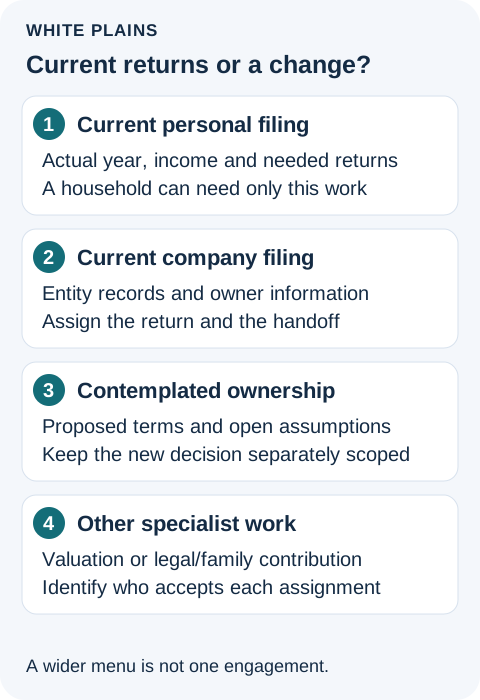
Compare filing options for the actual return
New York's income-tax filing resource center provides filing and assistance routes. Its Taxpayer Assistance Program distinguishes guided help from software access and follow-up. The 2026 guided assistance season has ended. Check the supported year, eligibility and current arrangements; an old schedule is not an available appointment. These individual options do not establish support for company returns.
For paid help, compare the accepted returns, named preparer, records work, fee and service location. A local service page, nearby office and remote engagement can describe different arrangements. The New York tax-help guide separates official resources from professional selection.
Agree review, filing and follow-up
Use a secure document route and identify unresolved items. Agree how you review the draft and authorize submission, who confirms each return's acceptance or handles a rejection, and how final copies are retained. Filing and paying a balance are separate steps. Ask which payment instructions you receive and what remains your responsibility.
The personal preparation guide and business preparation guide explain the general completion and company-owner handoff. For a letter, identify its actual issuer, taxpayer, period and requested action. The IRS notice guide concerns federal correspondence; the New York notice section keeps state and other issuers separate. Annual preparation does not automatically include a response.
Business Tax Planning in White Plains, NY
Business tax planning becomes more demanding when the business is supporting the owner's current income and a possible change in ownership. You may want to step back, bring in another owner or consider how the company fits into your family's longer-term plans. The first task is to define which decisions need tax analysis and which professionals will work together.
For a White Plains business owner, a useful CPA or enrolled agent engagement should connect reliable current business figures with the owner's position. A broad service list does not tell you how that connection will work. This guide explains how to compare the work, prepare the relevant facts and recognize the limits of a proposal before hiring.
Begin with the business decision and the owner's priorities
Write down what you expect the business to do over the next stage of ownership. Is the immediate priority dependable income, funding growth, admitting a partner or preparing for a future transition? An adviser needs to distinguish a decision being considered from one already agreed.
Then separate the company's operating needs from the owner's personal objectives. An owner may want to reduce involvement while the company still needs cash for staff, investment or debt commitments. The tax conversation should be based on those facts, with a clear statement of what the analysis will compare. It should not begin with a particular structure selected from an article.
Ask the proposed adviser to explain the work in two connected parts:
- The current position: which business and owner returns, current accounts, payments and income sources establish the starting point.
- The contemplated change: which new ownership or family circumstances need analysis, what information is missing and which specialist contributions are required.
This distinction helps you assess whether a recurring planning engagement is sufficient or whether additional transition work needs its own scope. A single annual return cannot describe every decision that may occur after it is prepared.
Compare the different offers surfaced for White Plains
The public practice descriptions inspected for this guide show several ways that tax work can be presented. These are research examples, not rankings, verified FSI partners or confirmation that a practice can accept your assignment.
| Researched practice description | Work described in the material | What an owner can clarify |
|---|---|---|
| Colasanti & Iurato LLP | Ongoing business accounting, financial reports, business advisory and year-round tax strategies | How do current reports reach the person preparing the business and owner projection? |
| Heller & Filippone LLP | Business decisions, budgets, cash flow, entity review, retirement and succession | Which proposed decision will be analyzed, and what is the output of that work? |
| Vescio Family Advisors | Business and individual planning, family circumstances, estate/trust/gift work and multistate returns | Which family and business work is included, and who coordinates the separate returns and advisers? |
Colasanti & Iurato's inspected website describes monthly operating statements, balance sheets and related accounting work alongside tax services. Heller & Filippone's advisory page explains how financial and operational decisions connect with tax planning. These are useful subjects to compare, but a public description does not establish the particular work, fee or responsible person for your engagement. [1][2]
Vescio's tax planning and preparation page was surfaced in the White Plains research, but its current displayed address is Bedford Hills. It is a regional comparison, not evidence of a White Plains office. Its service list includes several types of business and family returns; ask about the actual assignment and current capacity. [3]
Some descriptions were available through retrieved web copies because direct service-page requests were unsuccessful. Confirm the present offer with the practice. A place name in a search result or a promotional statement does not verify credentials, capacity or the office boundary.
Connect recurring records with business and family planning
Before discussing a change in ownership, establish whether the figures used in the analysis are dependable. Ask which period the management accounts cover, whether material balances have been reviewed and which numbers are estimates. A forward-looking model should identify its assumptions so a later change can be recognized.
The relationship between recurring accounting and a transition review matters. If one team maintains the business records and another advises the owner, agree how the relevant information will move between them. An unexplained spreadsheet is a weak handoff even when both teams are competent.
Family-related work deserves the same clarity. A business owner's personal return, a separate family entity and an estate or trust assignment may have different responsible people and information requirements. A firm advertising several services does not automatically include all of them in one engagement. Vescio's broad return categories and Heller & Filippone's succession discussion illustrate why the boundaries need to be explicit. [2][3]
Use a work map to make that conversation concrete:
| Area under discussion | Responsibility to establish |
|---|---|
| Current business and owner tax position | Who reconciles the relevant figures and reviews the combined assumptions? |
| Proposed ownership change | Who assesses the tax questions raised by the proposed terms? |
| Business value, if a valuation is needed | Who supplies the valuation and explains its purpose and assumptions? |
| Legal or family implementation | Which appropriately appointed adviser prepares or reviews the relevant documents? |
| Follow-up after a decision | Who checks that the records and subsequent work reflect what was agreed? |
The map is a way to define the engagement, not a statement that every owner needs every service. Ask the lead professional to identify what is relevant and what can reasonably be left outside the assignment.
Check New York treatment before changing the arrangement
Bring the entity's election and return history into the discussion. Current New York guidance says that a federal S corporation is not automatically treated as a New York S corporation unless the mandatory state-election rule applies. The relevant records should be inspected rather than the result inferred from an entity's informal label. [4]
Optional New York pass-through entity tax, or PTET, is another distinct question for eligible entities. Ask whether the entity and affected owners are within the applicable rules and what analysis would support an election decision. The state assigns the election to an authorized person for the eligible entity. Tax professionals may assist with analysis and may make permitted estimated payments, but those roles do not mean that a client election can automatically be made by the adviser. [5]
Keep other locations in view when the facts warrant it. Business activity in NYC and an owner's residence can raise different questions. NYC has separate corporate tax treatment, including its treatment of otherwise taxable federal S corporations; a state S election does not settle that city position. [6]
You do not need to turn the first meeting into a catalogue of every New York tax. You do need to explain the entity, ownership and activity facts that may change the scope. Ask the adviser to identify which conclusions can be reached now and what evidence is still required.
Compare proposals using the same facts and priorities
Prepare a short factual summary for each firm you approach. Describe the business, existing owners, recurring tax work and the change you are considering. Include the expected decision date and any documents or terms that have already been prepared. Keep tentative assumptions clearly labeled.
For each proposal, look for the following answers:
- What question will the engagement answer, and what will be delivered?
- Which current figures and returns are required before the work can proceed?
- Who performs the analysis, and who is responsible for technical review?
- Which business, personal and family assignments are included or excluded?
- When will another professional need to contribute?
- How are additional work and changes in scope authorized?
Verify the relevant professional status as well. New York's professional guidance explains how to check a CPA's license and registration. The IRS distinguishes the unlimited federal representation rights of CPAs, enrolled agents and attorneys. A credential check and relevant experience answer different parts of the selection decision. [7][8]
A well-defined proposal can explain uncertainty without promising a result. For example, the adviser may need a more complete ownership record or proposed terms before assessing a transition. Ask what information would change the analysis and how that information will be obtained.
Questions White Plains business owners ask
Does planning an ownership change require more than my annual business return?
Ask for the recurring business and owner position and a separate scope for the contemplated change. Provide the existing ownership documents, proposed terms and timetable. The professional should identify which tax analysis, valuation or legal contributions are needed and who coordinates them. A return-preparation quote does not establish that the transition work is included. [2][3]
Can one White Plains tax firm handle both business and family tax work?
Compare the actual team and assignment rather than infer every service from a business-tax label. The inspected offers span ongoing business advice and regional family, estate, trust and multistate work. Ask who performs and reviews each part, how specialists contribute and which terms apply. The website descriptions do not confirm availability or an all-inclusive engagement. [1][2][3]
Does a federal S corporation election settle my New York position?
No. New York's guidance distinguishes its separate election from mandatory state S treatment, and NYC has separate corporate tax rules. Have the professional inspect the actual elections, acknowledgments and activity facts before recommending a change. The federal return alone does not resolve every jurisdiction's treatment. [4][6]
Is a nearby office enough when my business operates in more than one place?
An office location does not establish the required experience or all tax obligations. Explain where owners reside and business activity is carried on, including relevant entities, premises and work locations. Ask which state, city or commuter-district questions need review and who handles them. Current MCTMT guidance distinguishes business activity and allocation from a base address alone. [9][10]
Records for the agreed assignment
Record the current returns and the ownership or family decision being considered. Keep the entity, owner, supporting records and separately accepted specialist work identifiable, with an assigned reviewer and follow-up for each.
Sources and review date
Sources checked October 30, 2026. Practice descriptions are attributed research observations, not tax authority, verified credentials or current capacity. This is general adviser-selection information.