
Tax preparation in Irvington: choose personal, business or planning help
Irvington personal tax preparation can cover ordinary household income without buying household-administration or family-office services. State the year, federal and New York returns, other states and missing records. If someone else organizes bills or receipts, ask which confirmed information the preparer needs and who explains an unresolved item.
For business preparation, identify the entity, actual tax classification, owners, period and accounts. Keep company records separately identifiable from household administration. Agree who finishes each set of information, prepares the returns and supplies owner documents. Organizing a bill, authorizing payment and analyzing tax treatment are different responsibilities; no bank authority should be inferred from a service label.
Compare filing options for your actual return
Compare paid preparation, supported self-service software and basic assistance against the whole return and tax year. New York's income-tax filing resource center provides filing and assistance routes. The Taxpayer Assistance Program distinguishes guided sessions from software access and follow-up. Its 2026 guided assistance season has ended; check the current page for the relevant year, eligibility and arrangements rather than assume a local appointment is available. These individual filing options do not establish support for company returns.
The New York individual preparation section helps distinguish ordinary and more involved filing needs. For paid help, agree which person accepts the return and what records, review and questions the fee includes. A company or specialist project is not a condition of obtaining personal preparation.
Agree how each filing will be completed
Use an agreed secure document route, identify missing information and name who prepares and reviews each return. Confirm how you review the draft, authorize submission and receive each federal and state filing status. Ask who handles a rejection, what remains your responsibility and how final copies are retained. Submission, a refund and paying a balance are different matters. Amendments, notice responses and later planning need their own accepted scope.
For company and owner responsibilities, see New York business preparation. If an actual letter needs attention, the New York notice section starts with the issuer, taxpayer, period, requested action and response responsibility.
Business Tax Planning in Irvington, NY
Household bills and business books can both need attention without belonging to the same assignment. An Irvington business owner may want help administering personal finances as well as reviewing the company and owner tax position. Before hiring, identify the daily work that must happen and the information the tax professional needs from it.
This distinction matters when a proposal uses a broad label such as family office, financial planning or business accounting. Does someone organize the bill, arrange an approved payment, record what happened or analyze a tax question? The actual work should be recognizable.
Compare Irvington household and business tax offers
Three inspected descriptions show different work. These are attributed research examples, not rankings, verified FSI partners or confirmation of current capacity.
Klein's family-office page describes day-to-day household tasks: bills, checkbooks, receipts and deposits, routine expenses and personal-asset inventories. It also lists tax work and coordination with an investment adviser. The argument gives a concrete household-management assignment to discuss, rather than just a family-office label. [1]
RMJR's Irvington page describes cloud accounting, company-book reconciliation and business returns alongside personal tax preparation. Ask whether your requested work concerns those company records, separate household administration or additional owner analysis. Its service examples do not determine your entity's tax classification. [2]
LL Financial Services describes business and individual tax work alongside financial planning and investment management. It markets Northern Westchester services and displays an Ossining address, so it is a regional comparison rather than a claimed Irvington office. Its broader planning language does not itself establish household bill administration. [3]
Klein displays Irvington and White Plains addresses; RMJR displays an Irvington address. Postal descriptions do not independently establish premises within village boundaries. The Klein service description was retrieved from an older web copy. Confirm the present offer. LL's professional and registration claims, including displayed 2025 Form ADV link titles, are not independent verification of current status or capacity.
Name the household tasks and approval points
Choose a real recurring task and ask the provider to explain the proposed service from receipt to finished record. A household bill is a useful example because receiving it, checking it, authorizing payment and recording payment are distinguishable activities.
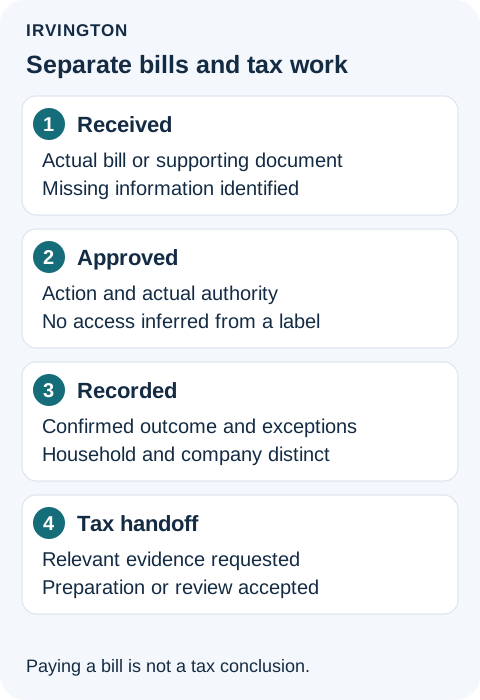
Ask for clarity at four points:
- Received: Who obtains the document and records what is still missing?
- Prepared: Who identifies the requested action and flags an unexplained amount or duplicate?
- Approved: Who has agreed authority to approve the action, and what happens when approval is absent?
- Recorded: What confirms the outcome, and where does an unresolved item remain visible?
These are questions for defining a service, not instructions to grant account access or execute payments. Ask what arrangements would be appropriate before providing access. A provider organizing documents has not necessarily accepted payment duties; a planned payment is not evidence that it happened.
Klein's actual bill, receipt and checkbook examples make this distinction relevant. Ask which tasks the proposal accepts, what you receive and which decisions remain with you or another appointed person. [1]
Keep company records and household administration distinguishable
Identify whose records are being administered. A company bookkeeper may have a clear picture of the operating business while a separate person handles privately paid bills or receipts. Explain both arrangements without treating them as one set of company transactions.
For an item requiring tax review, identify the payer or recipient, account, period, purpose and underlying document. Mark any uncertainty. Ask the tax professional which additional facts are needed before reaching a conclusion. Entering an item in software or placing it on a household list does not decide its treatment.
RMJR's company-accounting description gives a useful comparison: ask whether the work ends with reconciled company books and returns or also accepts the particular owner question. A broader personal service should state what information it supplies to that review. [2]
This article does not classify a household payment as a business deduction, determine taxable income or recommend moving money between accounts.
Request usable household inputs for the tax review
Agree what completed administration will produce. A useful status record can distinguish a confirmed receipt or payment from a planned, disputed or unexplained item. Identify the period, source document and person responsible for resolving an exception.
Then ask the tax reviewer what information is relevant to the actual company-and-owner question. Do they need the underlying document, a confirmed total with supporting records or clarification of who owns an account? Request the professional's record requirements rather than assume a household spending summary answers everything.
Klein's daily administration and LL's broader financial-planning descriptions represent different starting points. One can help organize transactions while another discusses financial objectives; neither public description establishes the particular tax analysis you have purchased. [1][3]
Keep unresolved items visible when information is passed on. The useful result explains what is confirmed, what is missing and who answers the remaining question. Paying bills or receiving financial advice does not itself complete the owner's tax review.
Check the professional and written work
Ask about experience with the actual administration and tax tasks. Verify a named New York CPA's license and registration separately. The state's consumer guidance addresses explanations of assumptions and alternatives and written terms covering services, timing and fees. [4]
CPAs, enrolled agents and attorneys have unlimited IRS representation rights. Those rights do not establish bank authority, legal or investment competence, or every household-administration skill. Agree appropriate information access and a secure way to share records with the appointed professionals. [5]
Questions about Irvington household finance and tax help
Does a family-office label mean a provider can pay my household bills?
No authority is established by the label. Klein's dated page actually describes bills and checkbooks, but ask which tasks your proposal accepts, who approves actions and what records confirm completion. Discuss appropriate access separately; this guide verifies no current contract or bank mandate. [1]
Are my company books enough for household administration and owner tax planning?
They may not cover separately administered personal items. RMJR describes company books and returns. Identify the actual household records and owner question, then ask the reviewer what additional evidence is needed. The useful output is a defined information request and accepted analysis, not a presumed deduction. [2][4]
How is household bill administration different from financial planning?
Daily administration concerns accepted tasks and their status; a financial-planning proposal may concern broader objectives. Klein and LL describe those different emphases. Ask whether your proposal administers transactions, advises or accepts both, and which confirmed records reach the tax reviewer. No bank or investment powers are inferred. [1][3]
Records for comparing the proposed work
Keep a concise record of the business, owner situation and daily household support or tax review being sought. Identify existing professional support.
Sources and review date
Sources checked October 31, 2026. Practice descriptions are attributed observations, not independently verified credentials, authority or capacity. Retrieved copies may predate retrieval; confirm current services.