
Tax preparation in Waukegan for individuals and businesses
Start with the return you need completed, then define any additional review. Personal filing, company preparation and the specialist work below can be separate assignments.
On this page
Personal tax preparation in Waukegan
Name the personal filing year, income records, residence or work changes and relevant states. Ordinary preparation does not require an employer project. If Illinois and Wisconsin facts are involved, ask which personal returns the preparer accepts separately from the business's payroll and withholding review.
Business tax preparation in Waukegan
Identify the employer or other business taxpayer, classification, period and accepted returns. Keep current company preparation, worker-specific withholding analysis and earlier payroll corrections distinct. Ask who supplies the reviewed residence, service and declaration information, who implements it and which final records reach the entity and owner preparers.
Compare filing options and completion
For a straightforward personal return, IRS VITA/TCE assistance is one route to check. Confirm the actual site's supported work, tax year, eligibility and current arrangements. IRS Free File has separate partner, form, state and filing-year conditions; check current availability before starting. Neither route establishes help with every business return. The Illinois individual preparation section gives state context.
Compare paid quotes using the same returns, years, states and record condition. Agree a secure document route, the preparer and reviewer, and how missing information or extra work is approved. Review the draft before authorizing filing. Name who confirms acceptance or resolves a rejection, supplies final copies and explains payment responsibilities. A submitted return does not prove that a balance was paid. The personal preparation guide and business preparation guide develop those handoffs.
If a letter is the immediate issue, identify its actual issuer, period, instructions and date. The IRS notice guide concerns federal correspondence; Illinois notice help distinguishes the state route. Ask whether response or representation work is included rather than assuming annual preparation covers it.
Business tax planning in Waukegan for cross-border employers
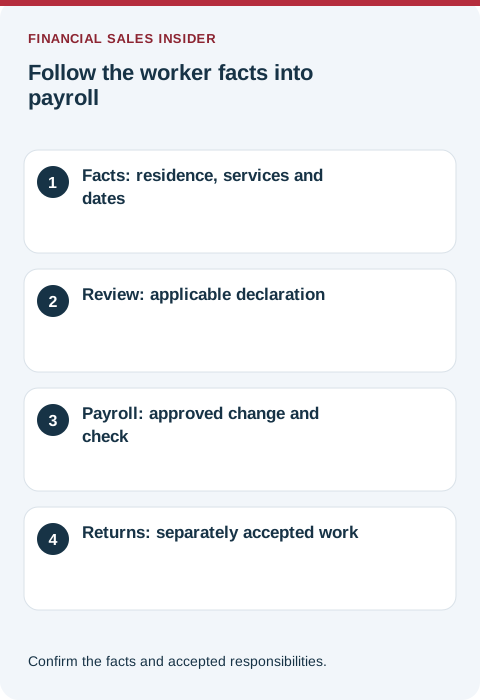
For a Waukegan business with employees living or working across the Illinois and Wisconsin border, buying payroll processing does not define the tax review. Choose an engagement that establishes the worker facts, reviews the employer's obligations and carries an approved determination into the payroll records.
The regional context is real: Dieck, Arenas & Associates describes serving Northern Illinois and Southern Wisconsin, while EKJ names Kenosha County alongside its Illinois service area. Those descriptions are starting points for questions, not confirmation of specialist scope or available FSI firms.
Business records, worker-specific payroll facts and the owner's separate return are different parts of the assignment. Confirm who accepts each review.
Build the worker record before changing withholding
Give the prospective reviewer the employer's legal entity, existing payroll arrangement and actual staffing pattern. For each affected worker, identify residence and domicile facts, service locations, relevant dates and changes during the year. A mailing address alone should not settle a residence question.
Ask operations and payroll staff to distinguish recorded facts from assumptions. For example, a Wisconsin home address does not explain whether the employee works at an Illinois site, Wisconsin premises or both. Record who can confirm the working pattern and when it changed.
Request an explanation of the evidence needed for each determination, the person reviewing it and what remains unresolved. The broader planning documents checklist helps prepare the business and owner pack; it does not replace these worker-specific facts.
Test the two staffing directions separately
A Wisconsin resident working for the Illinois business
Suppose an existing employee lives in Wisconsin and performs services at the Waukegan operation. Ask the adviser to assess the actual residence and work facts against Illinois withholding guidance, including the reciprocal-state conditions and required evidence.
Illinois Publication 130 addresses the employee's IL-W-5-NR statement and the employer's records. The statement goes to the Illinois employer. Have the reviewer identify the applicable declaration, check its supporting facts and assign retention and updates when residence changes. Possessing a form is not a substitute for establishing that it applies.
Then ask a separate Wisconsin employer question. Its withholding guidance, stating laws enacted as of April 20, 2026, considers both the wage condition and the employer's business activity. Paying a Wisconsin resident is not, by itself, the complete test. Have the professional establish the business's relevant Wisconsin activities and explain whether withholding or registration work follows.
An Illinois resident performing work in Wisconsin
Now consider an Illinois-resident employee who performs services in Wisconsin. Give the reviewer the work arrangement and effective dates rather than copying the first employee's payroll settings.
Wisconsin's employer guidance discusses reciprocity and written verification through Form W-220. Ask who establishes that the employee qualifies, obtains the appropriate evidence and communicates the approved treatment to the payroll operator. The review should also identify the applicable Illinois employer work; stopping one state's withholding does not establish that the remaining obligations are complete.
Residence questions and exceptions need their own review. Wisconsin's January 2026 Publication 121 is expressly for preparing 2025 returns and includes Illinois residency exceptions. It provides context for the distinction, not a blanket 2026 filing answer for either employee.
Follow the determination into the first affected payroll
Ask candidates to explain one worker's case from source evidence to verified records. Agree who performs each step:
- The technical reviewer records the facts, treatment assessed, relevant period and unresolved conditions.
- The employer confirms the operating facts and authorizes the agreed change.
- The payroll operator applies the instructions from the agreed effective point and records what changed.
- The designated checker compares the first affected payroll with the approved determination and supporting declaration.
- The year-end reviewer checks that the relevant wage and withholding records reflect the reviewed facts and subsequent changes.
These are engagement outputs to agree, rather than a universal statutory workpaper format. Ask what evidence the checker receives: approved instructions, the actual payroll result and any exception record. A software setting alone cannot demonstrate that the correct employee, period and treatment were used.
If the result differs, identify who investigates, which information is missing and who approves the resolution. Keep the issue open until the responsible reviewer explains it. Scope prior-period payroll corrections and personal-return work separately; changing future payroll does not automatically recover earlier withholding.
Keep the owner's separate tax work visible
An owner may also receive employee compensation, but business and ownership income need their own analysis. The dated Wisconsin reciprocity publication distinguishes employee income from self-employment and pass-through income, among other categories. Ask for current-year review of the owner's actual payments and entities.
Keep that assignment identifiable alongside the employer work. A payroll withholding change is not proof that the business has additional cash available for owner withdrawals, or that all business and personal returns have been assessed.
Compare proposals against the same assignment
Give each candidate the same staffing facts and request a scope covering technical review, declaration evidence, payroll instructions, verification, updates and excluded correction work. Confirm who is the named CPA or EA reviewer and ask about comparable Illinois/Wisconsin employer work. Verify claimed credentials separately.
Compare recurring processing with the additional technical assignment before evaluating the fee. The business tax planning fee guide explains why analysis, implementation and ongoing support need identifiable scopes. Your existing payroll provider can remain involved if the actual responsibilities and information exchange are agreed.
Questions for a cross-border employer engagement
Does a reciprocal-state address settle the payroll treatment?
No. Give the reviewer residence, service-location and effective-date facts, then ask which conditions and declarations apply. Wisconsin's employer assessment also considers the business-activity condition. An address or completed form alone is not the entire determination.
Will a payroll change also correct earlier personal returns?
Do not assume so. Ask which periods and corrections the engagement accepts and who handles the employee's separate return work. Future processing, employer corrections and personal-return analysis are distinct responsibilities to confirm.
Records and responsibilities to keep
Keep the worker facts, applicable declarations, approved instructions and verified payroll results together. Identify who handles changes and separately accepted earlier-period corrections. Agree a secure process before sending employee identity documents or payroll records.