
Tax preparation in Rockford for individuals and businesses
Start with the return you need completed, then define any additional review. Personal filing, company preparation and the specialist work below can be separate assignments.
Personal tax preparation in Rockford
Identify the personal tax year, income records, household changes and relevant states. A manufacturing business or capital project is not required. If a company supplies information for the return, ask who confirms the final figures and whether any owner-pay or investment analysis is separately accepted.
Business tax preparation in Rockford
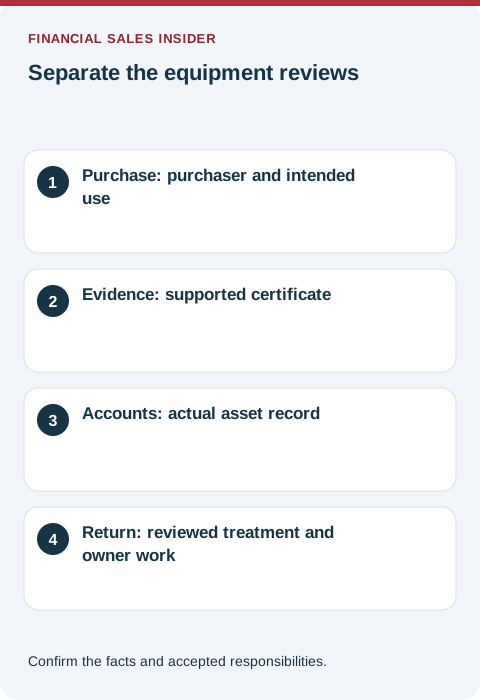
Name the actual taxpayer, classification, period and records. Separate annual preparation from a review of equipment purchases, qualifying use or purchase-tax documentation. Ask who maintains the asset register, supplies the reviewed conclusion and sends final owner information. A supplier certificate and an income-tax deduction answer different questions.
Compare filing options and completion
For a straightforward personal return, IRS VITA/TCE assistance is one route to check. Confirm the actual site's supported work, tax year, eligibility and current arrangements. IRS Free File has separate partner, form, state and filing-year conditions; check current availability before starting. Neither route establishes help with every business return. The Illinois individual preparation section gives state context.
Compare paid quotes using the same returns, years, states and record condition. Agree a secure document route, the preparer and reviewer, and how missing information or extra work is approved. Review the draft before authorizing filing. Name who confirms acceptance or resolves a rejection, supplies final copies and explains payment responsibilities. A submitted return does not prove that a balance was paid. The personal preparation guide and business preparation guide develop those handoffs.
If a letter is the immediate issue, identify its actual issuer, period, instructions and date. The IRS notice guide concerns federal correspondence; Illinois notice help distinguishes the state route. Ask whether response or representation work is included rather than assuming annual preparation covers it.
Business tax planning in Rockford for manufacturing and distribution owners
Before an industrial business commits cash to equipment, its owner needs to understand the purchase, operating and personal consequences. A proposed tax deduction is one part of that decision. Financing, working capital, equipment use and owner compensation also belong in the assessment.
This guide helps you compare business tax planning expertise in Rockford, using the actual activity, investment and owner responsibilities.
Choose expertise around the investment decision
Rockford has an established industrial context. The Greater Rockford Chamber's aerospace and defense alliance describes a network anchored in Rockford and involving manufacturers, suppliers and public partners. Membership or location does not itself establish a tax benefit.
Explain your actual activity to a prospective adviser. Do you manufacture, assemble, distribute finished goods or combine several operations? Describe what the equipment will do, which entity will acquire it and who will use it. A distributor should not assume that a manufacturer's treatment applies to ordinary warehouse equipment.
Ask about comparable investment assignments. A useful response describes the information reviewed, alternatives assessed and professionals involved. An adviser can demonstrate a method without revealing a client's figures or promising to reproduce another owner's result.
Set the review timetable around the commercial decision. Tell the firm when you must sign, fund or take delivery, and which terms remain open. Ask what can be assessed now, what depends on further documentation and which implementation steps require another specialist.
Separate exemption evidence from income-tax deductions
The Illinois ST-587 exemption certificate and instructions ask for the purchaser, equipment and intended qualifying use. The instructions describe primary-use categories and explain that the seller retains the certificate.
That documentation task is different from deciding how an asset is treated on an income-tax return. Ask the adviser to keep the purchase-tax question and the income-tax analysis separate. A certificate is not proof that every machine, supply or use qualifies.
Prepare a project file with quotations, equipment descriptions, purchaser and user identities, expected uses and the proposed installation timetable. Where equipment has mixed uses, explain them. Ask what additional evidence the professional needs before a conclusion can be reached.
If the business leases equipment, identify the purchaser or lessor and the lessee instead of assuming the same entity fills every role. Ask who prepares any supporting documentation and what the supplier must retain. Do not sign a blanket statement simply because it is part of a vendor's standard paperwork.
Protect working capital and owner pay
Ask for a cash forecast alongside the tax analysis. It should show the purchase or financing commitments, installation costs, operating cash needs and funds available for owner payments. The fact that an expenditure may affect taxable income does not show that the business can afford it.
Have the adviser compare realistic alternatives. They might include proceeding with the intended project, changing its scope or deferring a commitment for commercial reasons. Request the assumptions and unresolved tax questions for each option. Avoid starting with a target saving and working backward to justify spending.
Owner pay needs its own assessment. If you work through an S corporation, the IRS reasonable compensation guidance makes the services performed relevant. A capital purchase does not make an arbitrary salary-and-distribution split appropriate.
Ask how changes in your duties, staffing or production affect the review. The tax professional should distinguish the compensation assessment from the amount of cash you would like to withdraw. A plan that relies on unavailable cash or undocumented assumptions is difficult to implement.
Compare a written capital-project planning scope
Before accepting a proposal, ask what the written work will contain. Look for the entities and tax years covered, the evidence still required, alternatives compared, payment assumptions and people responsible for implementation.
Confirm which parts require additional expertise. A tax adviser may need to coordinate with your bookkeeper, equipment supplier, lender or attorney. Ask who obtains answers and how a changed contract, delivery date or use will be brought back for review.
For a distribution business, request an explicit answer about the limits of any manufacturing-related analysis. For a manufacturer with several entities, identify which company buys, owns and uses the equipment. These facts should remain visible in the engagement rather than disappear into a general promise to optimize taxes.
Compare fees for equivalent deliverables. A filing engagement may exclude the project review, while a planning quote may exclude accounting cleanup or implementation. The business tax planning fees guide sets out a practical comparison method.
Verify applicable professional records through Illinois license lookup. The IRS credential guide explains preparer qualifications and representation rights. Ask separately about experience with your operational and ownership questions.
Questions to resolve before committing capital
Should I buy equipment just to reduce this year's tax?
Start with the commercial need and affordable cash commitment. Ask a professional to assess tax treatment as part of the decision. A potential deduction does not repay the entire purchase cost or establish that immediate spending is the best option for the business.
What should the firm deliver before I sign?
Agree on a written assessment of the alternatives, evidence, assumptions and unresolved issues. Identify which conclusions remain provisional and which approved actions require further work. You should know who will update the assessment if the project changes.
Records and responsibilities to keep
Keep quotations, purchaser and user identities, use evidence, asset records and reviewed instructions together. Identify who checks changed delivery or operating facts and communicates them to the preparer. Agree secure transfer arrangements.