
Tax preparation in Marion for individuals and businesses
Start with the return you need completed, then define any additional review. Personal filing, company preparation and the specialist work below can be separate assignments.
On this page
Personal tax preparation in Marion
For personal preparation, name the year, household income records, changes and federal, Illinois or other-state returns. Ordinary filing does not require dispensary ownership. Where business information affects the personal return, ask who supplies the supported figures and which specialist position remains outside the preparer's accepted work.
Business tax preparation in Marion
Identify the actual taxpayer, classification, activities, licenses and reporting period. Confirm the company and owner returns accepted, along with any separately scoped Illinois reporting. For a dispensary, keep the specialist applicability conclusion distinct from records preparation and return completion. A proposed reserve reduction or product label is not a substitute for that review.
Compare filing options and completion
For a straightforward personal return, IRS VITA/TCE assistance is one route to check. Confirm the actual site's supported work, tax year, eligibility and current arrangements. IRS Free File has separate partner, form, state and filing-year conditions; check current availability before starting. Neither route establishes help with every business return. The Illinois individual preparation section gives state context.
Compare paid quotes using the same returns, years, states and record condition. Agree a secure document route, the preparer and reviewer, and how missing information or extra work is approved. Review the draft before authorizing filing. Name who confirms acceptance or resolves a rejection, supplies final copies and explains payment responsibilities. A submitted return does not prove that a balance was paid. The personal preparation guide and business preparation guide develop those handoffs.
If a letter is the immediate issue, identify its actual issuer, period, instructions and date. The IRS notice guide concerns federal correspondence; Illinois notice help distinguishes the state route. Ask whether response or representation work is included rather than assuming annual preparation covers it.
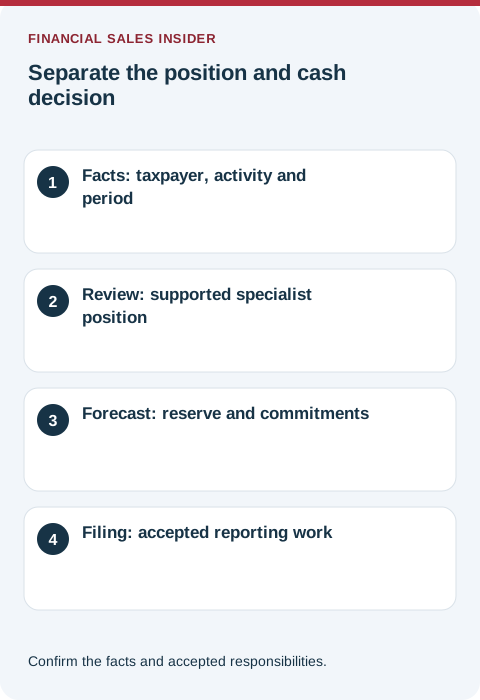
Business tax planning in Marion for a dispensary cash decision
Before committing to a larger owner payment, establish whether a proposed reduction in your dispensary's tax reserve follows a supported tax position. A headline about medical cannabis moving to Schedule III does not tell you what cash this particular business can release.
This guide concerns an existing business serving medical and adult-use customers and an owner considering a 2026 cash-plan revision.
Define the payment decision and the taxpayer
Tell the prospective adviser what you want to change: the amount retained for tax and the proposed owner payment. Supply the existing forecast, payments already made and the date when the new commitment would be made. Ask what review is needed before relying on a lower reserve.
Identify the legal entity on the business returns and licenses, its actual tax classification and the owner's relationship to it. An LLC label does not answer every tax question. The proposal should explain how the business position connects to this owner's forecast, rather than assume all business tax flows through to an individual.
Request a position-plus-forecast assignment. A quote for preparing the eventual return may leave the current cash decision outside the accepted work.
Check the medical rule's scope before changing the forecast
The April 2026 federal final rule has a narrower scope than a change covering all cannabis activity. It addresses FDA-approved marijuana products and products subject to a qualifying state medical marijuana license, while distinguishing marijuana that remains in Schedule I. Its stated effective date is April 28, 2026.
The rule discusses Section 280E's deduction disallowance for Schedule I or II trafficking. The practitioner should explain its applicability before a proposed expense treatment changes the reserve.
The rule expressly does not determine a particular licensee's federal tax liability and directs state licensees to tax counsel about their circumstances. Have the responsible professional assess the actual taxpayer, products, licenses, activities and reporting period before using a different position in the forecast.
The effective date is not an expense-allocation formula. Nor does the rule's encouragement to consider retrospective relief grant prior-year relief. This guide establishes neither an allocation nor a tax reduction for your business.
Prepare evidence for the two dispensing activities
Give the reviewer the license holder, covered site, relevant authorizations and dates, alongside the actual tax-year beginning and end. Explain changes during that period. A business name, medical customer label or accounting category cannot replace the applicability assessment.
Ask which records the assignment needs. Useful starting material includes medical and adult-use POS sales detail, accounting exports, inventory and cost records, relevant payroll and shared-cost support, prior workpapers and current owner-payment information. Identify missing evidence and unexplained differences.
The purpose is to connect actual activity to the conclusion being considered. Separate sales data can help the reviewer investigate the position; it does not independently establish a deduction. Ask who prepares the records, who assesses the tax treatment and who resolves an unanswered legal question. Do not substitute a preferred percentage for that work.
Keep Illinois questions separate
IDOR's cannabis tax information describes business and site records and separate reporting involving medical and adult-use activity, including CD-1 and ST-1. Agree which Illinois reporting review is included and which periods and sites it covers.
A classification used at the register does not, by itself, establish the federal position. Equally, a federal medical-rule conclusion does not settle the Illinois reporting assignment. Ask the practitioner to establish the applicable current requirements and investigate inconsistent records.
This guide also establishes no 2026 Illinois income-tax adjustment for the business or owner. If a proposed forecast includes one, require the actual taxpayer, year, current authority and calculation to be identified separately. An older individual-form instruction is not sufficient support for a different entity and year.
Compare Marion and specialist offers against this decision
Lucas Accounting Solutions describes a Marion and Southern Illinois practice offering CFO, advisory, management and implementation services, with cannabis businesses among its ideal clients. Its website expressly says it is not currently accepting new clients. That disclosure matters when considering an immediate engagement.
The Center's Marion service description combines financial, legal and tax work with analysis, recommendations and implementation. Its staff page distinguishes accounting-firm-only partners. Confirm the contracting legal entity, accepted professional roles and relevant cannabis experience; the broader format does not establish that this assignment is available.
GreenGrowth's cannabis services and Illinois Cannabis Accounting's compliance services already describe substantive accounting, tax, forecasting and implementation work. Compare who will review your position, provide any legal contribution and connect it to the cash plan. These are attributed service descriptions, not verified credentials, capacity, Marion offices, recommendations or FSI relationships.
Ask for a dated conclusion and a refreshed cash plan
Request a written explanation identifying the facts reviewed, supported conclusions, provisional assumptions and information still needed. It should show whether the proposed reserve and owner-payment revision is supported. The answer may be that it is not yet supportable.
The IRS estimated-tax guidance calls for expected annual figures and adjustments for changed circumstances and tax law. Have the practitioner apply the appropriate business and owner requirements, including payments already made. Do not treat the individual's forecast as every entity's calculation.
Agree who updates the model when evidence or a professional conclusion changes, and who carries accepted changes into ongoing records and preparation. Then compare tax planning fees for the defined work, including exclusions and implementation. A meeting alone does not specify those deliverables.
Questions before changing a dispensary tax reserve
Does a medical sales label establish the federal result?
No result is established by that label alone. Ask for the actual product, license, activity, taxpayer and period assessment before relying on a revised position.
Can I commission useful work while a question remains unresolved?
Yes. Define the position review, evidence needed and forecast output. Require uncertainty to remain visible, including what prevents reliance on a proposed cash revision.
Records and responsibilities to keep
Keep the actual taxpayer, license, product and activity evidence with the dated specialist conclusion and reserve calculation. Identify unresolved facts and who supplies accepted changes to the preparer. Agree secure handling and confirm professional scope and capacity directly.