
Tax preparation in Countryside for individuals and businesses
Start with the return you need completed, then define any additional review. Personal filing, company preparation and the specialist work below can be separate assignments.
Personal tax preparation in Countryside
A personal return can be the whole assignment. Name the year, income sources, household changes and federal, Illinois or other-state work involved. A dealership interest may add information to review, but a reader with ordinary wages or retirement income does not need a transaction-reporting engagement to obtain personal preparation.
Business tax preparation in Countryside
For a dealership or another business, name the actual taxpayer, classification, owners and available accounts. Ask which annual returns are included and who supplies final owner information. In a dealership, identify who reconciles vehicle, parts, service and cancelled transactions before the entity preparer relies on the totals. Transaction reporting and historical corrections need their own accepted scope.
Compare filing options and completion
For a straightforward personal return, IRS VITA/TCE assistance is one route to check. Confirm the actual site's supported work, tax year, eligibility and current arrangements. IRS Free File has separate partner, form, state and filing-year conditions; check current availability before starting. Neither route establishes help with every business return. The Illinois individual preparation section gives state context.
Compare paid quotes using the same returns, years, states and record condition. Agree a secure document route, the preparer and reviewer, and how missing information or extra work is approved. Review the draft before authorizing filing. Name who confirms acceptance or resolves a rejection, supplies final copies and explains payment responsibilities. A submitted return does not prove that a balance was paid. The personal preparation guide and business preparation guide develop those handoffs.
If a letter is the immediate issue, identify its actual issuer, period, instructions and date. The IRS notice guide concerns federal correspondence; Illinois notice help distinguishes the state route. Ask whether response or representation work is included rather than assuming annual preparation covers it.
Business tax planning in Countryside for dealership owners
When comparing tax planning firms for a Countryside dealership, ask how the team will handle different kinds of receipts before discussing a projected saving. A vehicle sale, a parts invoice and a service transaction should not disappear into one unexplained sales total.
The Countryside City Clerk's FAQ distinguishes registered property such as vehicles from its general-merchandise tax description and separately identifies vehicle transactions under ST-556. That distinction makes a generic city sales-tax percentage an inadequate starting point for a dealer's review.
Dealership turnover, stock value and transaction receipts are different inputs. This guide compares the work connecting reliable records with business and owner planning.
Test how the firm classifies mixed dealership receipts
Describe the actual activities the business carries on. Vehicle retailing, parts, service and other receipts may require different questions. Ask a prospective firm to explain what it needs to establish the treatment of each category rather than assume that every amount on an invoice follows the same rule.
Request a review organized around representative transaction documents. These might include a completed vehicle sale, a parts invoice, a service invoice and a cancellation or adjustment. Use anonymized examples for an initial discussion and obtain secure instructions before sharing confidential customer records.
For each example, ask what facts determine the classification, which source the professional would consult and who would resolve missing information. The city FAQ is an initial distinction, not a complete answer for every transaction. Current state and local requirements must be assessed against the actual activity and documents.
A useful response should also identify the limit of the firm's work. Will it assess classifications, prepare transaction returns, review the work of dealership staff or provide planning from totals supplied by someone else? Those are different responsibilities, even when each proposal is described as business tax planning.
Ask for a statement-to-return responsibility map
The dealer statement and the applicable returns need a clear connection. Ask who traces the relevant statement accounts to transaction records, checks the reporting totals and explains differences. Do not assume that preparing an annual entity return includes reviewing every transaction process.
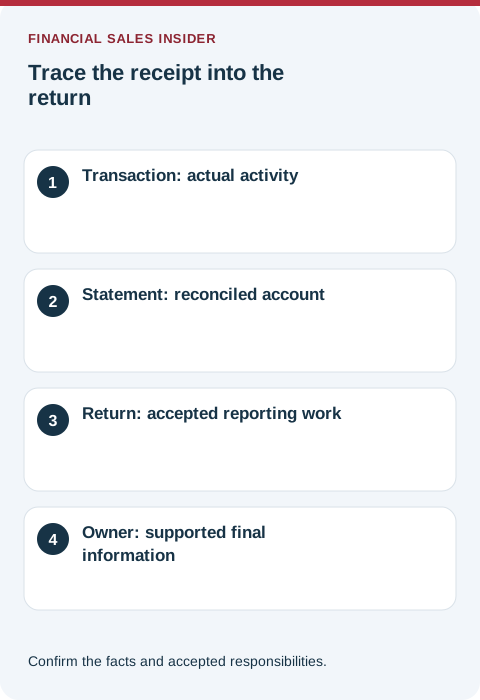
One practical way to compare proposals is to ask each firm to describe the same four stages:
- Identify which system holds the transaction and which account receives the receipt.
- Establish who reviews the proposed category and supporting documents.
- Assign preparation, review and submission responsibilities for the applicable return.
- Retain a reconciliation showing the reported amount and any unresolved difference.
Ask how corrections enter that process. A voided sale, a refund or a changed invoice should have a named person investigating the records and communicating the conclusion. The professional should assess any reporting consequence; an internal accounting correction should not be assumed to complete a tax correction.
Request an exception record rather than an assurance that everything will be checked. It can identify the transaction, missing document, person responsible and next review date. Ask which unresolved items would prevent the team from relying on the totals for planning.
Connect unresolved records to the owner projection
A planning forecast is only as useful as the information behind it. Ask the adviser to distinguish reviewed figures from provisional totals and explain which unresolved transaction issues could change the analysis.
The useful owner deliverable is a projection that identifies the business information used, the period covered and the assumptions still open. It should explain who updates the owner analysis after the dealership records are finalized. This is particularly important when different professionals handle transaction reporting, entity returns and the owner's personal work.
Keep responsibilities visible if an inventory or financing question arises during the review. Ask whether the engagement includes that specialist assessment or whether another adviser is needed. An operating-record review should not quietly turn into an unsupported recommendation to change an accounting method.
Agree on when a changed result comes back to you. For example, the firm can explain the process it would use if a reconciliation changes a figure already included in a forecast. Request the communication and approval steps rather than treating an early projection as a final result.
Compare dealer expertise and engagement boundaries
Ask candidate firms for an explanation of comparable work with dealer-owned businesses. Relevant experience should include the actual assignment you need, such as reviewing mixed receipts or coordinating dealership staff with tax preparers. A general business-services menu does not establish that experience.
Confirm who will lead, perform and review the work. If dealership employees retain the transaction process, specify what the outside firm reviews and what remains your team's responsibility. Establish how questions are escalated and whether reviews are recurring or limited to a particular period.
Check applicable professional records through Illinois license lookup. The IRS credential guide explains preparer qualifications and representation rights. Assess dealership experience and current capacity separately.
Compare fees using equivalent scope: transaction review, reconciliations, entity and personal work, updates and corrective work. The business tax planning fees guide explains how to identify exclusions and additional implementation costs.
Questions for a dealership planning engagement
Does one published Countryside rate settle the transaction review?
No. The city's FAQ itself distinguishes registered vehicles from general merchandise. Ask the professional to assess the particular receipts and applicable requirements. A rate copied into accounting software does not, by itself, explain which category belongs to each transaction.
Must a new adviser redo every transaction?
The engagement should define the period, records and review approach. Ask how the professional will establish a reliable starting point, address identified exceptions and allocate earlier corrective work. Do not assume that a new planning relationship automatically includes a complete historical reconstruction.
Records and responsibilities to keep
Retain representative sale, parts, service and adjustment documents alongside the statement reconciliation and unresolved-item record. Name the person who explains changes to the entity and owner preparers. Obtain secure instructions before sharing confidential customer or financial records.