
Tax preparation in Bloomington for individuals and businesses
Start with the return you need completed, then define any additional review. Personal filing, company preparation and the specialist work below can be separate assignments.
Personal tax preparation in Bloomington
For wages, retirement income, investments or self-employed work, identify the year, household changes and federal, Illinois or other-state returns you need prepared. A co-owner buyout is not required to request ordinary personal filing. If a transaction affects your return, ask who supplies the reviewed settlement information and which additional analysis is included.
Business tax preparation in Bloomington
Name the actual company, classification, owners and periods. Agree who completes the accounts, prepares each return and sends final information to the continuing and departing owners' preparers. Keep an interest purchase, a separate owner loan and the business's operating payments distinguishable. The buyout review below is additional work to define, not something an annual preparation fee automatically includes.
Compare filing options and completion
For a straightforward personal return, IRS VITA/TCE assistance is one route to check. Confirm the actual site's supported work, tax year, eligibility and current arrangements. IRS Free File has separate partner, form, state and filing-year conditions; check current availability before starting. Neither route establishes help with every business return. The Illinois individual preparation section gives state context.
Compare paid quotes using the same returns, years, states and record condition. Agree a secure document route, the preparer and reviewer, and how missing information or extra work is approved. Review the draft before authorizing filing. Name who confirms acceptance or resolves a rejection, supplies final copies and explains payment responsibilities. A submitted return does not prove that a balance was paid. The personal preparation guide and business preparation guide develop those handoffs.
If a letter is the immediate issue, identify its actual issuer, period, instructions and date. The IRS notice guide concerns federal correspondence; Illinois notice help distinguishes the state route. Ask whether response or representation work is included rather than assuming annual preparation covers it.
Business tax planning in Bloomington for a co-owner buyout
Buying out a co-owner requires more than agreeing what the interest is worth. The continuing owner needs to understand the actual settlement commitments, the work the departing person leaves behind and whether the business and personal funding can meet the proposed payment dates.
Bloomington research surfaces different relevant offers. DBC describes documented valuations for buyouts and financing. CLA Bloomington connects business and owner tax work with separately identified wealth-advisory services. Three Sixty describes business transitions and personal wealth as an investment adviser. Compare the work each accepts; those descriptions do not make the services interchangeable or confirm availability.
Company value, the agreed settlement and cash available at each payment date are different figures. This guide helps you compare the work connecting them.
Define the interest and the proposed settlement
Consider a continuing owner negotiating the departure of a co-owner who also manages important customer relationships. The discussion includes an interest purchase, repayment of a separate owner loan and payments spread over time. No arrangement is recommended here; the example identifies the assignment to compare.
Give the prospective team the current owners, entities, governing agreements and draft terms. Identify what transfers, what remains outside the deal and who would make each payment. Ask counsel to explain the relevant rights and agreement provisions rather than expect the tax adviser to infer them from an ownership percentage.
The IRS business-sale guidance distinguishes assets and ownership interests. Have the actual transaction and existing tax treatment reviewed before relying on an estimated tax result. This page determines no capital-gain treatment, deduction, basis adjustment or suitable purchase structure.
Bridge the valuation to the amounts actually payable
Ask the valuer to identify the valuation date, purpose, intended users, interest assessed and material assumptions. Establish whether the proposed engagement supplies an independent value opinion, a financial forecast, transaction tax analysis or several identifiable outputs.
For the continuing-owner example, request a reconciliation from the interest value to the proposed settlement. Keep the price for the interest, separate loan repayment, other agreed balances and payment terms visible. Ask how cash, debt and owner loans were treated in the valuation so the same item is not added or deducted again without explanation.
A strong valuation service may already address these distinctions. BVA's substantial partner-buyout description, for example, discusses ownership rights, enterprise and equity value, separate loan proceeds and replacement work. The additional question for your engagement is how that analysis reaches the continuing owner's dated funding commitments.
Have the team mark provisional terms clearly. A value conclusion does not establish that the parties agreed to that price or that the proposed settlement is affordable.
Test the payment dates against the continuing business
For this buyout, the departing owner's customer work cannot simply disappear from the operating forecast. Ask who will perform it afterward, when replacement support begins, what it costs and whether expected receipts depend on a successful handover. Explain any responsibilities the continuing owner will absorb instead.
Request a schedule using the actual proposed completion date and subsequent payment dates. It should distinguish:
- Cash already available from receipts still expected.
- Purchase payments and separately agreed loan repayments.
- Acquisition borrowing, its funding conditions and later debt service.
- Replacement staff or support, continuing payroll and ordinary operating commitments.
- Tax payments and other amounts requiring the accepted professional review.
A normalized earnings figure used in a valuation is not a bank balance. Ask the planner to explain the cash available at each commitment date after continuing costs, rather than compare only annual profit with the total buyout price.
Test a weaker receipts case using the same payment obligations. If customer collections arrive later or the handover takes longer, which commitment becomes difficult first? Ask the team to compare commercially available responses, such as revised timing, additional agreed funding or postponing the commitment while evidence is incomplete. Do not treat an unapproved financing arrangement as available cash.
Keep the remaining owner's funding separate
Identify payments the business would make and those the remaining owner would fund personally. Include personal borrowing and relevant other income in the appropriately scoped owner review. Counsel and the tax professional need to assess the actual arrangements; a company bank account is not automatically a personal acquisition fund.
If the proposal assumes a business distribution funds a personal payment, show the transfer in both schedules. It reduces company cash while increasing the owner's available funds; it does not create a second pool of combined resources. Ask who reviews the proposed transfer before the model relies on it.
The useful conclusion explains which dates are supported, which depend on uncertain receipts or funding and what would change the recommendation. It may identify a commitment that should remain open rather than endorse the original timetable.
Assign the work through agreement and handover
Identify the client and intended use of each assignment, including any conflicts that the professionals need to resolve. An investment adviser is not automatically your CPA or EA, and a tax credential alone does not establish valuation expertise or legal representation.
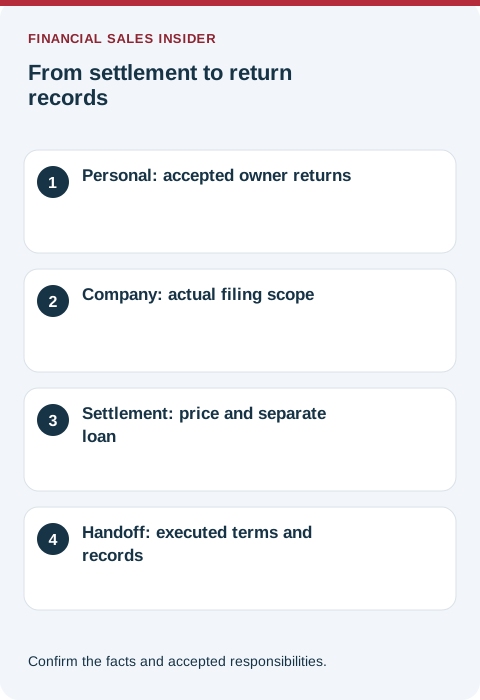
Agree who interprets the documents, supplies value evidence, reviews business and owner tax consequences and maintains the cash schedule. Ask who checks revised terms before signature and compares the executed arrangement with the assumptions previously assessed. The bookkeeper and preparer need the final relevant documents and reviewed instructions.
Use the planning records checklist to organize the wider pack, keeping the settlement reconciliation and dated funding schedule alongside it. When comparing engagement fees, separate an initial assessment, valuation, transaction review, implementation and later recurring work. Ask what useful work and fees remain if negotiations stop.
Questions before committing to a buyout
Does the valuation tell me what I can pay each month?
No. Ask for the actual settlement dates and a continuing-business cash assessment that includes replacement duties, operating commitments and funding conditions. The value of an interest and capacity to meet a particular payment timetable are different questions.
Can the business and owner schedules use the same distribution twice?
No. Show money leaving the business and reaching the owner consistently. Ask the appropriately scoped professional to assess the proposed transfer and explain the resulting company and personal funding, rather than count it as additional combined cash.
Records and responsibilities to keep
Keep the ownership and settlement documents, separate loan records and dated funding schedule with the reviewed conclusions. Identify which preparer receives the executed terms and who resolves any remaining difference. Agree a secure process before sharing private agreements and financial records.