
Tax preparation in Temecula for individuals and businesses
Temecula personal tax preparation begins with the actual filing year, household income and returns needed. Explain moves, work locations and business information with dates if relevant. A marketing or mailing address does not establish the person's filing facts or require a purchase-planning engagement.
For business preparation, name the actual entity, tax classification, owners, period and operating addresses. Agree which returns and records are accepted, who resolves the books and who supplies owner information. If local account work is needed, identify the City or county task and who is authorized to perform it. Tax advice, an application and postpurchase reporting should not be assumed to transfer together.
Choose the filing service that fits your return
Compare paid preparation with any official filing option that fits the entire return. CalFile is a California state-return service, with year-specific eligibility and form restrictions; it does not complete federal filing. Business or rental activity needs particular care when checking its qualifications. The California individual preparation guide explains the supported-year and eligibility limits, including the dated 2025 rules. Do not assume a new filing season is already supported.
For paid help in Temecula, compare how records, questions and draft review will be handled, whether remotely or through an agreed meeting. Use the California credential checks for the professional's actual category and authorization. An advertised service is not confirmation of experience with your return or current availability.
Know when the filing work is complete
Agree a secure document route and a list of missing information. Identify who prepares and reviews the return, how you check the draft and authorize submission, and how each federal and state filing status is reported. Ask who handles a rejection and what remains your responsibility. Keep final copies and payment instructions; submitting a return and paying a balance are separate steps. Later amendments, notices and new planning questions should have an explicit scope.
For company-specific filing responsibilities, use the California business preparation guide. If the immediate problem is an agency letter, the California notice-help guide separates the agency, period, deadline and response assignment.
Business tax planning in Temecula
If you are buying a business, relocating an operation or taking more income from an established company, start the tax-planning discussion before the paperwork is fixed. For a Temecula owner, that discussion should distinguish the business location, the ownership being transferred and the owner's personal position.
Business owners can seek ordinary preparation or additional advice without a purchase, move or minimum income. Revenue, property value and a sale price are separate facts.
Check the address before choosing the local process
Temecula's instructions require a license for business activity within city limits. Its commercial application asks applicants to check those limits and directs Wine Country, Morgan Hill and De Luz businesses toward the county licensing route.[1][2] An address described casually as Temecula therefore deserves a jurisdiction check.
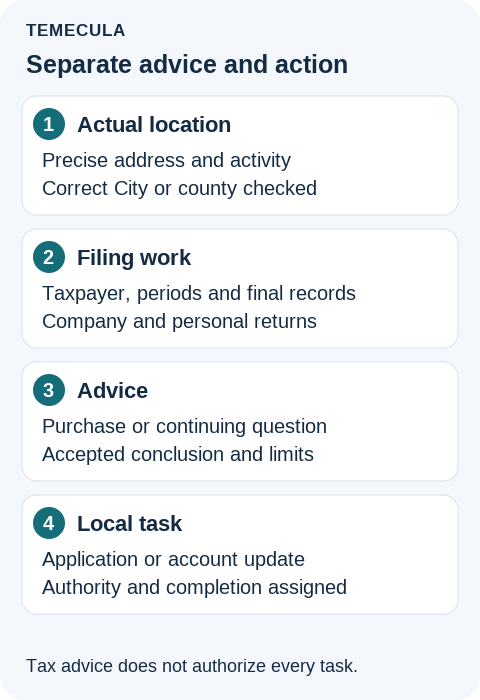
Before asking a tax professional to handle a move or acquisition, provide the exact operating address and a description of the activity. Ask which city or county questions require confirmation and whether local registration assistance is included in the engagement. A mailing label is not an adequate substitute for identifying the responsible authority.
Put ownership changes into the acquisition discussion
The city’s instructions say business licenses expire on January 31 and describe separate application and renewal steps.[1] If you are buying an existing operation, ask who will confirm the new owner's registration requirements and coordinate the transition. Do not assume that receiving the seller's documents completes the buyer's responsibilities.
Separate the transaction questions
For a hypothetical owner purchasing an established service business, the tax adviser should first understand what is being bought, which entities are involved and when control changes. The lawyer, lender, bookkeeper and tax adviser may each have a different part to perform. Ask for a responsibility record covering the review before signing, the closing information and the records needed afterwards.
Distinguish the professional review from permission to carry out a local-account task. Agreeing to give tax advice does not establish that the same person has accepted an application or account update, or that the owner has authorized that action. Ask which person handles the local contact, what approval is needed and who confirms completion. Separately identify the reporting work accepted after the purchase. This is a scope discussion, not a grant of authority or instructions for making an application.
For an ordinary continuing business with no purchase or move, define the company and owner preparation or planning actually wanted. The transaction example does not require every reader to commission acquisition support.
A business tax advisor in Temecula should be able to describe the scope of that review without promising a tax saving before seeing the facts. If a firm recommends specialist transaction work, request a separate explanation of the deliverables and fees.
Make ongoing owner planning part of the comparison
Once the purchase or move is complete, ask how the adviser would keep the owner and business positions connected. Useful questions include how frequently projections are updated, what prompts an additional review and how changes are communicated to the return preparer.
If the business has payroll, several owners or more than one entity, explain that at the start. Ask who reviews the underlying records and who is responsible for putting approved actions into practice. A one-off recommendation and a year-round engagement should not be compared as though they deliver the same work.
Choose relevant experience rather than a broad promise
A commercial property operation, medical practice and contracting company each present different questions. Ask about your actual ownership and business model. If work extends beyond Temecula or California, identify those activities and ask how the firm would determine which specialists need to be involved.
Local meetings can be helpful for a transaction with several advisers. Remote service may also work if the communications and document process are clear. Confirm the arrangement rather than assuming a firm has an office or available team in every area mentioned on its website.
Verify the professional and prepare the first discussion
Check a California CPA's license using the California Board of Accountancy. An enrolled agent's status can be verified through the IRS process.[3][4] Follow that with questions about the person who will lead the engagement, their capacity and their experience with a comparable decision.
Prepare recent returns, current accounts, the entity chart, the operating address and any transaction documents already drafted. State what has been signed and the remaining deadlines. Describe the Temecula-area business and the help required, then confirm scope, fees and availability before engagement.
Related resources
- California tax help for individuals and businesses
- Separate seller questions: selling a business in California
- California tax planning for commercial property owners and developers
- Business owner tax planning documents checklist
Sources
[1] City of Temecula. Business registration, licensing and tax guidance. Checked October 29, 2026. [2] City of Temecula. Business License Application: Commercial Inside the City. Checked October 29, 2026. [3] California Board of Accountancy. License lookup. Checked October 29, 2026. [4] Internal Revenue Service. Verify the status of an enrolled agent. Checked October 29, 2026.