
Tax preparation in Roseville for individuals and businesses
For Roseville personal tax preparation, identify the year, income sources and federal, California and other-state returns. A home address does not establish eligibility for a business-use deduction. Explain actual self-employed activity and use records if that question is relevant.
For business preparation, name the taxpayer, tax classification, owners and current books. Distinguish premises costs already incurred from alternatives still under consideration, and identify who paid them. Agree whether the fee covers filing on established facts or comparing a location decision. Tax qualification, workable use, deposits and City permission remain different checks.
Choose the filing service that fits your return
Compare paid preparation with any official filing option that fits the entire return. CalFile is a California state-return service, with year-specific eligibility and form restrictions; it does not complete federal filing. Business or rental activity needs particular care when checking its qualifications. The California individual preparation guide explains the supported-year and eligibility limits, including the dated 2025 rules. Do not assume a new filing season is already supported.
For paid help in Roseville, compare how records, questions and draft review will be handled, whether remotely or through an agreed meeting. Use the California credential checks for the professional's actual category and authorization. An advertised service is not confirmation of experience with your return or current availability.
Know when the filing work is complete
Agree a secure document route and a list of missing information. Identify who prepares and reviews the return, how you check the draft and authorize submission, and how each federal and state filing status is reported. Ask who handles a rejection and what remains your responsibility. Keep final copies and payment instructions; submitting a return and paying a balance are separate steps. Later amendments, notices and new planning questions should have an explicit scope.
For company-specific filing responsibilities, use the California business preparation guide. If the immediate problem is an agency letter, the California notice-help guide separates the agency, period, deadline and response assignment.
Business tax help in Roseville: compare workable premises and tax advice
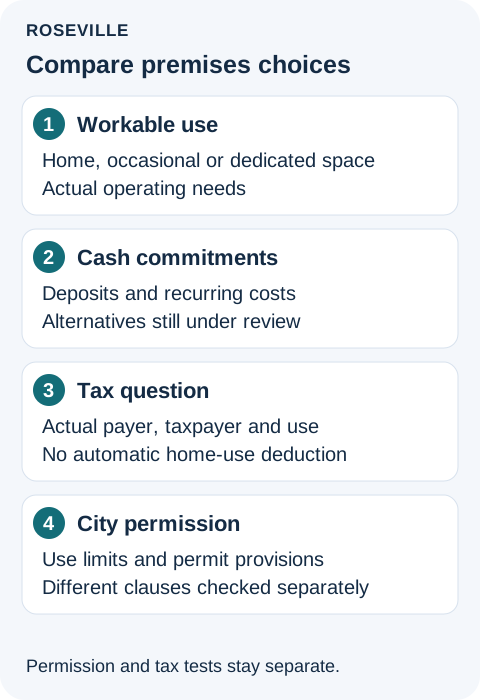
The lowest rent is not automatically the lowest workable cost, and the largest proposed deduction is not automatically the best premises decision. Before choosing a home base, occasional rented space or dedicated commercial premises, ask a Roseville CPA or enrolled agent to separate operating suitability, cash commitments and the tax analysis of the actual arrangement.
Owners can seek preparation without changing premises, or agree a separate review when a location decision is still open. Property value and premises costs are different measures. Describe the owner circumstances and the actual decision requiring advice.
Compare workable operating options first
Start by describing how the business serves clients. Does it need private meetings, employee attendance, equipment storage or work at customers' sites? An option that cannot accommodate the actual activity should not be presented as financially equivalent simply because it has lower recurring payments.
For an illustrative comparison, an owner is deciding between continuing administrative work at home with client meetings elsewhere, renting meeting space when needed, and taking a dedicated office. Give the adviser the actual agreements, expected use and business requirements. Do not assume that all three options permit the same activity or produce the same tax treatment.
Ask the prospective firm whether it will compare the relevant alternatives or merely prepare a return after you choose. A decision review should make clear which operating and legal questions need confirmation outside the tax engagement.
Put the cash comparison beside the tax review
A useful premises comparison separates recurring charges from deposits, setup commitments, exit terms and other amounts tied up before the operation earns additional income. Ask the firm to explain the cash assumptions independently from the tax characterization of each cost.
Bring actual proposals and identify who pays each item, which entity signs and how the space will be used. A comparison based on an assumed full deduction can mislead before eligibility and treatment are reviewed. This page does not determine which costs are deductible or when.
The evaluable output is a recommendation with visible conditions: the options compared, verified costs, unresolved facts and how the tax conclusions affect the owner's decision. Ask whether the professional will explain an option that has a smaller tax benefit but a better fit with the business's commitments. A tax label should not replace the commercial decision.
Test home-use advice against the actual use
IRS Publication 587 describes qualifying-use conditions for a business-use-of-home deduction. Its exclusive-use discussion says the relevant area must be used only for the trade or business, while also describing exceptions and other conditions. Regular use matters too. A residential business address alone does not establish that an actual room or activity qualifies. [1]
Give the reviewer the actual use, shared household use, other work locations and business structure. Ask which conditions apply before comparing ways of calculating an allowable amount. If the company and owner are separate taxpayers, ask which arrangement is being reviewed rather than copying a method from another business.
The home-use review should feed the premises comparison. It should not become a sales pitch that a home base is always cheaper after tax, nor should an office proposal be justified by an unexplained assumed deduction.
Keep Roseville client-contact rules in the operating check
Roseville's home-occupation guidance has two separate provisions to keep clear. Its Permit Requirements section says a home occupation requiring personal contact with customers or employees at the site requires approval of an Administrative Permit. In its Limitation on Use section, the restriction on rendering services, merchandise sales or distribution to customers or clients on the premises includes an exception for private instruction. That exception should not be treated as a blanket exemption from the separately stated permit requirement. Confirm the actual activity and current requirements with City staff; neither statement grants permission for your business. [2]
This matters when assessing whether home and rented premises are genuine alternatives. A tax calculation cannot authorize client visits at a location. Keep the City confirmation with the operating assumptions so the adviser knows which option is actually available for comparison.
Connect the chosen premises to the owner plan
Ask how the agreed premises choice changes the business figures used in the owner's current-year review. Give the adviser expected personal income beyond this business, withholding and payments already made. IRS estimated-tax guidance describes revising calculations when expected income changes; it does not establish an individual's payment amount from the premises cost alone. [3]
If the business is an S corporation and the owner's duties are changing alongside the move, ask whether a compensation review is also needed. IRS guidance addresses reasonable compensation for shareholder-employee services before nonwage distributions. Neither the rent nor the owner's desired take-home amount substitutes for evaluating the actual services. [4]
Agree which conclusions are implemented now, which depend on City or contract confirmation and when the adviser will revisit the figures. The resulting work should help you choose and carry through an option, not merely add a property address to a tax organizer.
Compare the firm's proposed work
Ask who reviews the premises alternatives, who handles home-use or cost-treatment questions and who coordinates the result with bookkeeping and the owner's return. Clarify whether the engagement includes scenario comparison, written explanation, implementation and an update after final costs are known, or only a projection based on your chosen inputs.
Use the California Board of Accountancy lookup to check a claimed California CPA credential, or the IRS enrolled-agent verification process. Status verification does not establish relevant premises expertise, availability or a promised financial result. [5][6]
Verify a California tax professional
Questions before choosing Roseville tax advice
Should I select the option with the largest projected deduction?
Ask for the operating, cash and tax comparisons together. The tax analysis needs applicable conditions and actual costs; the business also needs an arrangement it can use and afford. No option is recommended here from the size of a proposed deduction alone.
Does using my home address prove that a room qualifies?
No eligibility is established by an address alone. The relevant use and applicable federal conditions need review, while Roseville operating permissions are a separate question. [1][2]
What should the adviser leave me with before I commit?
Ask for the alternatives actually compared, costs and conditions used, unresolved questions and the conclusions the firm is prepared to explain. Identify implementation responsibilities and any review needed when the agreement or business use changes.
Sources
[1] Internal Revenue Service. Publication 587, Business Use of Your Home. Qualifying-use context only; no individual deduction determined.
[2] City of Roseville. Home-occupation guidance. Actual activity, exceptions and current approvals require City confirmation.
[3] Internal Revenue Service. Estimated taxes.
[4] Internal Revenue Service. S corporation compensation and medical insurance issues.
[5] California Board of Accountancy. License lookup.
[6] Internal Revenue Service. Verify the status of an enrolled agent.