
Tax preparation in Rancho Cucamonga for individuals and businesses
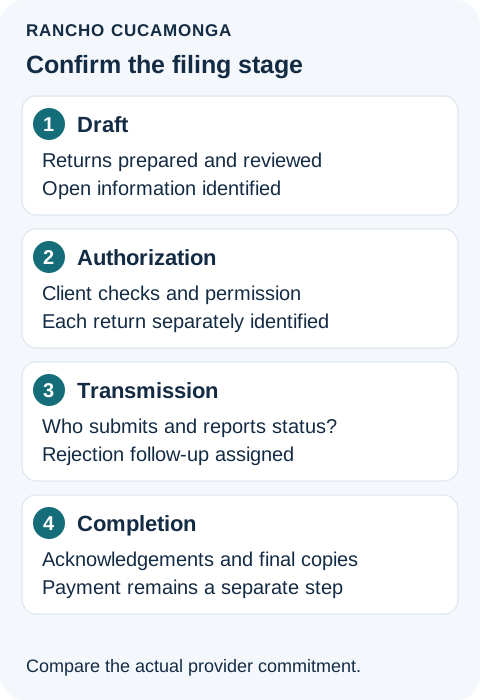
For Rancho Cucamonga personal tax preparation, identify the year, income documents and each federal, California or other-state return. Ask what the fee includes and what the preparer means by ready, submitted and accepted. A message that the taxes are finished does not identify every filing stage.
For a business, name the entity, actual tax classification, owners and period. Agree who resolves incomplete books, prepares and reviews the returns, sends owner information and follows up on a rejection. Compare each provider's actual completion commitment. Authorization, transmission, acknowledgement and payment are separate matters; the process advertised by one firm is not a universal promise.
Choose the filing service that fits your return
Compare paid preparation with any official filing option that fits the entire return. CalFile is a California state-return service, with year-specific eligibility and form restrictions; it does not complete federal filing. Business or rental activity needs particular care when checking its qualifications. The California individual preparation guide explains the supported-year and eligibility limits, including the dated 2025 rules. Do not assume a new filing season is already supported.
For paid help in Rancho Cucamonga, compare how records, questions and draft review will be handled, whether remotely or through an agreed meeting. Use the California credential checks for the professional's actual category and authorization. An advertised service is not confirmation of experience with your return or current availability.
Know when the filing work is complete
Agree a secure document route and a list of missing information. Identify who prepares and reviews the return, how you check the draft and authorize submission, and how each federal and state filing status is reported. Ask who handles a rejection and what remains your responsibility. Keep final copies and payment instructions; submitting a return and paying a balance are separate steps. Later amendments, notices and new planning questions should have an explicit scope.
For company-specific filing responsibilities, use the California business preparation guide. If the immediate problem is an agency letter, the California notice-help guide separates the agency, period, deadline and response assignment.
Business tax help in Rancho Cucamonga: confirm preparation progress and the next assignment
Before moving to the owner's next tax decision, establish where the current preparation work stands. A draft return, a request for authorization and a message about submission describe different stages. Ask who explains the outstanding steps, supplies relevant confirmation and accepts the separate planning question.
Owners and equity partners can compare ordinary preparation and any additional planning at different income levels. Company sales, profit and assets are separate measures. This Rancho Cucamonga guide compares responsibilities without determining a return's legal filing status or promising a provider.
Compare the promised end of the preparation assignment
Three public descriptions illustrate different boundaries. They are research examples, not FSI partners or independent verification of credentials, results or current availability.
Deily & Company describes considering business decisions during the year, along with business and personal planning and several specialist subjects.[1] Ask which actual forward question the proposal accepts and how that work connects with preparation. A year-round planning description does not identify the status of your current returns.
Clarity Tax Partners expressly offers preparation-only as an option alongside a more comprehensive long-term planning relationship.[2] Ask which choice your proposal represents. Preparation-only can meet a defined need without supplying an analysis of every decision the owner may make later.
G&S Accountancy's business-return page describes steps including prior-return intake, written engagement, records work, review, owner authorization, transmission and monitoring acknowledgements. It says it confirms IRS and FTB acceptance in writing, then describes later planning.[3] Those are the provider's advertised process statements, not independently tested performance or a universal filing protocol.
Use these differences to ask what the preparation assignment produces, what confirmation the owner receives and when the proposed planning work begins. Do not infer all of that from the phrase tax services.
Ask which stage the return has actually reached
Identify the taxpayer, period and work being discussed. An update about one company return does not explain the status of every related business or personal assignment. Ask the professional to make the relevant status clear before interpreting a general message that the taxes are ready.
For a proposed electronic-filing workflow, these questions help distinguish progress:
| Update received | What to clarify |
|---|---|
| Records are ready | Which records and assignment have been assessed, and what uncertainty remains? |
| A return is prepared for review | Who reviews it, what questions need answers and what happens next? |
| Owner authorization is requested | What is awaiting your action and who explains the next step? |
| A submission or response is reported | Which return does it concern, what confirmation exists and who follows up? |
These are service-comparison questions, not mandatory steps for every filing method. Ask the appointed professional to explain the actual process and what a particular confirmation means. This guide supplies no filing deadline, cure period, form requirement or determination of substantive tax correctness.
G&S's published sequence makes the difference between preparing, authorizing, transmitting and monitoring a response visible.[3] Ask other candidates how their proposed arrangement handles those responsibilities rather than assume everyone follows the same sequence or provides the same update.
Name the person responsible for outstanding confirmations
If a step remains open, identify the responsible person and the information or action needed. Is the professional waiting for an owner response, a missing record, another review or a submission-related update? Ask what you should expect to receive and how to raise a question if it does not arrive.
For an unresolved response, ask who examines it, explains its significance and identifies the next work. Do not rely on a message about an earlier stage as proof that every later responsibility has been completed. Equally, do not try to diagnose the situation from a short status label without the professional's explanation.
Clarify the scope of follow-up. Does the preparation engagement include monitoring the relevant response and addressing an unresolved item, or does some work need separate agreement? Who informs the person preparing a connected owner return? The proposal should make those duties understandable.
G&S's acknowledgement description is an example of a stated service commitment.[3] An advertised commitment does not establish what has happened for a particular client or confirm a preparer's credentials. Ask the actual provider what has happened in your case and what remains.
Keep the next owner decision separate from filing progress
If you also need planning, state the business question explicitly. Identify the owner and entities, the decision still open and the current information available. Ask which facts the reviewer needs and whether any outstanding preparation issue affects the analysis.
An unresolved preparation task should remain assigned while the new question is considered. Ask who handles each and how relevant information moves between them. This does not prescribe whether a decision can proceed; the appropriate professional must assess the actual dependency.
When preparation is complete, confirm the planning scope rather than assume the next appointment covers everything. Clarity's preparation-only and broader options illustrate that distinction.[2] Deily's decision-focused description gives a starting point for discussing which forward review you want.[1]
Request an explanation of the question examined, relevant facts and assumptions, conclusions or unresolved matters, and any agreed next action. Identify who carries out that action and what further work requires approval. A completed preparation assignment and a useful planning review can connect without being the same service.
Compare charges against those boundaries too. Prior-period work, records corrections, response follow-up and a new decision review may have different terms. No provider's website alone establishes the combination accepted for your engagement.
Verify the reviewer and request the right assistance
Check the correct California CPA or firm identity and authorization through the Board of Accountancy's lookup.[4] For an enrolled agent, follow the IRS verification instructions and Office of Enrollment request route.[6] Ask separately who performs, reviews and communicates about the work.
The IRS explains that CPAs, enrolled agents and attorneys have unlimited representation rights before the IRS.[5] Those rights do not establish experience with every business decision or verify an advertised workflow.
Summarize the business, relevant owner circumstances, current preparation status and decision needing attention. Agree secure exchange before sending sensitive records. An initial discussion does not confirm a provider, appointment or fee. The California business tax planning resource gives wider context.
Sources
- Deily & Company: tax planning.
- Clarity Tax Partners: preparation and planning options.
- G&S Accountancy: business-return services and advertised process. Advertised tax statements and performance claims do not establish the treatment or outcome for your return.
- California Board of Accountancy: license search information.
- IRS: preparer credentials and qualifications.
- IRS: verify enrolled-agent status.
Public descriptions checked October 30, 2026. General professional-selection information, not a filing-status determination, procedural instruction or confirmation of provider capacity.