
Tax preparation in Pasadena for individuals and businesses
Pasadena personal tax preparation can cover an employee household or an owner whose return depends on practice information. State the year, income sources, federal and California filings and other states. Agree which final business documents the personal preparer needs; ordinary filing does not require a practice purchase.
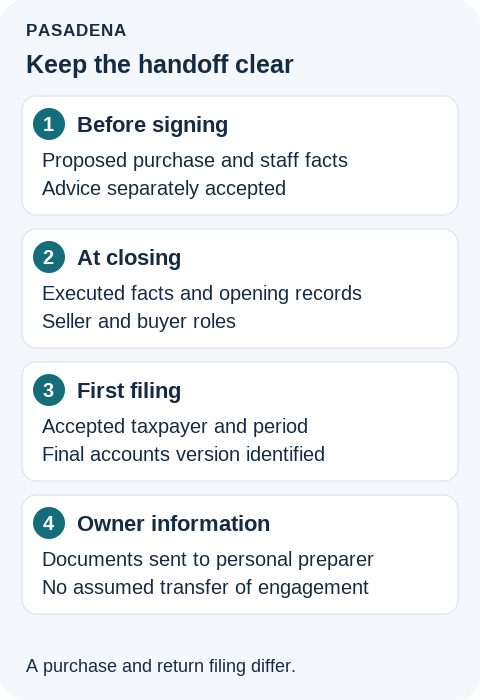
For a continuing business, identify the entity, actual tax classification, owners, period and records. If a practice was purchased, distinguish pre-closing information, buyer opening records and first-year filing responsibilities. Name who confirms the final accounts version and passes owner information to the personal preparer. That completed-record handoff is different from advice before signing the purchase or choosing new premises.
Choose the filing service that fits your return
Compare paid preparation with any official filing option that fits the entire return. CalFile is a California state-return service, with year-specific eligibility and form restrictions; it does not complete federal filing. Business or rental activity needs particular care when checking its qualifications. The California individual preparation guide explains the supported-year and eligibility limits, including the dated 2025 rules. Do not assume a new filing season is already supported.
For paid help in Pasadena, compare how records, questions and draft review will be handled, whether remotely or through an agreed meeting. Use the California credential checks for the professional's actual category and authorization. An advertised service is not confirmation of experience with your return or current availability.
Know when the filing work is complete
Agree a secure document route and a list of missing information. Identify who prepares and reviews the return, how you check the draft and authorize submission, and how each federal and state filing status is reported. Ask who handles a rejection and what remains your responsibility. Keep final copies and payment instructions; submitting a return and paying a balance are separate steps. Later amendments, notices and new planning questions should have an explicit scope.
For company-specific filing responsibilities, use the California business preparation guide. If the immediate problem is an agency letter, the California notice-help guide separates the agency, period, deadline and response assignment.
Choosing Pasadena business tax help as a practice changes
A Pasadena practice may need annual business and owner preparation, ongoing advice or additional help when staff, ownership or operations change. Define that assignment before assuming a practice specialist has accepted every part of a purchase or transition.
Owners at different income levels can use this guide. Practice collections, company turnover and a transaction price do not establish an owner's personal income.
Decide whether you need planning, preparation or both
For a practice continuing as it is, start with the returns, owners and periods that require work. Ask who obtains the practice records and what personal work is included. Buying another practice, adding staff or changing premises is not a prerequisite for a useful preparation engagement.
Business tax preparation in Pasadena concerns completing the applicable returns. A planning engagement should also explain the decisions under review, the information used and when recommendations will be revisited. Ask the firm to separate those deliverables so you can compare like with like.
For an established owner, useful scope questions include coordination of business and personal returns, projections after a significant change, communications with payroll and assistance putting agreed actions into practice. None should be assumed to come with a basic filing quote.
Test the engagement with your actual next decision
Where an acquisition includes retaining staff, ask how the information moves into the accepted first-year work. Which staff, owner-payment and opening records does the tax reviewer need? Who supplies the final information after the arrangement is agreed, and who explains a difference from the earlier description? Confirm how the bookkeeper, payroll provider, tax adviser and counsel divide those responsibilities.
This comparison concerns the records and handover the professional accepts. It is not an instruction to transfer confidential personnel information before an appropriate process is agreed, a decision about employment obligations or an acquisition-tax model. The useful answer identifies what the reviewer will receive, which questions it will examine and what remains with another professional.
Suppose you plan to acquire another practice and retain its staff. Ask each prospective adviser how they would approach the period before signing, the closing date and the first year after completion. Compare their information requests, deliverables and boundaries. This hypothetical test is more informative than a generic list of tax strategies or an unsupported savings estimate.
Ask what changes when the practice grows
Pasadena says most business license tax is calculated using a flat rate plus an employee component, subject to exceptions. Its guidance also requires separate licenses for branches or offices and a new owner application when a business changes ownership.[1] Those are useful items to put into an expansion or acquisition review.
Ask how the proposed locations, activities and ownership will be described to the city. The city's definitions and classifications need their own review; do not assume that a payroll report alone answers the business-license questions. A license calculation is also a different task from planning the owner's California and federal income taxes.
Use a responsibility record before signing
| Decision | Ask who will handle it |
|---|---|
| Buying assets or an ownership interest | Tax adviser and transaction counsel: analysis, documents and coordination |
| Opening a branch | Business owner and relevant city department: location, activity and registrations |
| Adding staff or owners | Payroll provider and tax adviser: information, timing and approvals |
| Combining bookkeeping | Bookkeeper and tax adviser: opening balances, entity boundaries and review |
The table is a way to organize the discussion. It does not determine which transaction structure or tax treatment is right for you.
Look for expertise in your ownership model
For a law firm, medical practice or other professional business, ask about experience with the actual entity and owners involved. A sole owner adding a partner has a different question from an owner buying equipment or retiring from a practice. Describe the proposed change before asking for a fee.
Ask the professional to explain what they would need to understand the deal, which issues they would analyze and where another specialist is required. Be cautious about proposals that jump straight to a standard entity recommendation without reviewing how the business operates.
Check credentials, communication and ownership of the work
Use the California Board of Accountancy's lookup for a California CPA and the IRS verification process for an enrolled agent.[2][3] Then ask who will actually lead your engagement, who will review the work and whether the firm has capacity for your timetable.
Choose local meetings or remote service according to your working needs. Confirm how documents will be exchanged securely and whether meetings include the decision-maker. An office in Pasadena does not by itself establish specialist transaction experience.
Bring a concise transaction and tax summary
Prepare your ownership chart, latest business and personal returns, current accounts, staff summary and the documents describing the proposed expansion or purchase. State the decision deadline and what has already been agreed with other advisers.
Obtain a written scope and fee proposal, and confirm availability before relying on a professional to handle the work. Agree a secure exchange process before sharing detailed practice, staff or owner records.
Related resources
- California tax planning for established business owners
- California tax planning for law firm owners and equity partners
- California tax planning for specialist medical practice owners
- California professional corporation tax planning
Sources
[1] City of Pasadena. Business registration, licensing and tax guidance. Checked October 29, 2026. [2] California Board of Accountancy. License lookup. Checked October 29, 2026. [3] Internal Revenue Service. Verify the status of an enrolled agent. Checked October 29, 2026.