
Tax preparation in Palm Desert for individuals and businesses
Palm Desert personal tax preparation can be a straightforward filing assignment when the years, income and records are established. Name federal and California returns, other states and missing information. A diagnostic or second opinion should answer an identified uncertainty rather than be assumed necessary for every personal return.
For a business, ask whether the proposed first stage accepts company and owner returns or only defines a later engagement. State the actual entity, tax classification, period and condition of the books. Compare what you retain if you stop after that stage: a filing quote, identified records gap, explanation or separately agreed review. Bookkeeping cleanup and continuing planning should be visible additions.
Choose the filing service that fits your return
Compare paid preparation with any official filing option that fits the entire return. CalFile is a California state-return service, with year-specific eligibility and form restrictions; it does not complete federal filing. Business or rental activity needs particular care when checking its qualifications. The California individual preparation guide explains the supported-year and eligibility limits, including the dated 2025 rules. Do not assume a new filing season is already supported.
For paid help in Palm Desert, compare how records, questions and draft review will be handled, whether remotely or through an agreed meeting. Use the California credential checks for the professional's actual category and authorization. An advertised service is not confirmation of experience with your return or current availability.
Know when the filing work is complete
Agree a secure document route and a list of missing information. Identify who prepares and reviews the return, how you check the draft and authorize submission, and how each federal and state filing status is reported. Ask who handles a rejection and what remains your responsibility. Keep final copies and payment instructions; submitting a return and paying a balance are separate steps. Later amendments, notices and new planning questions should have an explicit scope.
For company-specific filing responsibilities, use the California business preparation guide. If the immediate problem is an agency letter, the California notice-help guide separates the agency, period, deadline and response assignment.
Business tax help in Palm Desert: define the first review
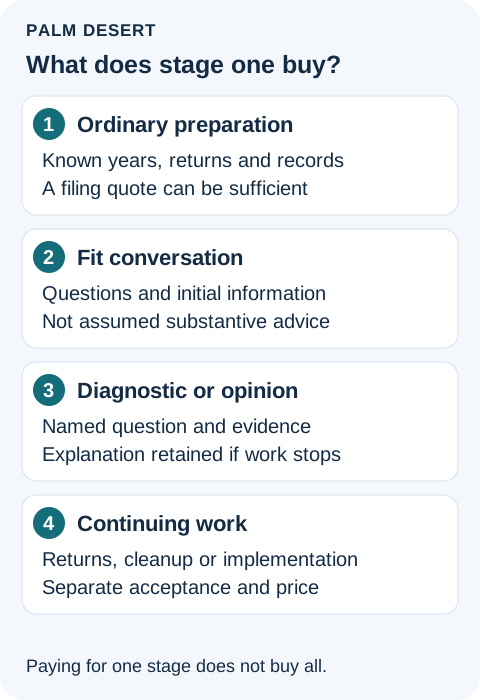
Before paying for a business tax review in Palm Desert, establish what the first stage will accomplish. An introductory conversation, a document-based diagnostic and an ongoing planning engagement can serve different purposes. Knowing which one you are being offered helps you decide what information to provide and what conclusions you can reasonably expect.
Owners can use this guide for a first review or ordinary preparation at different income levels. Company turnover, property value and proposed sale proceeds are separate measures. This guide evaluates professional scope without recommending a tax strategy or promising a firm's availability.
Separate a fit conversation from document-based advice
Ask the provider what happens at the initial meeting. Is it intended to learn about your needs and decide whether further work is appropriate, or will someone examine records and advise on a defined question? The appointment's name does not establish its scope.
O'Brien & Panchuk's public Palm Desert page makes that distinction explicitly. It describes an introductory fit assessment as information gathering, with a deeper diagnostic review potentially needed to define the work and fee proposal.[1] That is one firm's advertised approach. Confirm the actual first-stage work and fee directly.
Before booking a review, ask which documents the professional will actually read, what question the meeting can address and whether further work needs a separate agreement. If the conversation is only to establish fit, do not treat a general suggestion made there as a completed analysis of your business.
Use local service descriptions to ask better questions
The public descriptions around Palm Desert illustrate several possible starting points. They are research examples, not endorsed providers, FSI partners or independently verified performance claims.
A staged planning relationship: O'Brien & Panchuk describes year-round business-owner and property-investor work alongside the fit and diagnostic stages.[1] Ask what changes between the initial discussion and the document review, and whether either stage commits you to ongoing work.
A second opinion or targeted review: Masciola CPA lists second opinions, transactions, real estate and accounting cleanup among its services.[2] Explain whether you want existing advice reconsidered, records brought into order or a new decision analyzed. Those can require different information and should not remain one undefined request.
A general strategy discussion: Jonathan and Associates' planning description presents year-round work and a range of tax-saving approaches.[3] A strategy appearing on a firm's website does not establish that it is available, appropriate or valuable for you. Ask what facts must be examined before the professional can reach a conclusion.
Use the contrast to choose the first assignment you need. The most useful starting point may be a tightly defined question, rather than the largest package or the longest menu of techniques.
Bring business and property ownership into one clear brief
If you own an operating company and hold property separately, identify who owns each interest and what each activity involves. Do not send one combined value or income figure and assume the same treatment applies throughout.
Explain the decision ahead and any advice already received. For example, an owner considering a commitment involving the business and a separate property interest could ask whether the diagnostic will address both positions, coordinate with another adviser or review only one part. This is a scope question, not a recommendation to buy, sell, restructure or claim a deduction.
Ask the professional what records are needed before a useful review can begin. If the firm first needs accounts cleanup or information from an attorney, lender or existing adviser, clarify whether arranging that work is included. Missing facts should remain visible limitations rather than disappear behind a confident strategy label.
Decide what the diagnostic must leave you with
Agree the question and expected output before authorizing paid work. Ask which documents will be examined, what assumptions the professional expects to make and what you will receive afterwards. A diagnostic can identify further work, but you should understand how that conclusion will help your decision.
A useful review record can explain the issue considered, the evidence used, material uncertainties, any options discussed and the next action. Establish what remains unresolved and which conclusions depend on information not yet available. This does not guarantee a saving or require the professional to reach a predetermined result.
For a second opinion, ask whether the assignment includes reading the earlier advice and its supporting facts. For a new decision, explain the actual timetable and what is still open to change. Reviewing an earlier conclusion and analyzing a different proposal should not be treated as identical work merely because both concern the same owner.
Also clarify the outcome if no continuing engagement follows. What explanation or agreed deliverable will you retain? Are implementation, additional research or communication with another professional included or separately agreed? Settle those questions through the proposed terms rather than assume that paying for a diagnostic purchases ongoing support.
Choose the ongoing scope only after the decision is clear
Once the initial review identifies the work needed, compare the proposed responsibilities. Name the owner and entities covered, who performs any agreed actions, who communicates with other advisers and how later changes will be handled. A paid review, an introduction and a confirmed ongoing engagement are different events.
Check the actual professional as well as the service description. The IRS explains the qualifications and representation rights of practitioners, including CPAs and enrolled agents.[4] For a California CPA or firm, use the Board of Accountancy's lookup to check the correct identity and authorization.[5] For an EA, follow the IRS enrollment-status verification instructions.[6] None of those checks alone proves specialist suitability for your property or business decision.
Describe the ownership, annual personal pretax income, existing advisers and question you want reviewed. Use an agreed secure process for sensitive records. The California business tax planning resource provides broader state context.
Sources
- O'Brien & Panchuk: Palm Desert, public assessment and service description checked October 30, 2026.
- Masciola CPA, public services checked October 30, 2026.
- Jonathan and Associates: planning, readable public description reviewed October 30, 2026; confirm current scope directly.
- IRS: preparer credentials and qualifications.
- California Board of Accountancy: license search information.
- IRS: verify enrolled-agent status.