
Tax preparation in Oxnard for individuals and businesses
Oxnard personal tax preparation starts with the year, wage, rental, self-employed or owner income and the returns needed. If another professional prepares a company return, identify the information that must arrive before the personal return can be completed. Ask which missing records or earlier corrections affect the quote.
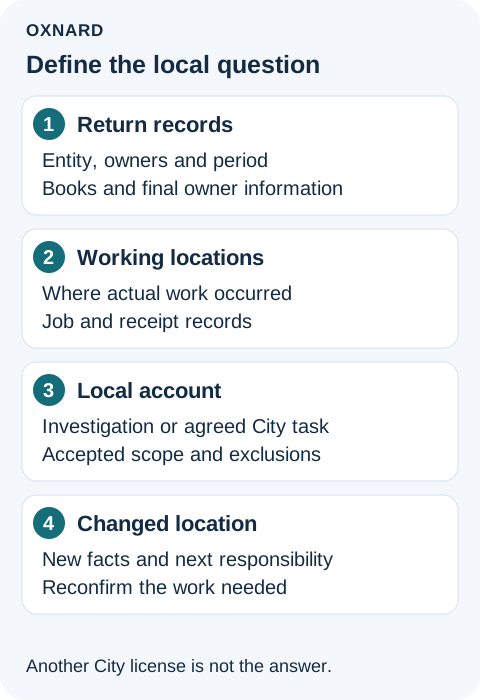
For business preparation, list the entities, actual tax classifications, owners and periods. Describe where work occurred and ask which records need reconciliation. A local account question should identify the activity, City and task expressly accepted by the professional. Supplying job-location records for a return is different from commissioning an investigation of local obligations; neither is the same as agreeing future agency-contact support.
Choose the filing service that fits your return
Compare paid preparation with any official filing option that fits the entire return. CalFile is a California state-return service, with year-specific eligibility and form restrictions; it does not complete federal filing. Business or rental activity needs particular care when checking its qualifications. The California individual preparation guide explains the supported-year and eligibility limits, including the dated 2025 rules. Do not assume a new filing season is already supported.
For paid help in Oxnard, compare how records, questions and draft review will be handled, whether remotely or through an agreed meeting. Use the California credential checks for the professional's actual category and authorization. An advertised service is not confirmation of experience with your return or current availability.
Know when the filing work is complete
Agree a secure document route and a list of missing information. Identify who prepares and reviews the return, how you check the draft and authorize submission, and how each federal and state filing status is reported. Ask who handles a rejection and what remains your responsibility. Keep final copies and payment instructions; submitting a return and paying a balance are separate steps. Later amendments, notices and new planning questions should have an explicit scope.
For company-specific filing responsibilities, use the California business preparation guide. If the immediate problem is an agency letter, the California notice-help guide separates the agency, period, deadline and response assignment.
Business tax planning in Oxnard
If your business works in several cities, explain the activity in each before choosing a tax-planning engagement. An Oxnard business tax advisor should understand the ownership, operating footprint and decision ahead, then define which questions it will investigate.
Ordinary business preparation and more complex owner planning are both valid reasons to seek help. Turnover, company profit and asset values are not the same as personal income.
Check the Oxnard certificate question independently
Oxnard's official guidance identifies a Business Tax Certificate for businesses operating in the City. It expressly addresses businesses based outside the City and businesses holding a license or tax certificate from another city. The page also provides a separate contractor application route. [1]
For a contractor, distributor or other owner working across boundaries, the practical question is who will review the local activity and maintain the account information. Ask whether that work is part of the tax engagement or should be arranged separately. Do not assume another city's certificate settles the Oxnard position.
The guidance concerns activities within Oxnard. This page does not claim that every California business needs an Oxnard certificate, determine an exemption or calculate a tax. Have the City or adviser confirm the current requirements for your actual activity and period.
Organize the operating footprint
Prepare one clear record of the entities, activities and locations involved. For a contracting business, identify the office, work locations and who keeps the project information. For a manufacturing or distribution business, explain what each site does and which entity owns the assets or inventory. For an ecommerce brand, describe the actual sales and fulfillment arrangements.
Ask the prospective professional what information it needs to investigate jurisdiction questions and how it works with your office team. A general statement about serving businesses in Ventura County does not establish who will perform a City-level review.
If the owner also has separate property or business interests, identify them. Confirm whether they are included or handled by another firm. Your business and personal position should be coordinated deliberately rather than treated as unrelated return files.
Decide which planning work you want to buy
You may need recurring company and owner returns, an ongoing review relationship, a specific transaction assignment or a combination. Ask the firm to define the first stage and the deliverables. Working in another city does not by itself mean you must buy every planning service.
Recurring owner planning
Ask when current-year results are reviewed, how changes in income are communicated and who coordinates information from bookkeeping and payroll. Confirm how the business work connects with your personal return and whether each is included in the engagement.
A purchase, sale or ownership change
Bring the proposed transaction and timetable into the first discussion. Ask what review is included before completion and where legal, valuation or other specialist input is needed. Do not assume a return-preparation engagement covers transaction support.
Implementation and follow-up
Ask who carries out agreed actions, how instructions are documented and who checks completion. A written recommendation is not an explanation of implementation responsibility. If the firm excludes implementation, establish who takes over and what information they receive.
These questions help assess scope. They do not prescribe an entity, election, compensation amount or tax result.
Compare proposals using the same information
| Give each firm | Ask it to identify |
|---|---|
| Ownership and entity map | The entities and owner work included |
| Activity and location list | The jurisdiction questions it will investigate |
| Decision timetable | The review stages and required lead time |
| Current adviser and records summary | Information requests, gaps and coordination |
| Desired service boundary | Planning, implementation and filing inclusions |
For a hypothetical owner expanding a trading business into additional working locations, one proposal may cover annual returns while another adds ongoing reviews and local-business coordination. Compare the defined work and exclusions before the fee.
Make the difference in operating coverage explicit. Does the recurring quote cover preparation using the records you supply, or does it also accept investigation of the named local-business activities? Which entity and local accounts are included? A regional service description does not answer those questions, and agreement to prepare a California return does not automatically accept each City-level task.
For the same expanding operation, ask what happens when a working location or activity changes after the quote. Identify who provides the updated facts, whether the firm reviews them within the existing assignment and how extra work is agreed if needed. Another professional or the City may need to address an excluded question. Keep that boundary visible rather than assume the original fee expands with every new project. This is a comparison of accepted services, not a conclusion that a particular project requires a certificate.
Ask how additional entities, record cleanup, other-state filings and specialist work are charged. If an estimate of savings is offered, request the assumptions, restrictions and implementation costs. Do not treat another business's advertised result as your expected outcome.
Check credentials and access to the responsible person
Use the California Board of Accountancy lookup for a claimed California CPA credential, including its guidance on out-of-state practice when relevant. A missing California result alone is not conclusive about an out-of-state professional's authorization. [2]
Verify an enrolled agent through the IRS process. [3] Ask about the actual lead professional, review responsibility and relevant experience with your industry and entities. Credential checking does not establish specialist expertise or availability.
For local meetings, confirm the office you can visit and who attends. For remote service, agree on secure record exchange, communication and written decisions. Keep a firm's office location separate from its advertised service area.
Prepare the first inquiry
Describe the business, your ownership role and the decision you want help with. State the working locations and the date ahead. Keep company profit and turnover separate from personal income.
Begin with that summary. Agree on the recipient, purpose and secure method before sharing detailed returns or identity documents.
Does a certificate from another city cover Oxnard activity?
Oxnard's guidance specifically addresses businesses with another city's license or certificate. Ask how the current requirements apply to your operations. [1]
Must planning and tax preparation be one engagement?
Ask the firm to identify the relationship between them. Different assignments can be appropriate, but responsibilities, information sharing and fees should be clear. The California business tax preparation guide covers the separate filing assignment.
Prepare your Oxnard business-tax discussion
Describe your business, working locations and the professional help you want. Include any proposed expansion or transaction and the timing.
The California tax-help guide provides broader context for the work you are comparing.
Sources and review date
[1] City of Oxnard: Business Licensing. Actual local context only; confirm applicability for the business, activity and period. No fee, exemption or individual obligation determined.
[2] California Board of Accountancy: License lookup. Read result and out-of-state guidance; no individual professional verified.
[3] Internal Revenue Service: Verify the status of an enrolled agent.
Sources checked October 31, 2026. General professional-selection information, not individualized tax or licensing advice.