
Tax preparation in Oakland for individuals and businesses
Oakland personal tax preparation may involve only wages or retirement income, or it may depend on rental records and information from a business. State the year and returns needed, identify missing information and ask who resolves it before preparation. Keeping an existing personal preparer can be appropriate even when another professional handles the company or property.
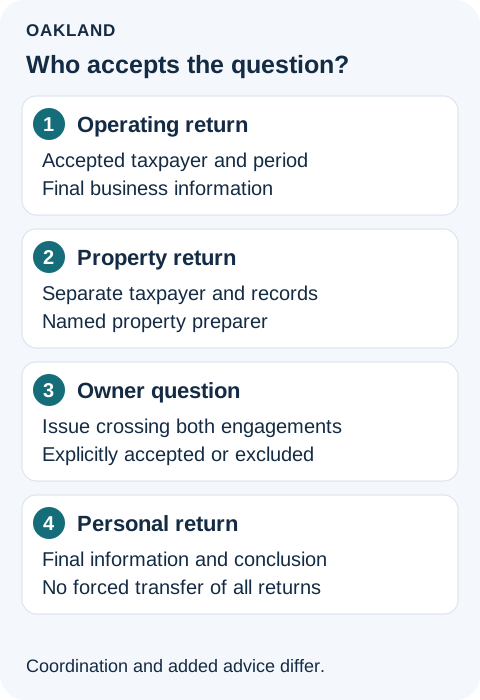
For business preparation, map the operating entity, any separately owned property and the owners who need final information. Confirm the tax classification, periods and returns each preparer accepts. If the two engagements exclude a question affecting the owner across both arrangements, name that question and the person accepting it. Coordinating known filing inputs and obtaining an additional owner-level conclusion are different assignments; neither requires moving every return to one firm.
On this page
Choose the filing service that fits your return
Compare paid preparation with any official filing option that fits the entire return. CalFile is a California state-return service, with year-specific eligibility and form restrictions; it does not complete federal filing. Business or rental activity needs particular care when checking its qualifications. The California individual preparation guide explains the supported-year and eligibility limits, including the dated 2025 rules. Do not assume a new filing season is already supported.
For paid help in Oakland, compare how records, questions and draft review will be handled, whether remotely or through an agreed meeting. Use the California credential checks for the professional's actual category and authorization. An advertised service is not confirmation of experience with your return or current availability.
Know when the filing work is complete
Agree a secure document route and a list of missing information. Identify who prepares and reviews the return, how you check the draft and authorize submission, and how each federal and state filing status is reported. Ask who handles a rejection and what remains your responsibility. Keep final copies and payment instructions; submitting a return and paying a balance are separate steps. Later amendments, notices and new planning questions should have an explicit scope.
For company-specific filing responsibilities, use the California business preparation guide. If the immediate problem is an agency letter, the California notice-help guide separates the agency, period, deadline and response assignment.
Choosing Oakland tax advice when business and property work are separate
An Oakland business preparer and a property adviser can each do their agreed work while leaving an owner-level question outside both engagements. When ownership spans an operating business and separately held premises, choose who accepts the question that connects them. The issue is more than collecting all the returns in one folder.
Owners at different income levels can use this guide. A stable business may need only defined annual preparation; a broader owner question should be agreed explicitly.
Build the ownership map before comparing firms
Suppose the operating company's preparer excludes the property entity, while the property adviser prepares that entity's return but does not undertake the owner's wider planning. Neither exclusion necessarily indicates a problem. The question is whether the owner wants a review that crosses those boundaries and, if so, who agrees to do it.
For example, an owner considering a business commitment may want to understand the position after expected obligations from both the operation and the property are considered. Ask a prospective adviser to define that question before requesting every available service. Which current accounts, property information, owner records and existing conclusions are needed? Which professional will review them together, and which matters remain with the preparers or another specialist? This is a commissioning example, not a calculation, client case or recommendation to make the commitment.
One of the current professionals may accept a focused additional engagement, or a separate adviser may be considered. Confirm relevant experience, the exact question, exclusions and permission for necessary information exchange. You do not automatically need to move all the returns to one firm. Equally, forwarding a property's return does not establish that the business preparer has accepted responsibility for its interpretation or for the owner-level decision.
List each entity, its activity, the owners and its operating locations. For property, identify the legal owner and address, how it is used and whether the operating business is a tenant. Do not merge several entities into one revenue figure and expect the adviser to infer the relationships.
Ask a prospective CPA or enrolled agent which entities it would work on and how it coordinates with the professional preparing any excluded return. The answer should identify information flows, responsibilities and review dates.
For an established manufacturing, distribution or professional business, also describe the work performed, major assets and planned changes. An adviser needs that context before it can define the assignment. The fact that a firm serves "businesses and investors" is a starting point for questions, not proof of fit.
Include Oakland's local-business layer
Oakland's official starting-business guide identifies a Business Tax Certificate and annual business tax for businesses in the City, including home-based businesses and owners renting residential or commercial space. It separately addresses zoning clearance for Oakland business locations. [1]
For an owner with an operating entity and a property entity, ask who investigates the local position of each activity. The relevant work should appear in the engagement scope rather than be assumed to form part of a California income-tax return.
The official guide is a general overview. Ask the adviser or City to confirm current requirements, applicable exceptions and the actual business period. This page does not establish a local rate, determine an exemption or calculate tax.
If a property or company is being purchased
Bring the proposed ownership, transaction date and existing records into the discussion. Ask which City accounts or other registrations require review and who will handle communications. Separate the buyer's proposed operations from the seller's historical filing position.
If operations extend beyond Oakland
Show where the business actually works, holds property, employs people or keeps inventory. Ask who investigates jurisdiction-specific obligations. Do not assume a county name or East Bay marketing description resolves the relevant City boundaries.
Compare two different kinds of engagement
Consider a hypothetical owner who operates a profitable distribution business and separately owns its premises. One proposal may include the entity returns and personal return. Another may add periodic projections, a review of an intended acquisition and coordination with the property adviser. Neither scope can be understood from a fee alone.
Ask both firms the same questions:
- Which entities and individuals are included?
- What records will be reviewed and who provides them?
- What business decisions will the planning meetings address?
- Who coordinates the operating and property work?
- Which local, other-state, implementation or transaction tasks are excluded?
- What will be delivered, by whom and when?
A useful comparison makes the exclusions visible. It should also explain what happens if records are incomplete or a transaction changes the work. Request approval rules for additional charges.
Ask about owner planning without buying a strategy list
Describe the issue first. You may want to discuss owner pay, changing business results, a partner transition, retirement or a planned sale. Ask the adviser how the facts would be reviewed and when legal or another specialist's input is needed.
For a high-income owner, coordination matters more than the length of a firm's advertised menu. Ask how business information and personal obligations are considered together. Do not assume a suggested technique applies because your annual income exceeds a number or another owner used it.
Business tax preparation should be stated separately. Confirm which returns are covered and whether planning, implementation and follow-up are included in the same fee.
Check credentials and accountability
For a claimed California CPA credential, use the California Board of Accountancy lookup and guidance on interpreting results. Its out-of-state information is relevant when a firm works across jurisdictions; a missing California search result is not conclusive by itself. [2]
For an enrolled agent, follow the IRS status-verification process. [3] Ask who will lead the engagement, who reviews recommendations and which relevant owner situations that team handles. A credential check is not a verification of specialist experience or availability.
If you prefer an Oakland office meeting, verify the location and attendee. If you prefer remote work, agree on document exchange, review meetings and how decisions are recorded. Choose the working arrangement as carefully as the advertised service area.
Prepare the first conversation
Start with the ownership map and the decision you want reviewed. Keep company profit, turnover and property value separate. Explain the condition of the books and the advisers already involved.
Agree on a secure method before sending detailed returns or identity documents. Ask the prospective firm to identify the initial stage, fee and information needed before further advice can be given.
Does a property owner need the same expertise as an operating business owner?
Some work overlaps, but the activity, entities and decision can differ. Ask about relevant experience with both parts of your actual ownership position.
Does Oakland local-business work automatically come with a tax return?
Confirm the scope explicitly. The proposal should identify local responsibilities and any work referred elsewhere.
Choose the accepted scope
Before accepting a broader owner engagement, name the question, the professional who will review it and the information each existing adviser agrees to provide. Keep preparation responsibilities and the additional owner's review distinct enough to see what is still excluded.
For broader context, see the California tax-help guide.
Sources and review date
[1] City of Oakland. Starting Your Business. General business, rental and zoning context; confirm current requirements, actual period and exceptions. No rate, exemption or liability determined.
[2] California Board of Accountancy. License lookup. Read the result guidance and out-of-state information; no individual professional verified by this guide.
[3] Internal Revenue Service. Verify the status of an enrolled agent.
Prepared for Financial Sales Insider. Refreshed 31 October 2026. General professional-selection information, not individualized tax, licensing or transaction advice. The local context uses the bounded official material checked 29 October 2026; confirm the rules for the actual activity and period.