
Tax preparation in Monterey for individuals and businesses
Monterey personal tax preparation can cover wages, retirement, investments or other household income without a business valuation or commercial study. State the year, federal and California returns, other states and documents still outstanding. Explain an actual transaction or ownership change before comparing preparation quotes.
For a business, identify the actual entity, tax classification, owners, period and reconciled records. Ask who resolves incomplete transaction information and gives the personal preparer final owner documents. A completed sale or purchase should reach the filing team through final supported terms rather than a preliminary commercial proposal.
Commercial analysis, a tax review and any valuation needed for a particular purpose are separate assignments. Ask what each contributes to the decision and how its conclusions inform later preparation. Ordinary annual returns can be an appropriate engagement without buying every specialist service a firm advertises.
On this page
Choose the filing service that fits your return
Compare paid preparation with any official filing option that fits the entire return. CalFile is a California state-return service, with year-specific eligibility and form restrictions; it does not complete federal filing. Business or rental activity needs particular care when checking its qualifications. The California individual preparation guide explains the supported-year and eligibility limits, including the dated 2025 rules. Do not assume a new filing season is already supported.
For paid help in Monterey, compare how records, questions and draft review will be handled, whether remotely or through an agreed meeting. Use the California credential checks for the professional's actual category and authorization. An advertised service is not confirmation of experience with your return or current availability.
Know when the filing work is complete
Agree a secure document route and a list of missing information. Identify who prepares and reviews the return, how you check the draft and authorize submission, and how each federal and state filing status is reported. Ask who handles a rejection and what remains your responsibility. Keep final copies and payment instructions; submitting a return and paying a balance are separate steps. Later amendments, notices and new planning questions should have an explicit scope.
For company-specific filing responsibilities, use the California business preparation guide. If the immediate problem is an agency letter, the California notice-help guide separates the agency, period, deadline and response assignment.
Business tax help in Monterey: connect the commercial and tax questions
A business decision can need both commercial analysis and a review of its tax implications. When comparing Monterey tax professionals, explain what the business is trying to achieve before asking for a tax figure. A preparation service, a valuation capability and an engagement evaluating the actual decision can provide different answers.
The work needed determines the engagement. Ordinary personal or business preparation can be appropriate without an income minimum or an additional planning project. Keep company sales, profit, asset values and personal income distinct when describing the assignment.
Compare Monterey planning and transaction-analysis offers
Three public descriptions provide useful comparison points. They are research examples, not FSI partners, recommendations or independent verification of credentials, quality or current capacity.
Ganeles & Associates describes planning for businesses and individuals, with strategic, alternative-minimum-tax and estate-related service categories.[1] Ask which actual business or owner question the proposal will examine. The published list does not define the analysis for your particular decision.
Savage Accountancy separately lists economic and tax analysis for business transactions, business and individual planning, valuation and litigation-related services.[2] Those are different capabilities worth discussing. Ask whether the engagement evaluates the commercial decision and its tax implications or supplies another defined piece of work.
CAL Accounting publishes a Monterey-focused planning description and a range of advertised tax-saving approaches.[3] A strategy list is a starting point for questions, not evidence that an approach fits your circumstances or answers the business objective.
Savage's inspected page also includes an older 2018 newsletter and media material.[2] Older newsletters and promotional technical statements are not current tax guidance for your circumstances. Public descriptions establish what is advertised, not a method, outcome or engagement FSI has verified.
Describe the business objective before asking for a tax figure
State the actual decision and why it matters to the business. Identify what you want to achieve, the proposal being considered and which commitments or constraints the professional needs to understand. Explain what remains open rather than presenting an unsettled proposal as a completed event.
Ask the candidate to identify the business question it will help answer. For example, does the assignment examine the proposal's commercial implications alongside the tax review, or will it assess a narrower tax question using information supplied by others? No particular transaction or business change is assumed here.
Keep the requested outcome understandable:
| Point to describe | Question for the prospective reviewer |
|---|---|
| Commercial objective | What decision is the work intended to support? |
| Actual proposal | Which terms and business facts will be examined? |
| Relevant constraints | Which costs, commitments or limitations need consideration? |
| Open choices | Which alternatives remain relevant to the agreed question? |
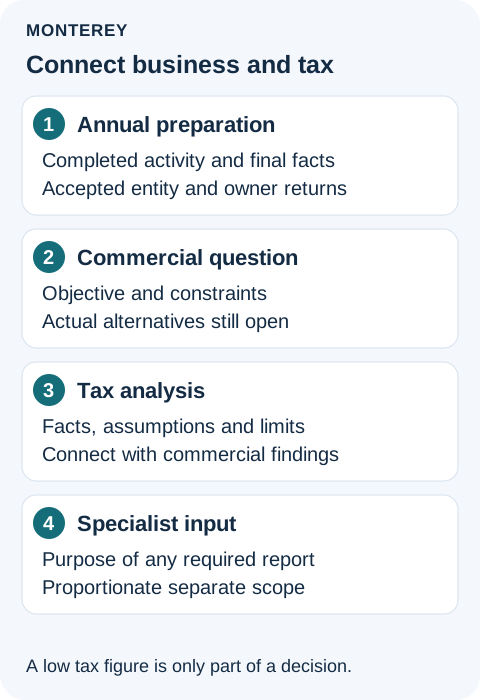
A clear objective helps you avoid commissioning work merely because it appears on a service menu. It also lets the professional explain what is outside its proposed analysis and which further input may be needed.
Ask how commercial and tax conclusions will be explained together
Savage's explicit economic-and-tax category makes this a concrete purchasing question.[2] Ask what the engagement will examine in each area and how the explanation will connect them. Do not infer a detailed process or guaranteed result from the published category alone.
Request reasons tied to the objective you stated. Which business assumptions are being used? What constraints or unresolved facts affect the comparison? Which tax conclusions have been reached, and which require further work? Ask how those points will be explained together rather than receiving unrelated outputs without a clear purpose.
Does the lowest tax figure establish the best business choice?
Ask how the figure relates to the actual business objective and the consequences being assessed. The tax result is one question within the proposed assignment; it does not, by itself, explain what the business would be committing to or achieving. This guide makes no calculation or recommendation about which choice to make.
Keep the scope precise if the work is narrower. A professional may accept the tax assessment while another adviser handles commercial analysis. Establish what each person contributes and how a conclusion dependent on the other's information will be explained. A defined division can be useful when the owner understands its limits.
Keep valuation and specialist work proportionate to the question
Savage advertises valuation, litigation and forensic work separately from tax preparation and economic analysis.[2] A capability being available for discussion does not mean your decision requires that assignment or that its fee is included.
Does a firm offering valuation mean I need one for planning?
Ask what information the actual review requires and why a valuation or other specialist contribution would be relevant. If a report already exists, explain its purpose and ask whether it is suitable input. Do not commission a formal assignment solely because it appears beside planning on the website.
The same question applies to other specialized services. Establish which contribution is needed, who accepts it and how it connects with the decision review. This guide does not determine a court, assurance or reporting requirement, prescribe a valuation method or verify any provider's specialist qualifications.
Then clarify the work after the analysis. Does the professional explain a conclusion for your consideration, coordinate an action you approve or also accept subsequent preparation? Ask how additional work is authorized and which responsibilities remain with existing advisers. Compare the actual boundaries instead of assuming that every service on the firm's page is part of one package.
Verify the professional and describe your Monterey decision
Use the California Board of Accountancy's lookup to check the correct CPA or firm identity, status and authorization.[4] For an EA, follow the IRS Office of Enrollment verification instructions.[6]
CPAs, enrolled agents and attorneys have unlimited representation rights before the IRS.[5] Those rights do not establish expertise with every commercial, valuation or transaction assignment. Ask who performs and reviews the work and how their experience fits your actual question.
Summarize the business, relevant owner circumstances and decision needing attention. State whether you want a defined tax review, connected commercial analysis or another specific contribution. Agree secure exchange before sharing sensitive records. An initial discussion does not confirm a provider, fee or appointment.
Related information: California business tax planning resource.
Sources
- Ganeles & Associates: planning services.
- Savage Accountancy: Monterey business and tax services. Advertised capabilities and dated contextual material, not verified outcomes or current legal guidance.
- CAL Accounting: tax planning. Advertised strategy and savings claims do not establish suitability or outcomes.
- California Board of Accountancy: license search information.
- IRS: preparer credentials and qualifications.
- IRS: verify enrolled-agent status.
Public descriptions reviewed October 31, 2026 using retained source records. General professional-selection information; no individual commercial or tax recommendation.