
Tax preparation in Gilroy for individuals and businesses
Gilroy personal tax preparation can be an annual household return without a written planning project. Name the year, wages, retirement, investment or freelance income and the federal, California and other-state filings needed. Ask which schedules, missing-record work and draft-review questions the quoted fee includes.
For business preparation, identify the entity and actual tax classification, owners, reporting period and year-end records. Establish who reconciles the accounts and delivers final business information to the personal preparer. Separate that filing work from a forecast, event-specific review or written plan for a future year.
A document described as a plan should identify the question it answers and what happens afterward. Keep its scope and billing basis distinct from the returns actually accepted. Older advertised rates or form references are not a current quote for your assignment.
Choose the filing service that fits your return
Compare paid preparation with any official filing option that fits the entire return. CalFile is a California state-return service, with year-specific eligibility and form restrictions; it does not complete federal filing. Business or rental activity needs particular care when checking its qualifications. The California individual preparation guide explains the supported-year and eligibility limits, including the dated 2025 rules. Do not assume a new filing season is already supported.
For paid help in Gilroy, compare how records, questions and draft review will be handled, whether remotely or through an agreed meeting. Use the California credential checks for the professional's actual category and authorization. An advertised service is not confirmation of experience with your return or current availability.
Know when the filing work is complete
Agree a secure document route and a list of missing information. Identify who prepares and reviews the return, how you check the draft and authorize submission, and how each federal and state filing status is reported. Ask who handles a rejection and what remains your responsibility. Keep final copies and payment instructions; submitting a return and paying a balance are separate steps. Later amendments, notices and new planning questions should have an explicit scope.
For company-specific filing responsibilities, use the California business preparation guide. If the immediate problem is an agency letter, the California notice-help guide separates the agency, period, deadline and response assignment.
Business tax help in Gilroy: know what the planning work delivers
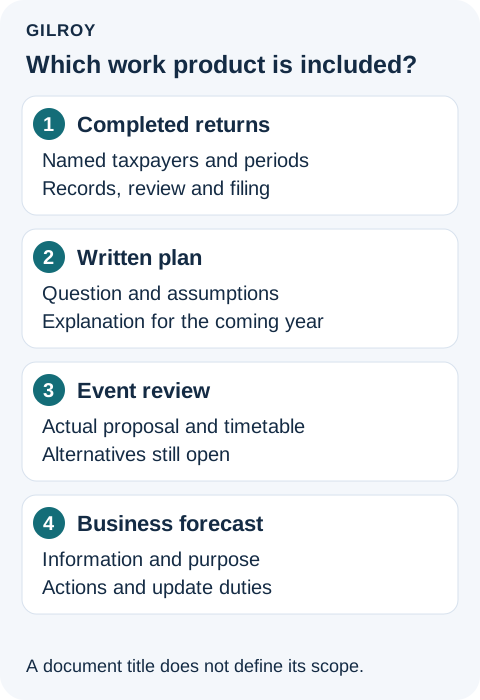
Before purchasing business tax planning in Gilroy, ask what you will receive and which decision it will help you make. A written plan, a review of a proposed transaction and a business forecast can involve different analysis. Establish the assignment before comparing the fee.
The work needed determines the engagement. Ordinary personal or business preparation can be appropriate without an income minimum or an additional planning project. Keep company sales, profit, asset values and personal income distinct when describing the assignment.
Compare Gilroy planning offers by the promised work product
Three Gilroy practice descriptions provide useful starting points. These are attributed public descriptions, not rankings, verified FSI partners or confirmation that a provider can accept your work.
The Art of Taxes describes planning that includes a physical copy of a plan for the coming year. Its separate quote page describes different billing approaches for returns, accounting and planning.[1][2] Ask what the plan analyzes, whose position it covers and which further work needs approval. Confirm current terms directly; this guide does not quote its advertised rates.
Vanni & Humphrey describes planning around particular events, including business openings or closures, rental-property activity and the disposal of appreciated assets.[3] If an event is approaching, identify the question the reviewer will answer and the explanation you will retain. A list of possible events does not establish a tax result for yours.
Blaettler Accountancy describes tax planning, estate and trust planning, and representation. Its business-consulting page separately describes financial projections and models for established businesses.[4][5] Ask whether you need a tax assessment, a business forecast or both, and which output the proposed fee purchases.
These distinctions make the comparison practical: give each provider the same decision and ask it to identify the work product it will deliver.
Agree what the written plan will let you decide
A document is useful when you can understand its question, supporting facts and limitations. Before authorizing the review, explain the owner and entities involved, the period under discussion and any action already committed to. Separate those facts from possibilities still being considered.
Ask the professional to describe the proposed output in concrete terms:
| Part of the plan | What you should be able to identify |
|---|---|
| Question | The actual business or owner decision being assessed |
| Starting position | The records, taxpayers and period used for the review |
| Assumptions | Confirmed facts, estimates and information still missing |
| Alternatives | The relevant options the professional has agreed to examine |
| Explanation | What the findings mean for the decision and where further advice is needed |
| Follow-through | Agreed actions, responsible people and work outside the engagement |
The review should explain why its conclusions apply to your circumstances. A strategy name or an attractive savings headline cannot supply that explanation.
What if important facts remain unresolved?
Ask the reviewer to identify which conclusions depend on them. For example, proposed terms may still be under negotiation, or the latest accounts may need clarification. Establish what can usefully be assessed now and what must be revisited when the information arrives. Missing facts should remain visible in the work product.
Separate the planning quote from returns and accounting
The Art of Taxes' quote page illustrates why the billing basis matters: it describes returns by forms, accounting by transactions and planning by time.[2] Those are website observations, not current quotes or a rule for how another firm charges.
Ask what the proposed planning fee includes. Which owner and entity records will be examined? Is the written explanation included? How are additional research, revised assumptions or another meeting approved? If time is charged, request the expected scope and the process for discussing work beyond it.
Does a planning fee include annual tax returns?
Establish that separately. Identify the returns and taxpayers covered, any accounting work required first and the fees or terms for each assignment. A provider can offer planning and preparation while accepting a different combination for your engagement. The written scope should make that combination clear.
Assign the steps after the recommendation
Receiving a plan does not show that its proposed actions have happened. Ask which steps need your decision, which professional will carry them out and how completion will be confirmed.
If an attorney, existing preparer or another adviser must contribute, identify that responsibility before relying on a proposed timetable. Ask which documents or instructions they need and who checks that the eventual action agrees with the facts reviewed. A planning fee should not be assumed to include every legal, accounting or filing task.
Keep the explanation and outstanding actions together. If circumstances change later, the responsible reviewer needs to know which assumptions were used and what was actually completed. Agree when an update becomes a separate assignment.
Check the professional and describe your Gilroy needs
For a California CPA or firm, use the California Board of Accountancy's lookup and check the correct identity and current authorization. Read the actual status and any restrictions in context.[6] For an enrolled agent, the IRS directs status-verification requests through its Office of Enrollment form.[8]
The IRS explains that CPAs, enrolled agents and attorneys have unlimited representation rights before the IRS.[7] Those rights do not establish experience with your particular business decision. Ask who will prepare and review the analysis and how their experience fits the assignment.
Describe your ownership, annual personal pretax income, existing professional support and the question you need reviewed. Begin with that summary and agree a secure process before sharing sensitive records. An inquiry does not confirm a firm, appointment or fee.
Related information: California business tax planning resource.
Sources
- The Art of Taxes: services.
- The Art of Taxes: quote and service information. The page includes older form and rate references; confirm current terms. No listed prices are adopted here.
- Vanni & Humphrey: tax planning.
- Blaettler Accountancy: tax services.
- Blaettler Accountancy: business consulting.
- California Board of Accountancy: license search information.
- IRS: preparer credentials and qualifications.
- IRS: verify enrolled-agent status.
Sources checked October 30, 2026. General professional-selection information; practice descriptions are not tax authority, independent credential checks or confirmation of capacity.