
Tax preparation in Fremont for individuals and businesses
Fremont personal tax preparation starts with the year, household income sources and federal, California and other-state returns. Explain moves, places where work was performed and missing or corrected statements before comparing fees. A household with wages or retirement income can seek preparation without a distributed business or a residency-planning project.
For business preparation, identify the actual tax classification, owners, period and records, including activities performed away from the business base. Ask who reconciles the accounts, supplies final owner information and confirms the returns the engagement accepts. A review of new activities that could change the filing footprint is different from preparing an already agreed set of returns.
Keep personal residency, business tax exposure and municipal registration distinct. Give each reviewer the relevant facts and ask what conclusion or additional information the return preparer needs. A home-business registration label or mailing address does not replace that handoff.
Choose the filing service that fits your return
Compare paid preparation with any official filing option that fits the entire return. CalFile is a California state-return service, with year-specific eligibility and form restrictions; it does not complete federal filing. Business or rental activity needs particular care when checking its qualifications. The California individual preparation guide explains the supported-year and eligibility limits, including the dated 2025 rules. Do not assume a new filing season is already supported.
For paid help in Fremont, compare how records, questions and draft review will be handled, whether remotely or through an agreed meeting. Use the California credential checks for the professional's actual category and authorization. An advertised service is not confirmation of experience with your return or current availability.
Know when the filing work is complete
Agree a secure document route and a list of missing information. Identify who prepares and reviews the return, how you check the draft and authorize submission, and how each federal and state filing status is reported. Ask who handles a rejection and what remains your responsibility. Keep final copies and payment instructions; submitting a return and paying a balance are separate steps. Later amendments, notices and new planning questions should have an explicit scope.
For company-specific filing responsibilities, use the California business preparation guide. If the immediate problem is an agency letter, the California notice-help guide separates the agency, period, deadline and response assignment.
Business tax planning in Fremont for a distributed service business
The owner may work at home, the team may work elsewhere and clients may receive services in several places. Choose Fremont tax advice that separates those facts rather than treating one address as the whole business. Ask which jurisdictions, taxpayers and tax types the proposed professional review will cover.
A business may need preparation for established filings or a separate review of a changed activity or location. Describe the actual scope without a minimum personal-income requirement. Revenue, profit and company value are different from the owner's income. This guide does not decide nexus, residency or a filing obligation.
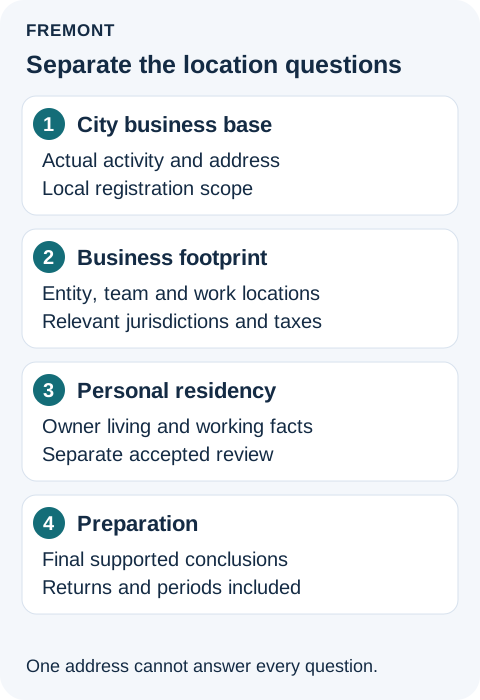
Separate three location questions
Municipal business base: which City operating or registration process applies to the actual activity and address?
Business tax footprint: which entities, activities and jurisdictions need review for the relevant income, payroll or transaction taxes?
Owner residence and personal position: what facts and income belong in the owner's separate assignment?
Those questions can involve overlapping evidence without sharing one answer. The FTB's business guidance considers activity, organization or commercial domicile and sales, property or payroll tests, and identifies potential apportionment and allocation issues for income inside and outside California. [1] Its personal residency guidance uses different concepts, including presence or domicile and temporary or transitory purpose, and says further factors matter. [2]
Ask the professional to identify the actual tests and evidence in scope. A City home-business classification does not establish the owner-residence conclusion or settle another state's business rules. No prior-year numerical threshold or simple day-count rule is supplied here.
Give the reviewer a factual operating map
Describe the entities, ownership, places where work is performed, relevant property, team arrangements, customer and contract facts, and proposed changes. Include how services are delivered and where records are held. Identify any facts that are estimates rather than settled arrangements.
For the owner assignment, explain the relevant living and working arrangements and other income to the appropriate adviser. For payroll or worker questions, ask which jurisdiction-specific specialist is needed. Do not assume the person preparing an income-tax return has been engaged for every employment or transaction-tax issue.
The useful map is not a public list of private addresses. Supply detailed documents through an agreed secure process. In a general inquiry, describe the business model, jurisdictions and decision timing without disclosing account access or sensitive identifiers.
Compare a known-return service with a footprint review
One proposal may prepare a set of returns you already identify. Another may also evaluate activities that could change that set. Ask the firm to state the difference, the information needed and the written conclusions it will provide.
For a proposed move or new offsite activity, request a review tied to the actual facts and effective dates. What changes for each relevant taxpayer or tax type? Which questions remain unresolved? Which conclusions need another state's adviser or legal counsel? The output should identify the action, responsible person and trigger for a later review.
An unexplained statement that the firm handles “all states” is not the same as evaluating your footprint. Conversely, a focused specialist review may be useful without replacing your current preparer if the information handover is clear.
Test a move proposal by asking what must be refreshed
If the owner or team changes location, ask which facts from the existing review remain valid. A new mailing address alone does not describe the operating activities, agreements or owner's circumstances. Ask the adviser to distinguish continuing facts from assumptions that need new evidence.
The written output should make the reviewed arrangement and conditions understandable. If an important question cannot yet be answered, it should say what information or specialist input is missing. A forecast can incorporate an assumption, but should not present that assumption as a completed jurisdiction conclusion.
After the review, ask who updates the relevant registrations, calculations, accounting records and returns within the agreed scope. Identify separate payroll, legal or transaction-tax work. This turns a move discussion into an accountable plan rather than a list of states.
Keep current-year owner advice connected
Ask whether the relevant personal and business forecasts reflect the reviewed operating facts. IRS estimated-tax guidance uses expected income and other tax inputs and calls for adjustment when circumstances change. [3] A location review and a personal payment calculation may be separate assignments, but their inputs must be coordinated if both are needed.
Compare the owner and entity coverage, who supplies reliable accounts and who reviews the conclusion. If a different professional prepares the return, agree how final findings and changed assumptions reach them. A tax-planning strategy list cannot replace an accurate description of where and how the business operates.
Apply Fremont's home-business definition only to its own process
The City's guidance says a Fremont business without a commercial or industrial location is considered home based even when work or services are performed elsewhere. It describes a Business Tax Application and Home Occupation Permit for registration at a residential location. [4]
For an offsite service business, confirm the actual City requirements rather than assume that no client visits means no home-business process. Assign the local account separately. This municipal definition does not establish a federal home-use deduction or determine state sourcing and personal residency.
Choose the people and coordination you need
Verify claimed California CPA status through the CBA lookup or enrolled-agent status through the IRS process. [5][6] Then ask about the assigned reviewer's experience with the relevant business model, jurisdictions and owner facts.
Confirm the deliverables, reviewer, fee basis, exclusions and capacity for the decision date. Ask who coordinates specialist conclusions and who checks implementation. The proposal should help you see both the work accepted and the questions that remain outside it.
Verify a California tax professional
Questions before choosing Fremont tax advice
Does a home-based City classification settle personal residency?
No. The City process and the FTB's personal residency guidance address different questions. [2][4] Give the relevant professional the actual owner circumstances and ask for the applicable review, without inferring the result from a registration label.
Does multistate preparation include checking new activities?
Ask whether the quote prepares a known set of returns or evaluates activities that may change the filing and payment position. Identify the taxpayers, jurisdictions, periods, evidence and implementation responsibility. The service names alone do not establish that scope.
What should a move review deliver?
A documented description of the facts reviewed, relevant conclusions and assumptions, unresolved questions and assigned actions. Ask which changes require another review and how findings reach the owner plan and return preparer. Do not treat a new address as proof that every tax question has been resolved.
Sources
[1] California Franchise Tax Board. Doing business in California. General scope only; no prior-year thresholds adopted.
[2] California Franchise Tax Board. Residents. General residency concepts and further-factor boundary; no individual determination.
[3] Internal Revenue Service. Estimated taxes.
[4] City of Fremont. Home-business guidance. Confirm current requirements for the actual activity.
[5] California Board of Accountancy. License lookup.
[6] Internal Revenue Service. Verify the status of an enrolled agent.